


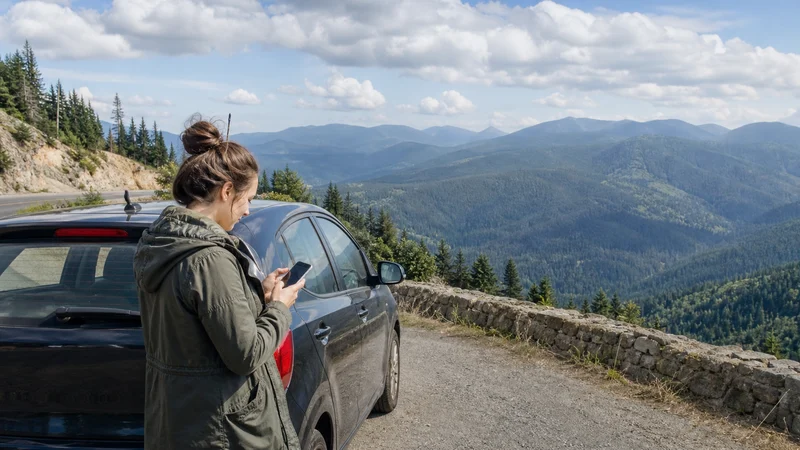

Romania eSIM coverage depends on the local partner network, the exact location and the traveller’s device. Strong service in a city centre does not guarantee the same result inside a rural guesthouse, railway cutting or Carpathian valley.
ANCOM’s Aisemnal platform provides measured Romanian mobile-signal information, while individual operators publish their own current maps. Neither source can predict indoor reception or congestion at one moment, so use coverage maps for preparation rather than as a guarantee.
NoveSIM travel eSIMs provide data only. We do not provide a Romanian number, conventional calls or SMS. Check the purchased plan to see which Romanian partner network and technologies it supports.
Quick answer: Expect the most consistent Romania eSIM experience in populated areas and more variation on mountain, forest and remote-road sections. Verify the plan’s partner network, check important stops on current maps and download the route before leaving a connected town.
Top Romania eSIMs

Romania eSIM
Fixed
1 GB, 7 days€ 2.202 GB, 15 days€ 3.963 GB, 30 days€ 4.84Unlimited
Unlimited, 1 day€ 2.20Unlimited, 3 days€ 5.28Unlimited, 5 days€ 7.93
Balkans eSIM
Fixed
1 GB, 7 days€ 4.402 GB, 15 days€ 7.053 GB, 30 days€ 9.25Unlimited
Unlimited, 1 day€ 4.84Unlimited, 3 days€ 11.01Unlimited, 5 days€ 17.17Europe Extra eSIM
Fixed
1 GB, 7 days€ 2.202 GB, 15 days€ 3.523 GB, 30 days€ 4.40Unlimited
Unlimited, 1 day€ 2.64Unlimited, 3 days€ 5.28Unlimited, 5 days€ 8.81Europe+ eSIM
Fixed
1 GB, 7 days€ 2.642 GB, 15 days€ 3.963 GB, 30 days€ 5.28Unlimited
Unlimited, 1 day€ 2.64Unlimited, 3 days€ 6.16Unlimited, 5 days€ 10.13Europe Lite eSIM
Fixed
1 GB, 7 days€ 2.202 GB, 15 days€ 3.523 GB, 30 days€ 4.40Unlimited
Unlimited, 1 day€ 2.64Unlimited, 3 days€ 5.28Unlimited, 5 days€ 8.81Start with the plan’s partner network
A travel eSIM does not create its own radio coverage. It connects through one or more local partners authorised by the plan. Confirm the supported network before comparing coverage, because a strong map for an unavailable operator does not help that eSIM.
The Romania mobile-networks guide explains the current Orange, Digi and Vodafone landscape. Do not rely on older comparisons that still treat the former Telekom operation as an unchanged separate choice.
Use maps at the level of the itinerary
| Trip section | What to inspect | Offline preparation |
|---|---|---|
| City stay | Accommodation and key transport areas | Hotel address and first route |
| Intercity journey | Corridor between endpoints | Ticket, timetable and destination map |
| Mountain or park visit | Gateway, valley and trail approach | Outdoor map and route details |
| Border region | Romanian signal and roaming-risk area | Correct network and next-country plan |
Aisemnal includes measured signal information and identifies areas where accidental roaming can occur. Operator maps can provide additional current planning detail, but conditions inside buildings and moving vehicles remain variable.
Cities still have local weak spots
Bucharest, Cluj-Napoca, Timișoara, Brașov and other populated areas generally offer more infrastructure than remote terrain. Even there, thick walls, underground spaces, crowded venues and temporary faults can affect performance.
A phone changing from 5G to 4G is not automatically a coverage failure. The Romania 5G guide explains why stable 4G remains suitable for most travel tasks.
Plan Black Sea coast coverage by location
Constanța and the larger Black Sea resorts are populated coastal areas, but reception can still vary inside hotels, beach buildings and crowded summer venues. Check the plan’s Romanian partner network at the exact accommodation rather than treating the entire coast as one coverage zone.
For Mamaia or a journey farther along the coast, download the hotel address, tickets and the next route before departure. Seasonal congestion can affect performance even when the phone shows a strong signal, while less developed stretches require the same offline preparation as other rural routes.
Trains and roads cross several radio environments
A journey can pass through towns, open land, cuttings, tunnels and forest in a short period. Expect the phone to change cells and occasionally lose data. Store the ticket and destination details before departure rather than waiting for a weak section.
Use the Romania train-connectivity guide or Romania road-trip guide for the relevant preparation.
Mountain and protected areas require an offline plan
Terrain can obstruct radio signals even when a nearby town has service. A connection at a park entrance does not prove that the trail is covered. Download a suitable map and keep an independent safety plan.
The national-parks guide covers outdoor preparation, while the remote-villages guide addresses accommodation and access away from larger settlements.
Keep network selection automatic
- Install and label the eSIM before travelling.
- Select it as the data line when the plan should be used.
- Apply the roaming setting required by the plan.
- Leave network selection automatic.
- Allow registration time after landing or crossing a border.
- Use manual selection only if troubleshooting is necessary.
If service fails, use the Romania manual-selection guide. Select only a network permitted by the plan and do not delete the installed eSIM.
Related Articles
- Best eSIM for Romania Travel
- Slow Mobile Data in Romania
- Romania Hiking Mobile Internet
- Mobile Data in Romania
FAQ
Does a Romania eSIM work everywhere in the country?
No mobile plan can guarantee service everywhere. Coverage varies with the partner network, terrain, buildings, capacity and device.
Which map should I use for Romania coverage?
Use ANCOM’s measured Aisemnal map and the current map of the plan’s partner network. Check the date and technology represented.
Why does coverage disappear on a Romanian train?
Moving trains cross changing cells, terrain, tunnels and cuttings. Short data interruptions can occur even between connected cities.
Should I manually choose a Romanian network?
Begin with automatic selection. Use manual selection only for troubleshooting and only with networks supported by the plan.
Final Recommendation
Assess Romania eSIM coverage through the actual partner network and itinerary. Check the places and corridors that matter instead of relying on a national adjective.
Keep automatic network selection enabled and retain the installed profile. A change between 5G and 4G is normal when data continues to work.
Download maps, tickets and accommodation details before mountain, rail or remote travel. Coverage planning is most useful when it includes a workable offline alternative.