


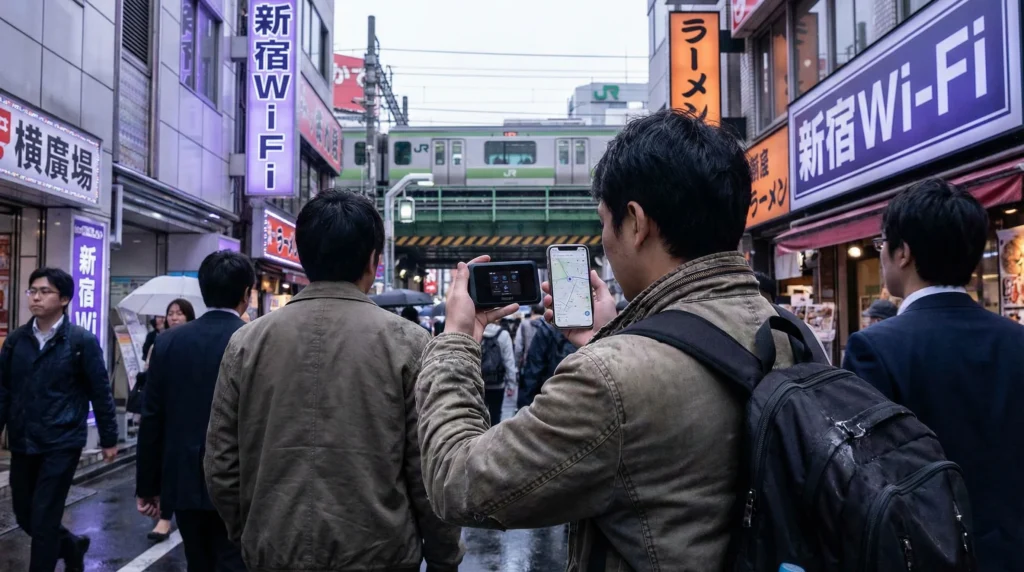

Pocket WiFi vs eSIM in Japan is mainly a choice between one shared router and a connection installed directly on each phone. An eSIM normally suits one independent traveller, while pocket WiFi can suit a group that stays together.
The comparison changes when travellers separate, need different travel days or rely on a connection for rail tickets and navigation. A shared router helps only the people close enough to connect to it.
NoveSIM travel eSIMs are data-only. They support internet applications but do not provide a Japanese phone number or traditional calls and SMS.
Quick answer: Choose an eSIM for individual mobility, pre-travel installation and fewer devices to carry. Choose pocket WiFi when several people will remain together, their phones cannot use eSIM, and someone can manage collection, charging and return.
Top Japan eSIMs


How does pocket WiFi vs eSIM in Japan compare?
| Consideration | eSIM | Pocket WiFi |
|---|---|---|
| Equipment | Installed on the phone | Separate router and charger |
| Group use | One plan per device or hotspot | Several nearby devices can share |
| When people separate | Each connected phone remains online | Only the router carrier stays connected |
| Arrival | Can be prepared before travel | May require collection or delivery |
| Departure | No equipment return | Router normally must be returned |
Which option suits one traveller?
An eSIM is usually simpler for one person with an unlocked compatible phone. It removes collection and return arrangements and keeps the connection with the device used for maps, bookings and messages.
Compare validity, data and hotspot terms in the Japan eSIM guide. Network and 4G or 5G access depend on the plan, device and local coverage.
Which option suits a family or group?
Pocket WiFi may be economical when everyone follows the same itinerary. It becomes less practical when people split up, because travellers without the router lose access.
Separate phone plans provide independence but may cost more in total. A phone hotspot can share an eSIM connection when supported, although it increases battery and data use.
What should you include in the total price?
- Data allowance and fair-use or daily high-speed limits.
- Hotspot or connected-device restrictions.
- Collection, delivery and late-return charges.
- Damage or loss fees for rented equipment.
- Whether validity covers arrival and departure.
Estimate shared consumption with the Japan data-use guide.
What should you prepare before arrival?
For eSIM, confirm compatibility and follow the Japan installation steps on reliable Wi-Fi. For pocket WiFi, save the collection point, opening hours, reservation and return procedure offline.
Airport arrangements differ. Review the relevant guide for Narita, Haneda or Kansai.
What happens if the connection fails?
With pocket WiFi, check router power, signal and connected devices. With NoveSIM, confirm the data line, roaming and data.esim APN. Keep the eSIM installed and use the Japan troubleshooting guide.
Related Articles
FAQ
Is pocket WiFi cheaper than an eSIM?
It can be for a group sharing one router. Compare total rental and return costs with the required individual plans.
Can an eSIM share data with a family?
Yes when the plan and phone support hotspot use. Check the terms and battery demand.
Does pocket WiFi work when the group separates?
Only devices close to the router remain connected. Separate phone connections suit independent itineraries.
Do I need to return an eSIM?
No. An eSIM is digital, while rented pocket WiFi normally has a return deadline.
Final Recommendation
In the pocket WiFi vs eSIM in Japan decision, choose eSIM for independent movement and pocket WiFi for a group that stays together.
Compare the complete price, data policy, battery requirements and collection and return logistics.
Keep offline copies of essential tickets and addresses whichever option you select.