


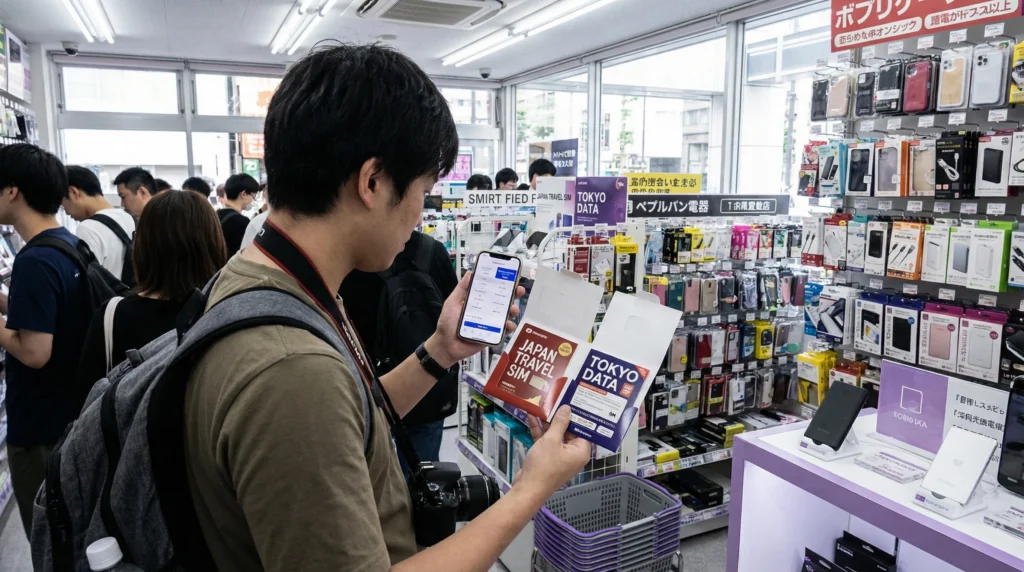

The best SIM card for Japan depends first on your phone. An eSIM is usually more convenient when the device is unlocked and compatible; a physical prepaid SIM is the practical alternative when eSIM is unavailable.
Compare the full cost, data allowance, validity, network access and whether the service includes a Japanese number. Many tourist products, including NoveSIM travel eSIMs, are data-only.
A data-only plan still supports WhatsApp, iMessage, email, maps and internet calls. It does not provide traditional Japanese voice calls or SMS unless the selected product explicitly says otherwise.
Quick answer: Choose an eSIM when you want to install before departure and keep your primary SIM in the phone. Choose a physical prepaid SIM when the phone lacks eSIM support or you specifically need a product whose included services are only available on a physical SIM.
Top Japan eSIMs


How do you choose the best SIM card for Japan?
| Point | Travel eSIM | Physical prepaid SIM |
|---|---|---|
| Installation | Digital profile | Inserted into SIM tray |
| Purchase timing | Can be arranged before travel | Delivered or purchased locally |
| Primary SIM | Can remain installed on dual-SIM phones | May need to be removed on single-slot phones |
| Compatibility | Requires eSIM support and an unlocked device | Requires an unlocked device and correct SIM format |
| Phone number | Often data-only | Varies by product |
When is a physical prepaid SIM the better choice?
A physical SIM is appropriate when the phone does not support eSIM or when a specific prepaid product provides a service you genuinely require. Confirm whether identification, activation or collection conditions apply before relying on an airport or city purchase.
Keep the home SIM somewhere safe if it must be removed. Losing it can interrupt access to the usual number and account-verification messages.
When is an eSIM more convenient?
An eSIM avoids opening the SIM tray and can be installed before departure. On a compatible dual-SIM phone, the home line may remain available while the travel eSIM handles data.
Before choosing, compare the available plans in the Japan eSIM guide and confirm that the phone is unlocked. An eSIM does not bypass an operator lock.
Should you buy connectivity at the airport?
Airport purchase can work when you want help from a staffed counter, but stock, opening hours and queue times can affect the arrival. Buying and installing an eSIM before travel avoids making the airport your only setup opportunity.
Check the dedicated guides for Narita Airport connectivity, Haneda Airport connectivity and Kansai Airport connectivity.
How should you prepare a travel eSIM?
- Confirm eSIM compatibility and unlocked status.
- Select a plan whose data and validity cover the itinerary.
- Follow the Japan eSIM installation steps on reliable Wi-Fi.
- Label the travel line clearly.
- After arrival, select it for mobile data and follow its roaming instructions.
- Keep the primary SIM’s data roaming disabled unless intentionally using it.
If a NoveSIM eSIM requires manual APN entry, use data.esim. Keep the installed profile during troubleshooting unless support specifically instructs you to remove it.
How much data should the SIM include?
Choose by activity rather than by a generic daily figure. Maps and messages are light; streaming, video calls, uploads and hotspot use are heavier. Use the Japan data-planning guide to estimate an appropriate allowance.
Related Articles
- Mobile Internet Options in Japan
- Pocket WiFi vs eSIM in Japan
- Best Mobile Network in Japan for Tourists
- Japan Roaming Charges
FAQ
Can I buy a SIM card after arriving in Japan?
Yes, prepaid products may be available at airports and other retailers. Check service inclusion, compatibility, opening hours and activation requirements.
Does a tourist SIM include a Japanese number?
Not always. Many tourist SIM and eSIM plans are data-only, so verify the product details if a local number is essential.
Can I keep my usual number with an eSIM?
Usually yes on a dual-SIM phone. Keep the primary line active only as needed and disable its data roaming to control charges.
Is pocket WiFi better for a family?
It can be useful when everyone remains together, but the group depends on one charged device. Multiple phone-based plans provide more independence.
Final Recommendation
The best SIM card for Japan is an eSIM when the phone supports it and pre-travel installation is valuable. Use a physical prepaid SIM when device compatibility or a specific product feature makes it the better fit.
Verify what the plan actually includes, especially the phone-number status, validity, hotspot rules and activation trigger.
Whichever format you choose, prepare it before the first travel day and keep essential bookings available offline.