


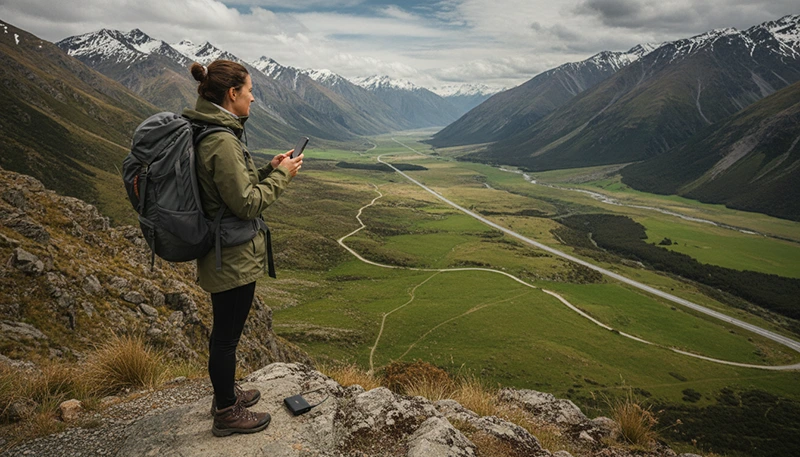

There is no single best New Zealand mobile network for every tourist itinerary. The right choice depends on the towns, roads and remote areas you will visit, plus the network access included with the selected SIM or eSIM plan.
Spark, One NZ and 2degrees serve the national market. Coverage in major cities is only part of the decision; rural drives and South Island routes require address- and route-level checks.
NoveSIM plans are data-only, and partner-network availability can change by plan. Always check the live plan details rather than assuming it uses a particular domestic operator.
Quick answer: Compare the current maps for your exact itinerary, confirm the partner network before buying and use a phone supporting New Zealand’s 4G bands, especially Band 28 for wider rural reach. Keep offline maps for sections where no operator guarantees reception.
Top New Zealand eSIMs

New Zealand eSIM
Fixed
1 GB, 7 days€ 2.222 GB, 15 days€ 3.993 GB, 30 days€ 5.32Unlimited
Unlimited, 1 day€ 2.66Unlimited, 3 days€ 6.66Unlimited, 5 days€ 10.65
Asia eSIM
Fixed
1 GB, 7 days€ 4.442 GB, 15 days€ 7.993 GB, 30 days€ 10.65Unlimited
Unlimited, 1 day€ 5.77Unlimited, 3 days€ 15.53Unlimited, 5 days€ 25.29How to Choose the Best Network in New Zealand for Tourists
| Check | Why it matters |
|---|---|
| Exact route | Population coverage does not describe every highway, valley or trailhead. |
| Partner network | A travel eSIM can use only the networks allowed by that plan. |
| Phone bands | An imported device may miss frequencies important outside cities. |
| Indoor use | Walls and building position can reduce a signal shown on an outdoor map. |
| Hotspot terms | Coverage alone does not confirm that laptop tethering is included. |
Spark, One NZ and 2degrees
Spark highlights broad national 4G and continuing 5G coverage. One NZ also publishes extensive 4G/5G coverage and advises checking individual locations. Both explain that their maps predict outdoor service rather than guaranteeing the experience at every point.
2degrees is another national option and should be checked against the same itinerary. Brand reputation is less useful than confirming the places where you will sleep, drive and work. A network that suits a city break may not be the strongest fit for a remote road trip.
North Island and South Island Travel
Urban North Island travel is generally easier to plan, but forested, coastal and central areas can still produce gaps. The South Island combines connected cities with longer mountainous and sparsely populated sections. For a South Island itinerary, see the dedicated network guide.
The New Zealand coverage guide explains rural, hiking and road-trip limitations without turning them into a claim that one operator works everywhere.
Device Compatibility
An unlocked phone must support the frequencies used by the selected network. Band 28 at 700 MHz is particularly important for broad 4G reach, while other 4G and 5G bands add capacity. Compatibility does not guarantee coverage, but missing an important band can reduce the service available to an imported device.
Choosing a Network Through a Travel eSIM
- Open the current plan details and identify the listed network access.
- Check that network’s map for every important stop.
- Confirm the phone is unlocked and compatible.
- Keep automatic network selection enabled after arrival.
- Download maps before remote travel.
For the wider plan decision, read the best eSIM for New Zealand guide. If connection settings fail despite known coverage, use the troubleshooting guide.
Related Articles
- Best internet option in New Zealand
- Best SIM card for New Zealand
- Best navigation apps for New Zealand
- How much data you need in New Zealand
FAQ
Which network has the best coverage in New Zealand?
No network is best at every location. Compare current maps for your actual route and verify which network the chosen plan can access.
Does the same network work on both islands?
National networks operate on both islands, but local reception varies with terrain, infrastructure and device compatibility.
Is Band 28 important?
Yes. Band 28 is important for broad 4G coverage, particularly outside dense urban areas.
Should I select a network manually?
Use automatic selection first. Manual selection is mainly a troubleshooting step when the current plan or support guidance identifies an allowed network.
Final Recommendation
The best network in New Zealand for tourists is the one verified for the actual itinerary, not the one with the broadest marketing claim.
Verify the live eSIM partner, coverage map and phone bands before paying.
For remote travel, combine mobile data with offline maps because even the strongest network can have gaps.