


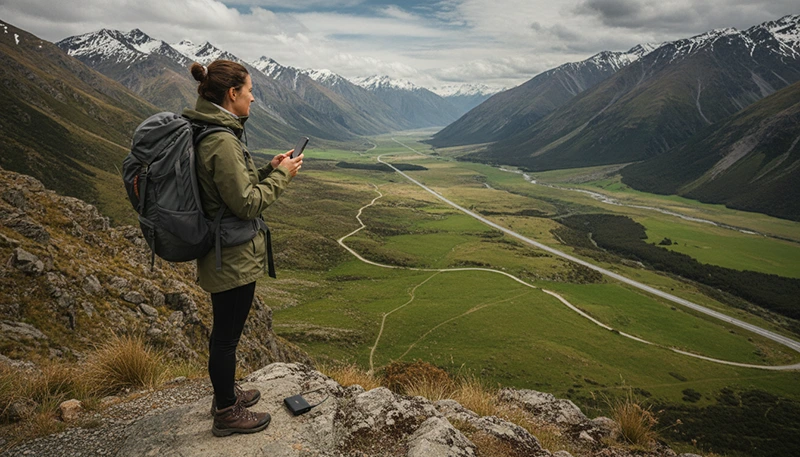

Choosing the best mobile network in New Zealand is important for travellers who need reliable internet for maps, bookings, WhatsApp, navigation and road trips. New Zealand has excellent mobile coverage in cities and popular tourist areas, but the differences between networks become more noticeable when travelling through rural regions, mountains and remote scenic routes.
The main mobile networks in New Zealand are Spark, One NZ and 2degrees. All three offer 4G coverage, with expanding 5G availability in populated areas.
Quick answer: Spark generally has the strongest overall coverage for travellers exploring cities, highways and rural areas. One NZ provides strong urban coverage and competitive speeds, while 2degrees is often a good value option in populated areas. For tourists, the best eSIM choice is usually a plan that connects through reliable local partner networks and matches your travel route.
Top New Zealand eSIMs

New Zealand eSIM
Fixed
1 GB, 7 days€ 2.182 GB, 15 days€ 3.933 GB, 30 days€ 5.24Unlimited
Unlimited, 1 day€ 2.62Unlimited, 3 days€ 6.54Unlimited, 5 days€ 10.47
Asia eSIM
Fixed
1 GB, 7 days€ 4.362 GB, 15 days€ 7.853 GB, 30 days€ 10.47Unlimited
Unlimited, 1 day€ 5.67Unlimited, 3 days€ 15.27Unlimited, 5 days€ 24.87Mobile Networks in New Zealand Overview
| Network | Best For | Tourist Experience |
|---|---|---|
| Spark | Overall coverage and rural travel | Strong choice for road trips and outdoor adventures |
| One NZ | Cities and popular destinations | Fast speeds and good urban performance |
| 2degrees | Budget-conscious travellers | Good value in populated regions |
1. Spark New Zealand: Best Overall Coverage for Tourists
Spark is often considered the strongest option for travellers who plan to explore beyond major cities.
It is particularly suitable for:
- New Zealand road trips.
- Campervan journeys.
- South Island exploration.
- National park visits.
- Outdoor adventures.
- Long-distance driving routes.
Tourists visiting destinations such as Queenstown, Milford Sound, Mount Cook, Franz Josef Glacier and remote scenic routes often prioritise coverage over maximum speed.
However, no network provides complete coverage everywhere. Mountains, valleys, forests and isolated areas can still have limited reception.
2. One NZ: Strong Urban Performance
One NZ (formerly Vodafone New Zealand) is another major network with strong performance in populated areas.
It is a good option for travellers spending time in:
- Auckland.
- Wellington.
- Christchurch.
- Hamilton.
- Tauranga.
- Popular tourist towns.
One NZ can provide excellent speeds in urban environments and areas with strong network availability.
For travellers mainly visiting cities and well-known attractions, the difference between Spark and One NZ may be less noticeable.
3. 2degrees: Good Value Network
2degrees is one of New Zealand’s major mobile operators and offers competitive pricing.
It can be suitable for travellers who:
- Spend most of their trip in cities.
- Need affordable mobile data.
- Travel mainly along popular routes.
- Do not require maximum rural coverage.
For extensive South Island road trips or remote adventures, travellers often prioritise the network with the widest practical coverage.
Which Network Is Best for a New Zealand Road Trip?
For campervan trips and scenic routes, coverage is usually more important than peak speed.
Popular road trip destinations include:
- Queenstown.
- Milford Sound.
- Fiordland National Park.
- Mount Cook.
- Lake Tekapo.
- Franz Josef Glacier.
- Tongariro National Park.
- Bay of Islands.
For these journeys, travellers usually prefer networks known for stronger coverage outside major cities.
| Travel Style | Recommended Network Priority |
|---|---|
| City holiday | Speed and price |
| Campervan trip | Coverage first |
| Hiking and adventure travel | Rural reception |
| Remote work trip | Stable connection in planned locations |
| Backpacking | Balance between coverage and cost |
Best Network for Auckland Tourists
Auckland has excellent mobile coverage across the city and surrounding areas.
Tourists visiting Auckland can generally expect good performance from all major networks.
Mobile internet is reliable for:
- Airport transfers.
- Maps and navigation.
- Restaurant bookings.
- Public transport information.
- Attraction tickets.
Best Network for Queenstown Tourists
Queenstown is one of New Zealand’s most visited destinations, but surrounding mountains can affect mobile reception.
Travellers exploring:
- Milford Sound.
- Glenorchy.
- Remarkables.
- Fiordland routes.
should prioritise coverage rather than only looking at advertised speeds.
Best Network for Wellington Tourists
Wellington has strong mobile coverage throughout the city and nearby attractions.
Travellers can comfortably use mobile data for:
- Navigation.
- Ride services.
- Messaging.
- Video calls.
- Travel planning.
Best Network for Christchurch Tourists
Christchurch offers excellent connectivity, making mobile data reliable for visitors exploring the city and nearby areas.
The challenge usually begins when travelling further into rural Canterbury, mountain regions or remote hiking areas.
Does a New Zealand eSIM Connect to the Best Network Automatically?
Most travel eSIMs connect automatically to available partner networks. The exact network depends on the eSIM provider, destination agreement and local availability.
Travellers normally do not need to manually choose a network.
Recommended settings:
- Network Selection: Automatic.
- Data Roaming: Enabled on travel eSIM.
- Mobile Data: Travel eSIM selected.
- Automatic Data Switching: Disabled.
Can You Manually Change Networks in New Zealand?
Yes, many phones allow manual network selection, but it is usually not recommended for tourists.
Automatic selection is normally better because:
- The phone can choose the strongest available network.
- You can move between regions without changing settings.
- You avoid selecting a weaker network accidentally.
Manual selection should mainly be used for troubleshooting.
Why Does My eSIM Have Slow Internet in New Zealand?
A slow connection does not always mean the network is poor.
Possible reasons include:
- Weak signal in a remote area.
- Network congestion.
- Indoor signal blockage.
- Mountain terrain.
- Background downloads.
- VPN usage.
- Hotspot sharing.
Try moving outdoors, restarting the phone and testing in another location.
Read the full guide for slow New Zealand eSIM connections.
4G vs 5G Networks in New Zealand
5G is available in many populated areas, but coverage depends on location, device compatibility and network availability.
For tourists:
| Usage | 4G | 5G |
|---|---|---|
| Maps | Excellent | Excellent |
| Excellent | Excellent | |
| Video calls | Good | Very good |
| Large downloads | Good | Faster when available |
A stable 4G connection is usually enough for normal travel needs.
Best Network Settings for Tourists Using eSIM
| Setting | Recommended Configuration |
|---|---|
| Mobile Data | New Zealand eSIM |
| Data Roaming | On for travel eSIM |
| Home SIM Roaming | Off |
| Network Selection | Automatic |
| APN | data.esim if required |
Tips for Staying Connected in New Zealand
- Download offline maps before remote trips.
- Save important travel documents offline.
- Carry a power bank during long drives.
- Do not rely on mobile coverage in isolated hiking areas.
- Test your eSIM before leaving cities.
- Keep your phone updated.
Related New Zealand Internet Guides
- New Zealand eSIM Plans
- Best eSIM for New Zealand
- Mobile Internet in New Zealand
- Internet for New Zealand Road Trip
- No Internet on New Zealand eSIM
FAQ
What is the best mobile network in New Zealand for tourists?
Spark is often preferred by travellers who need wider coverage, especially for road trips and rural areas. One NZ and 2degrees are also strong options in cities and popular destinations.
Which New Zealand network is best for a campervan trip?
Travellers usually prioritise the network with the strongest rural coverage because road trips often pass through areas with limited infrastructure.
Does a New Zealand eSIM choose the network automatically?
Yes. Most travel eSIMs automatically connect to an available partner network.
Should I manually select a network in New Zealand?
No. Keep Network Selection on Automatic unless troubleshooting a connection problem.
Does 5G work everywhere in New Zealand?
No. 5G availability depends on location, device compatibility and network coverage.
Which network is best for Milford Sound and Fiordland?
Coverage varies significantly in remote areas. Travellers should prepare offline maps and not rely on continuous mobile reception.
Final Recommendation
For most tourists visiting New Zealand, network choice should depend on the type of trip. City visitors can enjoy excellent service from all major operators, while road trippers, campervan travellers and outdoor adventurers should prioritise coverage.
Spark is often considered the safest choice for travellers exploring more remote parts of New Zealand, while One NZ and 2degrees provide strong alternatives, especially around cities and popular destinations.
When using a travel eSIM, the most important factors are not only the network name but also the provider’s local partnerships, coverage areas and correct phone configuration.