


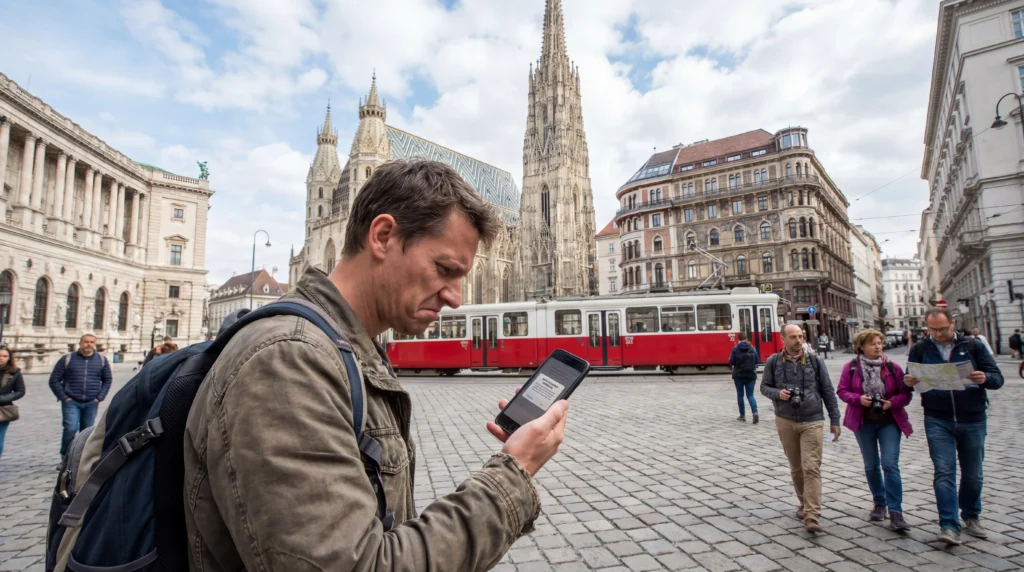

Roaming in Austria can be free or expensive depending on where you are traveling from.
If you are visiting Austria, you may be wondering whether roaming is free, how much mobile data costs, and how to avoid unexpected charges while using your phone abroad.
The answer depends mainly on your home mobile provider and whether you are traveling from the EU, UK, USA, Canada, Asia, Australia, or another non-EU country.
Quick Answer
- EU travelers: roaming in Austria is usually free under “Roam Like at Home”.
- Non-EU travelers: roaming can cost around $5–$12 per day or more, depending on your provider.
- Best alternative: use an Austria eSIM with fixed pricing.
Is Roaming Free in Austria?
Yes, roaming is usually free in Austria for EU travelers.
If you travel from another EU country, you can normally use your mobile plan in Austria the same way you use it at home. This is known as Roam Like at Home.
That means calls, SMS, and mobile data are usually included in your domestic plan while traveling inside the EU.
However, fair usage limits may apply. If your plan has limited data, very cheap unlimited data, or special restrictions, your operator may apply limits while roaming.
Roaming Charges for Non-EU Travelers
If you are traveling from outside the EU, roaming in Austria is usually not free.
Visitors from the USA, Canada, the UK, Asia, Australia, and other non-EU countries may pay daily roaming fees, international roaming bundles, or pay-as-you-go data rates.
- Daily roaming pass: often around $5–$12 per day
- Pay-as-you-go data: can become very expensive quickly
- Calls and SMS: may be charged at international rates
- Background apps: can use data without you noticing
This is why many travelers prefer to turn roaming off and use a travel eSIM instead.
How Much Does Data Roaming Cost in Austria?
| Traveler type | Typical roaming cost | Best option |
|---|---|---|
| EU traveler | Usually free within domestic plan | Use your existing plan |
| UK traveler | Depends on provider; roaming fees may apply | Check provider or use eSIM |
| USA / Canada traveler | Often daily pass or international roaming fee | Use Austria eSIM |
| Asia / Australia traveler | Often paid roaming or expensive pay-per-use data | Use Austria eSIM |
Data roaming costs can increase fast because maps, social media, messaging apps, email, cloud backups, and background updates use mobile data throughout the day.
Why Roaming Can Become Expensive
Roaming charges can surprise travelers because phones use mobile data even when you are not actively browsing.
- Google Maps and navigation use mobile data continuously
- Instagram, TikTok, and Facebook can auto-load videos
- WhatsApp, Messenger, and email sync in the background
- Cloud photo backup can use large amounts of data
- App updates may start automatically if mobile data is allowed
- Streaming and video calls can use data very quickly
Even a short trip to Austria can become expensive if your phone is using pay-as-you-go roaming.
Best Way to Avoid Roaming Charges in Austria
The easiest way to avoid roaming charges in Austria is to use a travel eSIM with fixed pricing.
An eSIM lets you use mobile data in Austria without replacing your physical SIM card. You can install it before your trip and activate it when you arrive.
Best eSIM for Austria
Avoid roaming fees and get mobile data in Austria with predictable pricing.
Most travelers choose 3–10 GB plans for trips to Vienna, Salzburg, Innsbruck, Graz, Hallstatt, and other destinations in Austria.
With NoveSIM, you get:
- Fixed pricing with no surprise roaming bill
- Instant eSIM delivery by email
- Easy setup with QR code or activation details
- No physical SIM card needed
- No airport queues or shop visits
- Works on eSIM-compatible phones
Top Austria eSIMs

Austria eSIM
Fixed
1 GB, 7 days2.00$2 GB, 15 days3.50$3 GB, 30 days4.50$Unlimited
Unlimited, 1 day2.50$Unlimited, 3 days6.00$Unlimited, 5 days9.50$
Europe Extra eSIM
Fixed
1 GB, 7 days2.50$2 GB, 15 days4.00$3 GB, 30 days5.00$Unlimited
Unlimited, 1 day3.00$Unlimited, 3 days6.00$Unlimited, 5 days10.00$Europe+ eSIM
Fixed
1 GB, 7 days3.00$2 GB, 15 days4.50$3 GB, 30 days6.00$Unlimited
Unlimited, 1 day3.00$Unlimited, 3 days7.00$Unlimited, 5 days11.50$Europe Lite eSIM
Fixed
1 GB, 7 days2.50$2 GB, 15 days4.00$3 GB, 30 days5.00$Unlimited
Unlimited, 1 day3.00$Unlimited, 3 days6.00$Unlimited, 5 days10.00$Roaming vs Local SIM vs eSIM in Austria
| Option | Cost | Convenience | Best for |
|---|---|---|---|
| Roaming | Free for many EU travelers, expensive for non-EU travelers | Very easy | EU travelers or short low-data use |
| Local SIM card | Usually predictable, but requires buying in person | Medium | Long stays or travelers needing a local number |
| eSIM | Fixed prepaid pricing | Very easy | Tourists who want instant mobile data |
Should You Turn Data Roaming Off in Austria?
If you are traveling from outside the EU, it is usually safer to turn data roaming off on your primary SIM.
This helps prevent unexpected charges from background data usage. You can then use WiFi or an Austria eSIM for mobile data.
If you are using an eSIM, remember that data roaming may need to be ON for the eSIM line, while roaming can stay OFF for your primary SIM.
How to Avoid a Surprise Roaming Bill
- Check your provider’s Austria roaming rates before travel
- Turn off data roaming on your primary SIM if fees apply
- Disable automatic app updates and cloud backups on mobile data
- Use WiFi for large downloads, video calls, and streaming
- Install an Austria eSIM before departure
- Select the eSIM for mobile data after arrival
- Keep your primary SIM active only if you need calls or SMS
Who Needs an Austria eSIM?
An Austria eSIM is especially useful if you are:
- traveling from outside the EU
- visiting Vienna, Salzburg, Innsbruck, Graz, Linz, Hallstatt, or Zell am See
- using Google Maps, WhatsApp, Uber, train apps, or booking apps
- posting on Instagram, TikTok, Facebook, or YouTube
- working remotely while traveling
- trying to avoid expensive roaming charges
- traveling between Austria and other European countries
View available plans here: Austria eSIM plans.
How Much Data Do You Need in Austria?
The right data plan depends on how long you stay and how you use your phone.
- 1–3 GB: maps, messaging, light browsing
- 5–10 GB: one-week trip, social media, daily travel apps
- 10 GB+: longer trips, remote work, video calls, heavy social media
For more help, read: How much data do you need for 7 days of travel?
Austria Travel Internet Tips
- Install your eSIM before your flight while you have stable WiFi
- Turn on data roaming only for your travel eSIM
- Select the eSIM as your mobile data line after arrival
- Keep your main SIM active if you want to receive SMS codes
- Use WiFi for large files, backups, and video calls when possible
Read also: When to install your eSIM before travel.
Useful Guides
- Austria eSIM plans
- SIM card Austria guide
- SIM card at Vienna Airport
- WiFi at Vienna Airport
- Best eSIM for Austria travel
- Europe eSIM plans
- eSIM vs roaming
- Local SIM vs eSIM
- Local SIM vs eSIM in Austria
- When to install your eSIM before travel
- What is an eSIM and how does it work?
- Check if your phone supports eSIM
- eSIM no internet after activation
- eSIM installed but not working after arrival
FAQ
Is roaming free in Austria?
Roaming is usually free in Austria for EU travelers under Roam Like at Home. Non-EU travelers may pay roaming fees depending on their mobile provider.
How much does roaming cost in Austria?
For EU travelers, roaming is usually included in the domestic plan. For non-EU travelers, roaming may cost around $5–$12 per day or more, depending on the provider.
Is roaming free in Vienna?
For EU travelers, roaming in Vienna is usually free under EU roaming rules. Non-EU visitors should check their provider’s rates or use an eSIM.
Should I use roaming or eSIM in Austria?
If you are from the EU and your plan includes roaming, your existing plan may be enough. If you are from outside the EU, an eSIM is usually safer and more predictable.
Can I avoid roaming charges with an eSIM?
Yes. You can turn off roaming on your primary SIM and use an Austria eSIM for mobile data with fixed prepaid pricing.
Should data roaming be on or off in Austria?
If your primary SIM has expensive roaming, turn data roaming off for that SIM. If you use a travel eSIM, data roaming may need to be on for the eSIM line.
Do I need an Austria eSIM if I am from the EU?
Usually no, unless your EU plan has limited roaming data, fair usage restrictions, or you want a separate travel data plan.
Can I keep my normal SIM active while using an Austria eSIM?
Yes. Most eSIM-compatible phones allow you to keep your main SIM active for calls and SMS while using the eSIM for mobile data.
Conclusion
If you are traveling from the EU, roaming in Austria is usually free within your domestic plan.
If you are traveling from outside the EU, roaming can be expensive and unpredictable, especially if your phone uses background data.
The safest and easiest option for non-EU travelers is to use an Austria eSIM with fixed pricing.