


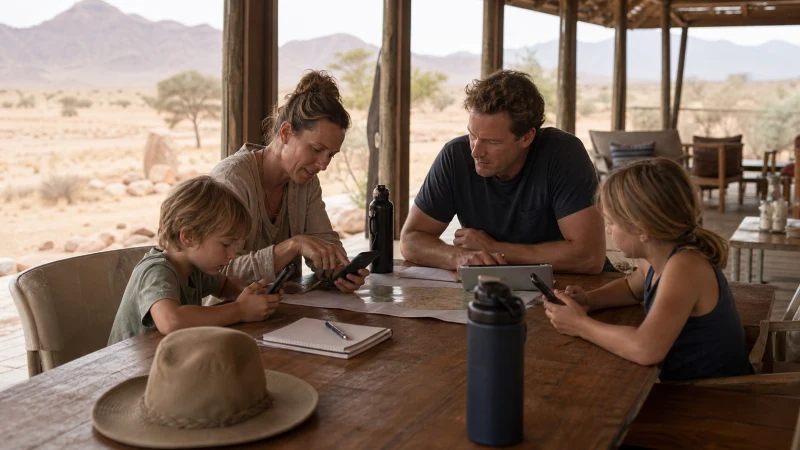

When looking at mobile internet for a family trip to Namibia, begin with shared devices, child safety, maps and data budgeting. Check the current plan and actual itinerary because mobile service can change from one stop to the next.
Most travellers need data for a few time-sensitive tasks: an airport transfer, a booking, navigation or a message. Save the fixed details offline before leaving a staffed or well-connected place.
The NoveSIM option provides travel data rather than a Namibian number, carrier calls or SMS. Performance depends on the plan, phone capabilities, partner access and local reception.
Quick answer: Keep maps, bookings and meeting details on more than one charged device. Control hotspot users and background downloads so the shared allowance remains available for the whole family.
Top Namibia eSIMs


Key checks for mobile internet for a family trip to Namibia
Decide which adult keeps booking references, offline maps and emergency contacts, and which devices may use the travel hotspot. Keep essential details on more than one charged phone so a flat battery or separated group does not remove the plan.
Prevent background use across shared devices
Tablets and children’s phones may begin app updates, photo uploads or video playback as soon as they join a hotspot. Disable automatic downloads, use offline entertainment and check the remaining allowance before a long family drive.
Keep pickup and meeting details offline
Save accommodation names, activity contacts and agreed meeting points outside messaging apps. A family group should know what to do when one device has no signal, particularly at airports, parks, lodges and roadside stops.
Balance hotspot use with battery life
Sharing data can be practical when the plan and phone support it, but the host phone uses more power and must stay near the group. Carry charging cables and a power bank, then disconnect idle devices after the needed task is complete.
Test the setup before it becomes urgent
Plan details can change, so confirm shared devices, child safety, maps and data budgeting on the Namibia eSIM product page. Keep Mobile Coverage in Rural Namibia: How to Prepare available for the next practical decision.
Before departure, compare the live plan with the needs that matter here: shared devices, child safety, maps and data budgeting. Read the high-speed allowance, validity period, activation rule and hotspot terms together rather than treating one feature in isolation. Confirm that the exact handset is unlocked and eSIM-compatible. Keep the installation details somewhere another device can display them. Current product information is more dependable than an old screenshot, a remembered description or a general promise about nationwide coverage.
- Confirm the exact handset is unlocked and supports eSIM.
- Keep the installation details private and available on another device.
- Download the first route, address and booking reference.
- Carry enough power for the longest planned transfer.
- Pause automatic updates, cloud backup and large media downloads.
Test the final mobile-data configuration
Use Does My Phone Support an eSIM for Namibia? to check the phone, then follow How to Install an eSIM for Namibia Before You Travel for the next setup stage. Give the two SIM lines clear names before changing mobile-data preferences.
- Confirm that the travel eSIM is visible and enabled.
- Select Travel as the Mobile Data line.
- Enable Data Roaming on Travel and keep it off on Primary unless home-carrier costs are understood.
- Disable automatic data switching.
- Allow Automatic Network Selection time to register.
- Use data.esim only when manual NoveSIM APN entry is required.
Diagnose one variable at a time
If mobile data stops, follow Namibia eSIM Not Working? Safe Troubleshooting Steps. Confirm the plan state, signal and selected data line before trying Airplane Mode or one normal restart, and leave the eSIM installed.
Note the location, phone model, network label and result of each safe check. This evidence is more useful to Support than several settings changed at once.
Run a useful test instead of a speed test
The best pre-travel check is a simple action that reflects the journey, not a measurement of maximum download speed. Run the check on mobile data and verify that the Travel profile is selected. Judge the result at the planned stop or transfer point rather than extrapolating from the strongest signal of the day. Save the fixed travel details locally and monitor the allowance after the practical check. If the connection does not support the task in Namibia, record the location and device state before contacting Support.
Related Articles
- Mobile Internet for a Namibia Road Trip
- Using Google Maps in Namibia Without Wasting Data
- Mobile Internet for Long-Distance Travel in Namibia
- Mobile Internet on Safari in Namibia
- Mobile Internet in Etosha National Park
- Mobile Internet Along Namibia’s Skeleton Coast
- Mobile Internet Around Sossusvlei and the Namib Desert
- Mobile Internet Beyond Lodge Wi-Fi in Namibia
- Namibia eSIM Coverage: Towns, Highways and Remote Routes
FAQ
What is the practical answer?
Keep maps, bookings and meeting details on more than one charged device. Control hotspot users and background downloads so the shared allowance remains available for the whole family.
Does a Namibia eSIM include a local number?
No. NoveSIM supplies mobile data but no Namibian number, ordinary voice minutes or carrier SMS. Messaging and internet-calling apps use the data connection.
Should Data Roaming be enabled?
Enable Data Roaming on the Namibia travel eSIM when partner access requires it. Keep roaming off on the primary line unless the home carrier’s charges are understood.
Should a non-working eSIM be deleted?
No. Preserve the installed profile and complete only reversible checks. If data still fails, give NoveSIM Support the phone model, location and visible network status.
Final Recommendation
Mobile internet for a family trip to Namibia should account for the number of devices, shared maps, child safety and realistic data use. Keep essential details on more than one charged phone.
Install the eSIM on a trusted connection, save the next route locally and test a normal online task in Namibia. Do not use that result to predict every remote stop.
Use the eSIM deliberately as the data line, monitor the allowance and preserve the profile if a fault occurs. Keep an offline alternative for reception gaps.