


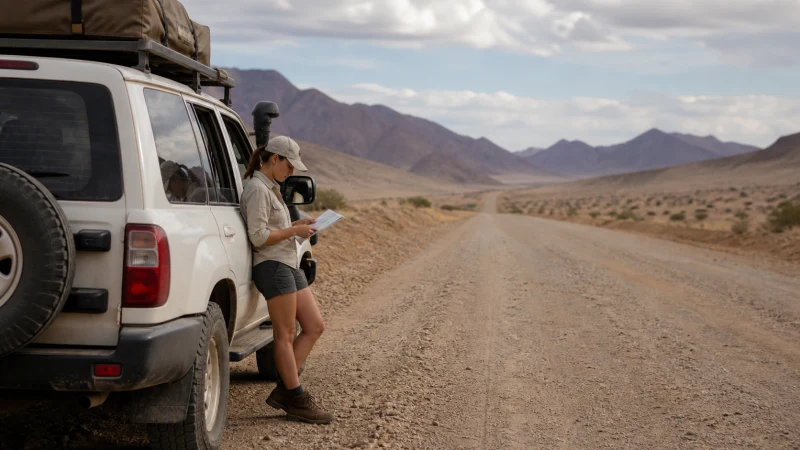

Mobile coverage in rural Namibia requires realistic expectations about long gaps, offline maps and emergency preparation. Give priority to the weakest important part of the itinerary, not the strongest signal seen in a city.
Start by saving anything that would be difficult to recover without data. The connection can then handle live changes without becoming the only copy of the travel plan.
NoveSIM’s Namibia plan is a data-only eSIM. Messaging and internet-calling apps work through data, but a local number and conventional mobile service are not included.
Quick answer: Treat mobile coverage in rural Namibia as intermittent outside connected settlements: download the route, save bookings and fuel information, carry power and never rely on mobile service for emergency access.
Top Namibia eSIMs


Offline preparation for mobile coverage in rural Namibia
Download the full route, save accommodation and activity contacts, record fuel stops and keep permits or booking references available without a signal. On remote routes, a coverage gap may last much longer than a brief network handover.
Treat reception as location-specific
Signal can change with terrain, distance, buildings, weather and the serving site. A connection at a lodge, camp or town does not establish continuous coverage for the next part of the route.
Protect battery and the remaining allowance
Pause cloud photo uploads, app updates and automatic video playback before remote travel. Keep a power bank charged and reserve enough data for route changes, messages and the return journey.
Keep safety planning independent of mobile service
Do not use mobile coverage as the only emergency plan. Share the route and expected arrival, follow local advice and carry the supplies appropriate to the drive or activity.
Confirm the handset and route together
Use the Namibia plan listing as the authority when checking long gaps, offline maps and emergency preparation. Then read Mobile Internet for a Namibia Road Trip for the related travel preparation.
Before departure, compare the live plan with the needs that matter here: long gaps, offline maps and emergency preparation. Read the high-speed allowance, validity period, activation rule and hotspot terms together rather than treating one feature in isolation. Confirm that the exact handset is unlocked and eSIM-compatible. Keep the installation details somewhere another device can display them. Current product information is more dependable than an old screenshot, a remembered description or a general promise about nationwide coverage.
- Confirm the exact handset is unlocked and supports eSIM.
- Keep the installation details private and available on another device.
- Download the first route, address and booking reference.
- Carry enough power for the longest planned transfer.
- Pause automatic updates, cloud backup and large media downloads.
Configure roaming on the correct profile
Read Does My Phone Support an eSIM for Namibia? before opening How to Install an eSIM for Namibia Before You Travel. Note which profile currently handles data before making a change.
- Confirm that the travel eSIM is visible and enabled.
- Select Travel as the Mobile Data line.
- Enable Data Roaming on Travel and keep it off on Primary unless home-carrier costs are understood.
- Disable automatic data switching.
- Allow Automatic Network Selection time to register.
- Use data.esim only when manual NoveSIM APN entry is required.
Escalate with useful device details
When service changes, consult Namibia eSIM Not Working? Safe Troubleshooting Steps. Do not erase the eSIM after one failed attempt; the existing profile and network state are useful diagnostic evidence.
Test one reversible change at a time and write down the result. This avoids masking the fault and keeps the recovery options open.
Check the connection before it becomes urgent
Choose one ordinary task that matters on the trip, such as opening the next booking, loading a saved route or sending a short message. Make sure the requested page is not merely a cached copy and that the phone is using Travel for data. Test in the relevant setting, because reception outdoors in town may not match a lodge room or an isolated route. Save the fixed travel details locally and monitor the allowance after the practical check. If it fails in Namibia, leave the eSIM installed and record the visible network, active line and error for Support.
Related Articles
- Using Google Maps in Namibia Without Wasting Data
- Mobile Internet for Long-Distance Travel in Namibia
- Mobile Internet on Safari in Namibia
- Mobile Internet in Etosha National Park
- Mobile Internet Along Namibia’s Skeleton Coast
- Mobile Internet Around Sossusvlei and the Namib Desert
- Mobile Internet Beyond Lodge Wi-Fi in Namibia
- Namibia eSIM Coverage: Towns, Highways and Remote Routes
- Mobile Networks in Namibia: A Visitor’s Guide
FAQ
What is the practical answer?
Treat mobile coverage in rural Namibia as intermittent outside connected settlements: download the route, save bookings and fuel information, carry power and never rely on mobile service for emergency access.
Does a Namibia eSIM include a local number?
No. NoveSIM supplies mobile data but no Namibian number, ordinary voice minutes or carrier SMS. Messaging and internet-calling apps use the data connection.
Should Data Roaming be enabled?
Enable Data Roaming on the Namibia travel eSIM when partner access requires it. Keep roaming off on the primary line unless the home carrier’s charges are understood.
Should a non-working eSIM be deleted?
No. Preserve the installed profile and complete only reversible checks. If data still fails, give NoveSIM Support the phone model, location and visible network status.
Final Recommendation
The dependable approach to mobile coverage in rural Namibia is the one that fits the real itinerary. Close to departure, confirm the plan’s validity, allowance and supported features.
Prepare the line on dependable Wi-Fi, store essential information offline and test a normal webpage before departure. Reception can still differ between towns, buildings and remote parts of Namibia.
Select Travel for Mobile Data, prevent automatic fallback to the home SIM and retain the installed profile during troubleshooting. These steps make the connection easier to manage without overstating coverage.