


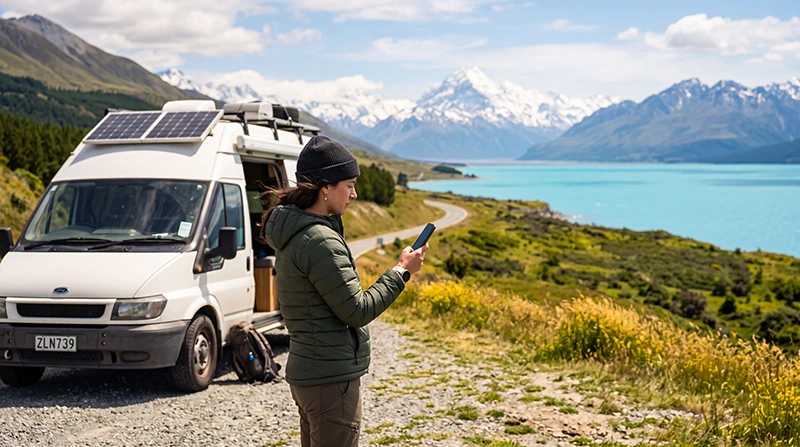

Reliable mobile internet is extremely useful when travelling around New Zealand. Visitors use it for driving directions, accommodation bookings, weather forecasts, activity confirmations, ferry information, messaging and emergency communication.
Tourists can connect through a travel eSIM, a local prepaid SIM card, international roaming or public WiFi. The best option depends on your phone, trip length, itinerary and whether you need a New Zealand telephone number.
Quick answer: a travel eSIM is usually the easiest option for visitors who mainly need mobile data. A local prepaid SIM may be better for a longer stay or when traditional calls and a New Zealand number are important.
Top New Zealand eSIMs

New Zealand eSIM
Fixed
1 GB, 7 days2.50$2 GB, 15 days4.50$3 GB, 30 days6.00$Unlimited
Unlimited, 1 day3.00$Unlimited, 3 days7.50$Unlimited, 5 days12.00$
Asia eSIM
Fixed
1 GB, 7 days5.00$2 GB, 15 days9.00$3 GB, 30 days12.00$Unlimited
Unlimited, 1 day6.50$Unlimited, 3 days17.50$Unlimited, 5 days28.50$How Can Tourists Get Mobile Internet in New Zealand?
Travellers generally have four practical connectivity options.
| Option | Best For |
|---|---|
| Travel eSIM | Visitors who want mobile data arranged before departure |
| Local prepaid SIM | Longer stays or travellers who need a local number |
| International roaming | Short visits when home-operator charges are reasonable |
| Public WiFi | Occasional backup rather than primary connectivity |
Travel eSIM for New Zealand
A travel eSIM is installed digitally without inserting a physical card. It can usually be purchased and installed before departure while you have reliable WiFi.
Advantages include:
- No need to visit a mobile shop after arrival.
- No physical SIM card to remove or lose.
- Your regular SIM can remain installed.
- Mobile data can be available shortly after landing.
- Regional plans may cover Australia and New Zealand together.
- WhatsApp can keep its existing number.
Browse New Zealand eSIM plans.
Local Prepaid SIM Card
A local prepaid SIM is a physical card purchased after arrival. It may include mobile data, calls, SMS and a New Zealand telephone number.
A physical SIM may be suitable when:
- You need a local telephone number.
- You want traditional calls and SMS.
- Your phone does not support eSIM.
- You are staying for several weeks or months.
- You prefer local top-up options.
Check whether the starter pack already includes a data bundle or requires an additional purchase.
International Roaming
Your home operator may offer a daily pass, travel package or pay-as-you-go roaming in New Zealand.
Before using it, confirm:
- The daily or package price.
- The included data allowance.
- Charges for incoming and outgoing calls.
- Whether reduced speeds apply after a limit.
- Whether the pass activates automatically.
- The total cost for the complete trip.
A daily fee can be convenient for a short stop, but expensive over a two-week road trip.
Read the New Zealand roaming charges guide.
Travel eSIM vs Local SIM vs Roaming
| Feature | Travel eSIM | Local SIM | Roaming |
|---|---|---|---|
| Purchase before travel | Yes | Usually no | Usually already available |
| Physical card required | No | Yes | No new card |
| Local phone number | Usually no | Often yes | Uses home number |
| Primary SIM can remain installed | Yes | Depends on the phone | Yes |
| Predictable data cost | Usually | Usually | Depends on the operator |
| Best for short data-focused trips | Yes | Sometimes | Only when reasonably priced |
How Much Mobile Data Do You Need?
| Trip Length | Light Use | Typical Use | Heavy Use |
|---|---|---|---|
| 1 to 3 days | 1 GB | 2 GB to 3 GB | 5 GB or more |
| 4 to 7 days | 3 GB | 5 GB to 10 GB | 15 GB or more |
| 8 to 14 days | 5 GB | 10 GB to 20 GB | Large allowance |
| 15 to 30 days | 10 GB | 20 GB to 30 GB | Large allowance or unlimited option |
Maps, messaging and travel searches normally use much less data than video streaming, cloud backups, social media uploads and hotspot sharing.
Mobile Internet for a New Zealand Road Trip
Road-trip travellers rely heavily on mobile data for navigation, fuel stations, campsite searches, weather forecasts and last-minute route changes.
Before starting your journey:
- Download offline maps.
- Save accommodation and campsite addresses.
- Download activity confirmations.
- Save emergency contact information.
- Check road and weather conditions.
- Carry a charged power bank.
No mobile plan can guarantee continuous service in every mountain pass, national park, rural valley or remote coastal area.
Mobile Internet for Campervan Travel
Campervan travellers often use more data than city visitors because they depend on their phones for route planning and accommodation research.
A larger allowance may be useful when you plan to:
- Travel for several weeks.
- Use a laptop hotspot.
- Book campsites while driving.
- Upload photographs and videos.
- Stream entertainment.
- Work remotely.
Download large files and entertainment through WiFi before entering remote areas.
Mobile Internet in Auckland
In Auckland, mobile data is useful for airport transport, ferry information, restaurant searches, maps, ride-booking and digital attraction tickets.
A small or medium data plan is normally enough for a short city visit. Choose a larger allowance when Auckland is the beginning of a longer New Zealand itinerary.
Mobile Internet in Rotorua and the North Island
Travellers driving between Auckland, Rotorua, Taupō and Wellington should choose a plan valid for the complete route.
Save offline maps before entering rural or geothermal regions where signal strength may change.
Mobile Internet in Queenstown
Queenstown visitors use mobile data for weather forecasts, transport information, activity bookings and scenic driving routes.
Save tickets and booking confirmations offline before travelling into mountain areas or joining day tours.
Mobile Internet on the South Island
A South Island itinerary may include Christchurch, Queenstown, Wanaka, Milford Sound, Mount Cook and the West Coast.
Prepare for variable coverage by:
- Choosing enough validity for the full trip.
- Downloading offline maps.
- Saving accommodation addresses.
- Downloading ferry, bus and activity tickets.
- Carrying a power bank.
- Checking weather conditions before long drives.
Is 5G Available in New Zealand?
A compatible phone and mobile plan may connect to 5G in supported locations. Availability depends on the device, plan, network and exact area.
A stable 4G connection remains sufficient for:
- Google Maps.
- Messaging.
- Accommodation bookings.
- Weather checks.
- Transport information.
- Internet calls.
Seeing 4G instead of 5G does not necessarily mean that the connection is faulty.
Can You Use Public WiFi?
Public or guest WiFi may be available at airports, hotels, cafés, libraries and visitor centres.
WiFi is useful for:
- Application updates.
- Downloading offline maps.
- Streaming entertainment.
- Uploading large photo collections.
- Completing cloud backups.
It should not be your only internet option during a road trip because availability, speed and login requirements vary.
Can You Use a Mobile Hotspot?
Hotspot sharing may be available depending on the selected plan and device. It can connect a laptop, tablet or another traveller’s phone.
Connected devices can use data quickly through:
- Operating-system updates.
- Cloud synchronisation.
- Video meetings.
- Streaming.
- Large file downloads.
- Automatic photo backups.
Set laptops to a metered connection and pause automatic updates before enabling the hotspot.
Does a Travel eSIM Include Calls and SMS?
Many travel eSIMs are data-only, so check the selected plan before purchasing. Data-only plans do not provide a new local telephone number for traditional calls or SMS.
You can use mobile data for:
- WhatsApp calls.
- Viber calls.
- FaceTime.
- Teams and Zoom.
- Email and online messaging.
Will WhatsApp Keep Your Existing Number?
Yes. WhatsApp normally continues using the number already registered to your account while another SIM or eSIM provides mobile data.
Do not select Change Number unless you intentionally want to transfer the account to another telephone number.
Can You Keep Your Primary SIM Active?
A compatible Dual-SIM phone can use the travel eSIM for mobile data while keeping the primary SIM available for calls, SMS and verification codes.
Recommended settings include:
- Select the travel eSIM for Mobile Data.
- Disable Data Roaming on the primary SIM.
- Disable Automatic Data Switching.
- Check the selected line before making a traditional call.
Your home operator may still charge for calls or messages while abroad.
How to Check Whether Your Phone Supports eSIM
Check the manufacturer’s specifications for your exact model and regional version.
You can also dial *#06#. An eSIM-compatible phone may display an EID together with one or more IMEI numbers.
The device must also be carrier-unlocked. A phone can support eSIM technology but still reject another provider’s plan when it is network-locked.
How to Install a New Zealand eSIM
- Choose a plan covering New Zealand.
- Confirm that the phone supports eSIM.
- Check that the device is carrier-unlocked.
- Connect to reliable WiFi.
- Open the installation instructions.
- Scan the QR code or enter the manual details.
- Label the new line New Zealand eSIM or NoveSIM.
- Keep the eSIM installed until the trip is complete.
Install the eSIM before departure and follow the specific activation instructions included with the plan.
Recommended New Zealand eSIM Settings
| Setting | Recommended Value |
|---|---|
| Travel eSIM | Enabled after arrival |
| Mobile Data | Travel eSIM |
| Data Roaming on travel eSIM | On |
| Data Roaming on primary SIM | Off |
| Automatic Data Switching | Off |
| Network Selection | Automatic |
| APN | data.esim when required |
How to Connect After Arrival
- Turn off Airplane Mode when permitted.
- Enable the New Zealand travel eSIM.
- Select it for Mobile Data.
- Enable Data Roaming on the travel eSIM.
- Disable Data Roaming on the primary SIM.
- Turn off Automatic Data Switching.
- Keep Network Selection on Automatic.
- Wait several minutes for network registration.
What If Mobile Internet Does Not Work?
- Confirm that the plan covers New Zealand.
- Check that the travel eSIM is enabled.
- Select it for Mobile Data.
- Enable Data Roaming on the travel eSIM.
- Disable Data Roaming on the primary SIM.
- Turn off Automatic Data Switching.
- Keep Network Selection on Automatic.
- Check that the APN is data.esim.
- Turn Airplane Mode on for 30 seconds and turn it off.
- Restart the phone when necessary.
Move outdoors or away from underground parking, airport service areas and heavily enclosed buildings before changing advanced settings.
Do not delete the eSIM during troubleshooting. The installation QR code may be valid for one installation only.
How to Reduce Mobile Data Use
- Download offline maps before driving.
- Save tickets and booking confirmations locally.
- Use accommodation WiFi for app updates.
- Pause automatic cloud backups.
- Disable automatic video playback.
- Lower streaming quality.
- Download entertainment through WiFi.
- Turn off hotspot sharing when it is not needed.
- Monitor data use in the phone settings.
Mobile Internet New Zealand Checklist
- Compare eSIM, local SIM and roaming costs.
- Confirm that your phone is carrier-unlocked.
- Check whether the phone supports eSIM.
- Dial *#06# and look for an EID when necessary.
- Choose enough validity for the complete trip.
- Select enough data for your travel habits.
- Review hotspot availability.
- Install the eSIM before departure.
- Download offline maps.
- Disable roaming on any SIM that should not use data.
- Do not delete the travel eSIM during troubleshooting.
Related New Zealand Travel Internet Guides
- New Zealand eSIM Plans
- Best eSIM for New Zealand
- Buy an eSIM for New Zealand
- Best SIM Card for New Zealand
- New Zealand Roaming Charges
- Internet in New Zealand for Tourists
- Local SIM vs eSIM in New Zealand
- How to Get Mobile Internet in New Zealand
- Best Way to Get Internet in New Zealand
FAQ
What is the best way to get mobile internet in New Zealand?
A travel eSIM is usually the easiest option for visitors who mainly need mobile data. A local prepaid SIM may be better when a New Zealand telephone number is required.
How much data do I need for one week?
Approximately 5 GB to 10 GB is a practical starting point for a typical one-week trip when accommodation WiFi is available.
Does mobile internet work everywhere in New Zealand?
No. Coverage can be weaker in remote valleys, mountain passes, national parks and sparsely populated areas. Download offline maps before long drives.
Can I buy an eSIM before travelling?
Yes. A New Zealand travel eSIM can be purchased and installed online before departure.
Can I keep my home SIM active?
Yes. Use the travel eSIM for Mobile Data, disable Data Roaming on the primary SIM and turn off Automatic Data Switching.
Will WhatsApp keep my regular number?
Yes. WhatsApp normally keeps the number already registered to your account while the travel eSIM provides mobile data.
Can I share the connection with a laptop?
Hotspot sharing may be available depending on the selected plan and device. Connected devices can consume data quickly.
What APN should I use for NoveSIM?
Use data.esim when manual APN configuration is required.
Final Recommendation
For most visitors, a New Zealand travel eSIM is the simplest way to arrange mobile internet before departure. Choose a local prepaid SIM when you need a New Zealand number or traditional calls, and use roaming only after checking the total cost.
A typical one-week traveller can start with approximately 5 GB to 10 GB. Road-trip, campervan, hotspot and remote-work users should choose a larger allowance.
Install the eSIM before departure, select it for Mobile Data and enable Data Roaming after arrival. Keep Network Selection on Automatic and download offline maps before travelling through remote or mountainous areas.