


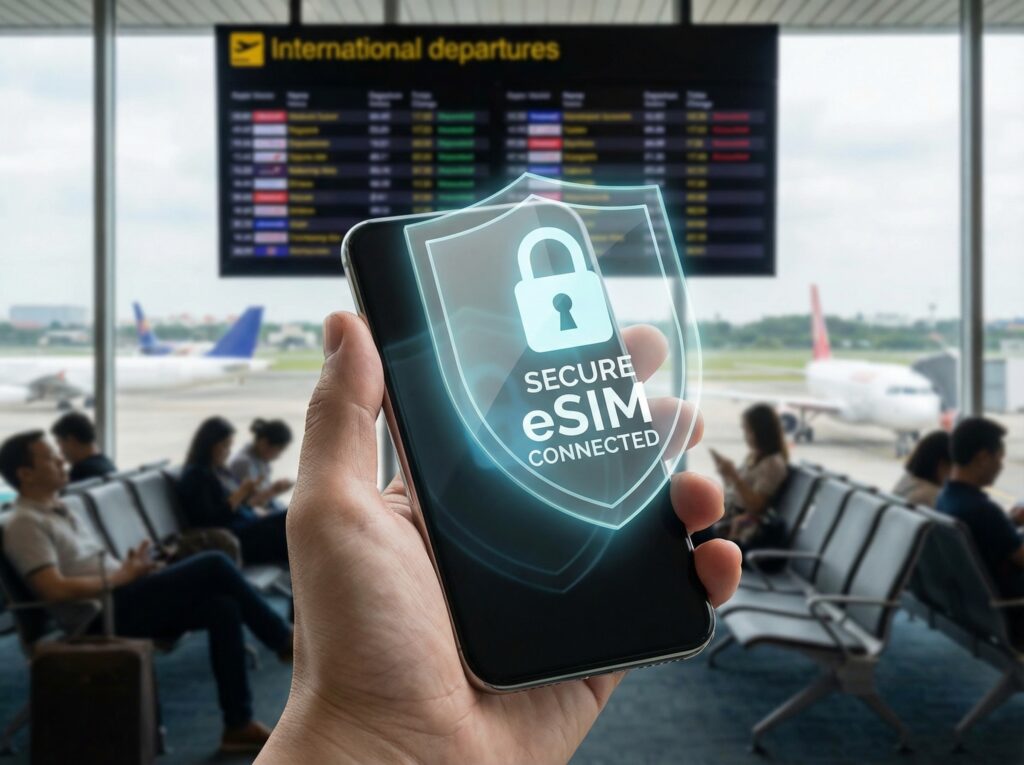

As eSIM technology becomes more popular, many travelers ask the same question: Is eSIM safe to use abroad?
The short answer is yes — in many cases, eSIM technology is even more secure than traditional physical SIM cards.
Understanding how eSIM security works helps travelers use mobile data confidently wherever they go.
Why eSIM is considered secure?
An eSIM is built directly into your device and cannot be physically removed.
This already eliminates one of the most common security risks associated with traditional SIM cards — SIM swapping through physical access.
In addition:
- eSIM profiles are encrypted
- activation requires secure provisioning systems
- network operators follow global GSMA security standards
- profiles cannot be duplicated easily like physical SIM cards
These protections make eSIM technology suitable for modern banking apps, secure logins, and everyday communication.
eSIM vs physical SIM security
| Feature | eSIM | Physical SIM |
| Physical removal | Not possible | Can be removed |
| Risk of loss/theft | Very low | Higher |
| Encryption | Yes | Yes |
| Remote management | Secure provisioning | Manual handling |
| SIM swap risk | Lower (physical access harder) | Higher |
For travelers carrying devices across multiple countries, the reduced risk of SIM loss or theft is a major advantage.
Is public Wi-Fi less safe than eSIM mobile data?
Public Wi-Fi networks:
- can be unsecured
- may expose traffic to interception
- sometimes require unknown login portals
Mobile data connections through an eSIM are typically encrypted by the mobile network, which makes them more reliable and safer than unknown public Wi-Fi hotspots.
If you often rely on airport or hotel internet, using mobile data instead can significantly improve your security.
Related reading: Does eSIM work without Wi-Fi?
Can hackers access your phone through an eSIM?
An eSIM itself does not provide access to your phone.
Security risks usually come from:
- Malicious apps
- Phishing links
- Unsecured Wi-Fi networks
- Weak passwords
Using an eSIM does not increase these risks. In fact, avoiding public Wi-Fi may reduce them.
Best security practices when using eSIM abroad:
To maximize security while traveling:
- Install the eSIM from trusted providers only
- Avoid sharing QR codes publicly
- Keep your phone updated
- Use device screen locks and biometric security
- Enable app-based two-factor authentication whenever possible
- Avoid connecting to unknown Wi-Fi networks when mobile data is available
These steps provide strong protection for most travelers.
Is eSIM secure for banking and payments?
Mobile banking apps rely on encrypted network connections and device-level security, not on whether the connection is provided by a physical SIM or an eSIM.
As long as your phone is secure and your apps are legitimate, using an eSIM does not reduce payment security.
Final thoughts:
eSIM technology follows strict global telecommunications security standards and is widely supported by mobile operators and smartphone manufacturers.
For travelers, it offers not only convenience but also a reliable and secure way to stay connected abroad.
Using safe browsing practices and trusted providers ensures that your mobile data connection remains protected wherever you travel.
Frequently asked questions about eSIM security
Is eSIM safer than a physical SIM card?
In many cases yes, because it cannot be physically removed or easily swapped.
Can someone clone my eSIM?
eSIM profiles are encrypted and securely provisioned, making cloning extremely difficult.
Is it safe to use banking apps with an eSIM?
Yes. Banking security depends on encryption and device security, not the SIM format.
Is mobile data safer than public Wi-Fi?
Generally yes, because cellular networks use encrypted connections managed by operators.