


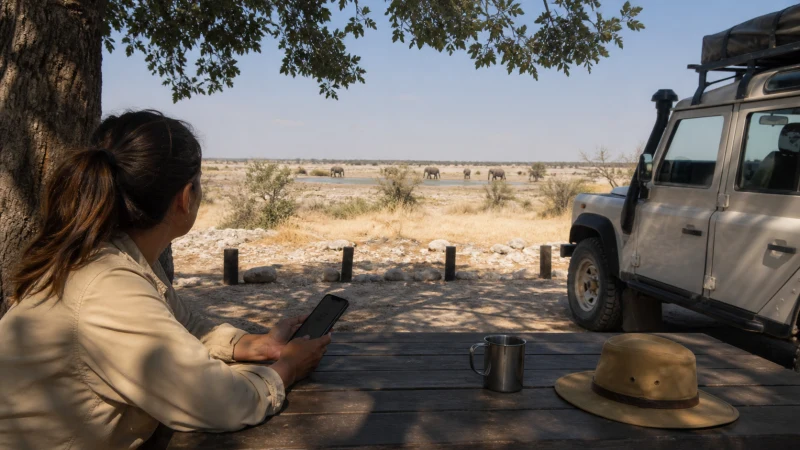

Mobile internet in Etosha National Park depends on camp connectivity, wildlife-drive rules and offline preparation. The phone, travel dates and places where data is genuinely needed determine the most suitable setup.
A practical setup protects the next leg of the journey first. Save the destination and transfer details, then reserve mobile data for updates that genuinely need a connection.
A NoveSIM Namibia eSIM supplies mobile data for maps, browsing and internet-based communication. It does not include a Namibian number, standard voice minutes or carrier SMS; network and hotspot availability depend on the plan, phone and local coverage.
Quick answer: Treat mobile internet in Etosha National Park as intermittent outside connected settlements: download the route, save bookings and fuel information, carry power and never rely on mobile service for emergency access.
Top Namibia eSIMs


Offline preparation for mobile internet in Etosha National Park
Download the full route, save accommodation and activity contacts, record fuel stops and keep permits or booking references available without a signal. On remote routes, a coverage gap may last much longer than a brief network handover.
Treat reception as location-specific
Signal can change with terrain, distance, buildings, weather and the serving site. A connection at a lodge, camp or town does not establish continuous coverage for the next part of the route.
Protect battery and the remaining allowance
Pause cloud photo uploads, app updates and automatic video playback before remote travel. Keep a power bank charged and reserve enough data for route changes, messages and the return journey.
Keep safety planning independent of mobile service
Do not use mobile coverage as the only emergency plan. Share the route and expected arrival, follow local advice and carry the supplies appropriate to the drive or activity.
Protect the first essential journey
Check current Namibia eSIM plans with camp connectivity, wildlife-drive rules and offline preparation in mind. Mobile Coverage in Rural Namibia: How to Prepare covers a closely related part of the journey.
Before departure, compare the live plan with the needs that matter here: camp connectivity, wildlife-drive rules and offline preparation. Read the high-speed allowance, validity period, activation rule and hotspot terms together rather than treating one feature in isolation. Confirm that the exact handset is unlocked and eSIM-compatible. Keep the installation details somewhere another device can display them. Current product information is more dependable than an old screenshot, a remembered description or a general promise about nationwide coverage.
- Confirm the exact handset is unlocked and supports eSIM.
- Keep the installation details private and available on another device.
- Download the first route, address and booking reference.
- Carry enough power for the longest planned transfer.
- Pause automatic updates, cloud backup and large media downloads.
Label both lines before changing settings
The checks in Does My Phone Support an eSIM for Namibia? and How to Install an eSIM for Namibia Before You Travel cover the relevant device stages. Record the original settings and change one control at a time.
- Confirm that the travel eSIM is visible and enabled.
- Select Travel as the Mobile Data line.
- Enable Data Roaming on Travel and keep it off on Primary unless home-carrier costs are understood.
- Disable automatic data switching.
- Allow Automatic Network Selection time to register.
- Use data.esim only when manual NoveSIM APN entry is required.
Use reversible checks when data stops
If mobile data stops, follow Namibia eSIM Not Working? Safe Troubleshooting Steps. Confirm the plan state, signal and selected data line before trying Airplane Mode or one normal restart, and leave the eSIM installed.
Take screenshots of the selected data line and visible network state before changing anything else. A short sequence of results is more useful than a full network reset.
Verify the task that matters on the journey
The best pre-travel check is a simple action that reflects the journey, not a measurement of maximum download speed. Confirm the active data line before starting and do not change another setting during the test. Use the real travel location for the check instead of treating a city speed test as evidence for the complete journey. Use the result to confirm the task, not to remove the offline fallback prepared for the journey. If it fails in Etosha National Park, leave the eSIM installed and record the visible network, active line and error for Support.
Related Articles
- Mobile Internet for a Namibia Road Trip
- Using Google Maps in Namibia Without Wasting Data
- Mobile Internet for Long-Distance Travel in Namibia
- Mobile Internet on Safari in Namibia
- Mobile Internet Along Namibia’s Skeleton Coast
- Mobile Internet Around Sossusvlei and the Namib Desert
- Mobile Internet Beyond Lodge Wi-Fi in Namibia
- Namibia eSIM Coverage: Towns, Highways and Remote Routes
- Mobile Networks in Namibia: A Visitor’s Guide
FAQ
What is the practical answer?
Treat mobile internet in Etosha National Park as intermittent outside connected settlements: download the route, save bookings and fuel information, carry power and never rely on mobile service for emergency access.
Does a Namibia eSIM include a local number?
No. NoveSIM supplies mobile data but no Namibian number, ordinary voice minutes or carrier SMS. Messaging and internet-calling apps use the data connection.
Should Data Roaming be enabled?
Enable Data Roaming on the Namibia travel eSIM when partner access requires it. Keep roaming off on the primary line unless the home carrier’s charges are understood.
Should a non-working eSIM be deleted?
No. Preserve the installed profile and complete only reversible checks. If data still fails, give NoveSIM Support the phone model, location and visible network status.
Final Recommendation
The dependable approach to mobile internet in Etosha National Park is the one that fits the real itinerary. Close to departure, confirm the plan’s validity, allowance and supported features.
A charged phone, offline directions and a tested data line provide a practical foundation. One successful test cannot predict reception across the whole journey.
Clear SIM labels, controlled roaming and reversible checks reduce avoidable failures. Combined with offline preparation, they provide a realistic setup for Namibia.