


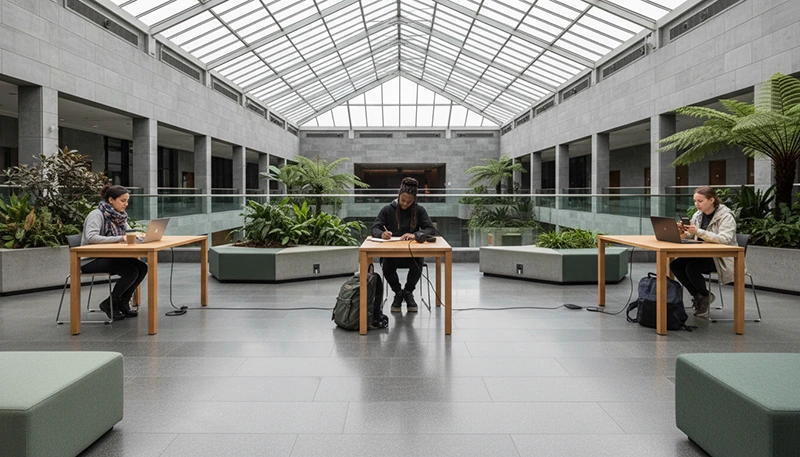

Coworking spaces can make remote work in New Zealand more predictable. They offer desks, power outlets, a professional environment and, in many cases, more reliable internet than hostels, holiday homes or busy cafés.
However, a coworking desk does not remove the need for backup connectivity. Opening hours, shared bandwidth, maintenance problems and fully booked meeting rooms can still interrupt your working day. An independent mobile data connection is therefore useful even when you expect to spend most of your time in a shared office.
Quick answer: choose a coworking space with work-suitable WiFi, comfortable seating, accessible power and suitable areas for calls. Keep a travel eSIM with hotspot support as backup for transport days, temporary outages and work outside the space. Confirm access hours before scheduling important meetings and keep essential files available offline.
Top New Zealand eSIMs

New Zealand eSIM
Fixed
1 GB, 7 days2.50$2 GB, 15 days4.50$3 GB, 30 days6.00$Unlimited
Unlimited, 1 day3.00$Unlimited, 3 days7.50$Unlimited, 5 days12.00$
Asia eSIM
Fixed
1 GB, 7 days5.00$2 GB, 15 days9.00$3 GB, 30 days12.00$Unlimited
Unlimited, 1 day6.50$Unlimited, 3 days17.50$Unlimited, 5 days28.50$Why Use a Coworking Space in New Zealand?
Coworking is particularly useful for digital nomads, consultants, freelancers and travelling employees who need a more dependable environment than accommodation WiFi can provide.
A suitable workspace may offer:
- Stable shared internet.
- Dedicated desks or hot-desking areas.
- Power outlets near the work surface.
- Meeting or telephone rooms.
- Comfortable chairs for longer sessions.
- Printing and scanning facilities.
- Kitchen or refreshment areas.
- Extended or member-only access.
- A quieter environment than a café.
- Opportunities to meet other remote professionals.
The quality and access conditions differ between locations, so compare practical details rather than choosing only by interior design or price.
What Internet Features Should You Check?
A workspace may advertise fast WiFi, but remote workers should look beyond a general speed claim. Stability, upload performance, congestion and call facilities can be more important than the highest possible download result.
| Feature | Why It Matters |
|---|---|
| Connection stability | Reduces interruptions during meetings and cloud work |
| Upload performance | Important for video calls, screen sharing and file transfer |
| Guest network security | Helps separate members from unknown public users |
| Call rooms | Provides privacy and reduces disruption to others |
| Power access | Essential for full working days |
| Access hours | Important when working across international time zones |
| Mobile signal indoors | Allows hotspot backup if the fixed connection fails |
Questions to Ask Before Booking
Before purchasing a day pass or longer membership, ask the workspace several direct questions.
- Is WiFi included in the desk price?
- Are there speed or usage limits?
- Does the connection remain stable during busy periods?
- Can members make video calls from the main area?
- Are private call rooms included or charged separately?
- Can rooms be booked in advance?
- Are external monitors available?
- Are there secure lockers?
- Is access available outside reception hours?
- Can you test the space with a day pass?
A short trial is often the safest choice before paying for a weekly or monthly membership.
Coworking WiFi or Mobile Data?
These connections should complement rather than replace one another. Coworking WiFi is normally better for long work sessions, while mobile data gives you independence when you leave the building or the shared connection becomes unavailable.
| Connection | Best For | Main Limitation |
|---|---|---|
| Coworking WiFi | Meetings, large files and full working days | Shared connection and fixed location |
| Travel eSIM | Backup access, transport and temporary hotspot use | Depends on plan allowance and local coverage |
| Accommodation WiFi | Evening work and entertainment | Quality can vary significantly |
| Public WiFi | Basic browsing | Security and reliability concerns |
| Local prepaid service | Longer stays and local telephone access | Usually arranged after arrival |
Why an eSIM Is Useful for Coworking
A travel eSIM gives you mobile data independently of the coworking network. This is valuable when you are travelling to the office, working from another part of town or dealing with an unexpected fixed-internet problem.
An eSIM can help with:
- Finding the workspace after arrival.
- Opening access instructions or booking emails.
- Receiving urgent messages outside opening hours.
- Joining a short call during a WiFi interruption.
- Using a laptop hotspot temporarily.
- Working during intercity travel.
- Finding another workspace when your first option is closed.
Many travel eSIMs are data-only, so check the selected plan if you require traditional calls, SMS or a New Zealand telephone number. Confirm hotspot support before relying on tethering.
Browse New Zealand eSIM plans.
How Much Mobile Data Should a Coworking User Buy?
Your mobile allowance depends on how reliable the coworking and accommodation WiFi connections are. Travellers who use mobile data only for maps and emergency messages need much less than workers who tether several times each week.
| Usage Pattern | Suggested Starting Point |
|---|---|
| Navigation and emergency messaging | 5 GB to 10 GB per month |
| Regular browsing outside the workspace | 10 GB to 20 GB per month |
| Occasional laptop hotspot use | 20 GB to 40 GB per month |
| Frequent meetings through mobile data | 40 GB or more per month |
| Mobile data as the main connection | A substantially larger allowance |
These figures are planning estimates. Video quality, cloud synchronisation, automatic updates and the number of connected devices can change actual consumption substantially.
Read the New Zealand mobile data allowance guide.
Using a Phone Hotspot in a Coworking Space
A hotspot is useful when the coworking network fails or when you need a separate connection for a short sensitive task. It should usually remain a backup rather than your default connection.
Before tethering a laptop:
- Confirm that the eSIM plan supports hotspot use.
- Connect the phone to power.
- Pause operating system updates.
- Disable unnecessary cloud synchronisation.
- Close streaming applications.
- Mark the connection as metered where supported.
- Disconnect when the task is complete.
Laptops can consume data in the background even when you are only checking email. Automatic file backup and software updates are common causes of unexpected usage.
Day Pass, Weekly Pass or Monthly Membership?
| Access Type | Best For | Considerations |
|---|---|---|
| Day pass | Testing a space or completing one focused workday | May offer limited booking access |
| Multi-day pass | Short stays with several planned work sessions | Check expiry and included facilities |
| Weekly pass | Remote workers staying in one city temporarily | Compare with individual day-pass cost |
| Monthly membership | Longer stays and regular desk use | Confirm notice period and access hours |
| Dedicated desk | Professionals needing equipment and consistency | Usually more expensive than hot-desking |
A flexible pass is often better when your travel schedule may change. A monthly membership becomes more attractive when you need a predictable workplace most weekdays.
Coworking for International Time Zones
Travellers working with Europe, Asia or the Americas may need access early in the morning or late at night. Standard reception hours may not match your meeting schedule.
Check:
- Whether members receive extended access.
- Whether calls are permitted outside normal hours.
- Whether heating, lighting and internet remain available.
- Whether the neighbourhood is convenient after dark.
- Whether public transport still operates.
- Whether the building requires a digital access code or key.
Keep mobile data available when travelling to or from the workspace outside normal business hours.
Coworking in Auckland
Auckland is a practical base for remote workers because it offers varied accommodation, transport connections and professional services. Coworking locations may be spread across different neighbourhoods, so consider commute time as well as desk price.
Mobile data helps with public transport, building access instructions and changing between temporary accommodation and workspaces.
Read the Auckland internet guide.
Coworking in Wellington
Wellington’s compact central area can make it easier to combine accommodation, coworking and cafés without long journeys. However, not every shared workspace offers private call facilities.
Check whether the building remains accessible during early or late international meetings and keep a mobile backup for journeys in changeable weather.
Read the Wellington internet guide.
Coworking in Christchurch
Christchurch can provide a useful base for South Island remote work and onward travel. A coworking membership may be practical when you stay in the city for several weeks before exploring more rural areas.
Complete large uploads and download necessary files before leaving for remote routes where mobile reception may become less predictable.
Read the Christchurch internet guide.
Coworking in Queenstown
Queenstown attracts remote workers who want to combine professional commitments with outdoor activities. Accommodation WiFi can become busy, making a dedicated workspace valuable for scheduled meetings.
Because demand can vary with the travel season, confirm desk and meeting-room availability in advance.
Read the Queenstown internet guide.
Working from Smaller New Zealand Towns
Smaller towns may offer a quieter environment and lower accommodation costs, but they can have fewer coworking alternatives. A community workspace, library or flexible office may be available even when there is no large dedicated coworking brand.
Before moving to a regional destination:
- Confirm the workspace opening schedule.
- Ask whether day passes are available.
- Check mobile reception at the accommodation.
- Save access instructions offline.
- Download important work files.
- Identify a second possible workspace.
- Avoid scheduling a critical meeting immediately after arrival.
Internet Security in Shared Workspaces
Coworking networks are generally intended for professional use, but they are still shared with other members and guests. Use sensible precautions when handling business accounts or confidential files.
- Confirm the official network name.
- Avoid suspicious duplicate networks.
- Use secure websites and trusted services.
- Disable file sharing and device discovery.
- Keep your laptop firewall enabled.
- Do not leave devices unlocked or unattended.
- Use mobile data for particularly sensitive activity when appropriate.
- Forget temporary networks after leaving.
Ask whether the workspace provides separate member and visitor networks if security is especially important to your work.
Phone Calls and Video Meetings
A quiet coworking area is not automatically suitable for speaking. Open-plan spaces may require members to use telephone booths or meeting rooms for longer calls.
Before an important meeting:
- Reserve a call room where possible.
- Test your microphone and headphones.
- Join a few minutes early.
- Keep your eSIM connection ready.
- Download the agenda locally.
- Have the organiser’s contact details available.
- Switch to audio if the connection becomes unstable.
Power, Equipment and Comfort
Internet is only one part of a productive coworking day. A desk can have excellent WiFi but still be unsuitable if the chair is uncomfortable or power outlets are inconvenient.
Check for:
- Accessible power at the desk.
- Comfortable seating.
- External monitors or monitor stands.
- Good lighting.
- Secure storage.
- A place for video calls.
- Kitchen access.
- Air conditioning or heating.
Carry your own charging cable, power adaptor and compact power bank even when the workspace provides shared accessories.
Coworking During a New Zealand Road Trip
Some travellers alternate between focused workdays in towns and travel days through rural regions. This can be an effective schedule when meetings and large uploads are completed before leaving a strong connection.
Before each remote section:
- Finish time-sensitive work.
- Download all necessary files.
- Save the next workspace address.
- Download offline maps.
- Tell colleagues when you may be unavailable.
- Avoid planning important meetings while driving between towns.
Mobile signal may vary in mountains, national parks, forested regions and remote coastal areas.
Read the New Zealand road-trip internet guide.
Coverage and 5G Expectations
Mobile coverage is generally easier to find in cities, larger towns and populated travel corridors. Reception may vary inside thick-walled buildings and in rural, mountainous or sparsely populated locations.
5G availability depends on the phone, selected plan, supported frequencies, location, local partner network and congestion. A device may switch between 5G, 4G, a slower connection and no service during the same trip.
A large mobile data allowance does not guarantee strong indoor reception. Test the hotspot where you plan to work before relying on it for an important meeting.
Keeping Your Primary SIM Active
A compatible Dual-SIM phone can use a travel eSIM for mobile data while keeping the primary SIM available for calls, SMS and verification messages.
To reduce accidental roaming charges:
- Select the travel eSIM for Mobile Data.
- Turn off Data Roaming on the primary SIM.
- Disable Automatic Data Switching.
- Check the selected line before making traditional calls.
Your home provider may still charge for calls, voicemail or certain messages while abroad.
How to Check eSIM Compatibility
Your phone must support eSIM and be carrier-unlocked. Compatibility can vary by exact model and regional version.
Dial *#06#. An eSIM-compatible phone may display an EID alongside one or more IMEI numbers.
You may also find Add eSIM, Add Cellular Plan, Add Mobile Plan or SIM Manager in the device settings.
Recommended eSIM Settings
| Setting | Recommended Value |
|---|---|
| Travel eSIM | Enabled after arrival |
| Mobile Data | Travel eSIM |
| Data Roaming on travel eSIM | On |
| Data Roaming on primary SIM | Off |
| Automatic Data Switching | Off |
| Network Selection | Automatic |
| APN | data.esim when required |
What to Do If the eSIM Does Not Connect
- Confirm that the plan includes New Zealand.
- Check that the travel eSIM is enabled.
- Select it for Mobile Data.
- Enable Data Roaming on the travel eSIM.
- Turn off Data Roaming on the primary SIM.
- Disable Automatic Data Switching.
- Leave Network Selection on Automatic.
- Enter data.esim as the APN when manual configuration is required.
- Turn Airplane Mode on for 30 seconds and turn it off.
- Wait several minutes for network registration.
- Restart the phone when necessary.
If you are inside a large building, test the connection near a window or outdoors before changing advanced settings. Building materials may weaken mobile reception.
Do not delete the eSIM while troubleshooting. Its installation QR code may be valid for one installation only.
Coworking Internet Checklist
- Test the workspace with a day pass when possible.
- Confirm WiFi, power and call-room access.
- Check opening hours against your working time zone.
- Keep an independent eSIM connection.
- Confirm that hotspot sharing is supported.
- Choose enough data for emergency tethering.
- Save building access instructions offline.
- Reserve private rooms before important calls.
- Pause updates before using a hotspot.
- Carry headphones, a charger and a power bank.
- Identify a second workspace in each city.
- Download files before travelling to rural areas.
Related New Zealand Travel Internet Guides
- New Zealand eSIM Plans
- Best eSIM for New Zealand
- Best eSIM for Digital Nomads in New Zealand
- Remote Work Internet in New Zealand
- Internet for Remote Work in New Zealand
- Long-Term Travel in New Zealand with an eSIM
- Best Data Plan for New Zealand
- How Much Data Do You Need for New Zealand?
- Internet in Auckland for Tourists
- Internet in Wellington for Tourists
FAQ
Is coworking WiFi reliable enough for remote work in New Zealand?
It is often more suitable than hostel or café WiFi, but performance varies by workspace and time of day. Test the connection and keep mobile data as backup.
Do I still need an eSIM when using coworking spaces?
Yes, an eSIM is useful for transport, access instructions, work outside opening hours and temporary hotspot use when the shared network fails.
How much mobile data should I buy?
Light backup use may require 5 GB to 10 GB per month. Regular hotspot use may require 20 GB to 40 GB or more.
Can I take video calls in a coworking space?
Usually, but many open-plan spaces require longer calls to take place in a booth or meeting room. Confirm the rules and booking process in advance.
Is a day pass better than a monthly membership?
A day pass is useful for testing a workspace or for occasional work. A weekly or monthly pass may offer better value when you need a desk regularly.
Can I use an eSIM hotspot inside a coworking building?
Yes, when the plan supports tethering and indoor mobile reception is suitable. Thick walls or interior rooms can weaken the signal.
What APN should I use for NoveSIM?
Use data.esim when manual APN configuration is required.
Final Recommendation
Coworking spaces are one of the most dependable ways to work online while travelling through New Zealand. Choose a workspace according to internet stability, call facilities, opening hours, comfort and location rather than selecting solely by price.
Keep an independent eSIM connection even when the coworking WiFi is strong. Mobile data protects you during outages, transport days and periods when the building is closed. Confirm hotspot support and select enough reserve data for urgent work.
Test each new space before committing to a longer membership, reserve call rooms for important meetings and download essential files before travelling beyond major towns. A strong coworking setup combines a suitable desk, dependable WiFi and a realistic backup plan.