


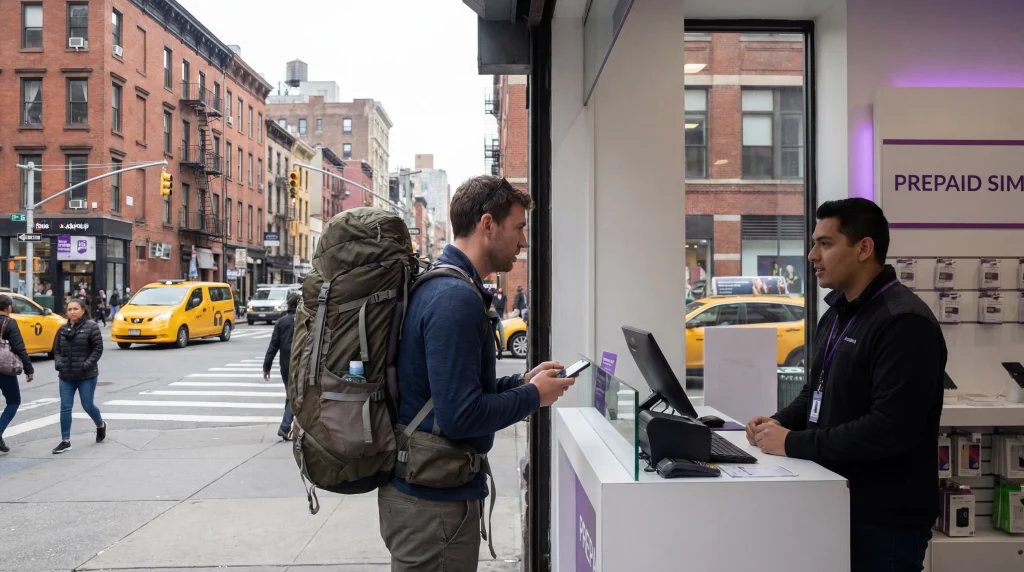

The best SIM card for a USA trip depends on your phone, route and need for a US number. A local prepaid SIM can provide conventional calls, texts and a domestic number. A travel eSIM is often simpler when you mainly need mobile data for maps, messaging and bookings.
Quick answer: Choose a US prepaid SIM if you need a local number or carrier calls and SMS. Choose a travel eSIM if data and setup before arrival are the priority. Before buying either option, confirm that the phone is unlocked, supports the required US network technology and has coverage along the complete itinerary.
Top United States eSIMs

United States eSIM
Fixed
1 GB, 7 days€ 2.662 GB, 15 days€ 4.443 GB, 30 days€ 5.77Unlimited
Unlimited, 1 day€ 3.55Unlimited, 3 days€ 8.87Unlimited, 5 days€ 13.75
Which SIM option is best for a USA tourist?
Start with the task the connection must perform:
- Data-only city trip: maps, ride-hailing, messages, digital tickets and restaurant searches;
- Local communication: a US number for conventional calls or SMS;
- Road trip: coverage across several states and rural highway sections;
- Remote work: hotspot permission, a larger allowance and a clear speed policy;
- USA and Canada itinerary: confirmed cross-border coverage or separate plans.
A data-only eSIM is normally enough when you communicate through WhatsApp, FaceTime, Messenger or email. A local prepaid SIM is more suitable when hotels, businesses or contacts need to call a US number.
US prepaid SIM versus travel eSIM
| Need | US prepaid SIM | Travel eSIM |
|---|---|---|
| US phone number | Often included | Not included with NoveSIM data-only plans |
| Setup before arrival | Sometimes possible | Yes |
| Physical SIM slot | Usually required | Not required |
| Carrier calls and SMS | Depends on the bundle | Use internet-based apps |
| Activation support | Available at staffed stores | Digital installation |
NoveSIM travel eSIMs provide mobile data. We do not provide a US phone number, conventional calls or carrier SMS. If you keep your primary SIM active for its existing number, its provider’s roaming fees can still apply.
Will your phone work with a US SIM?
Phone compatibility is especially important in the United States. A device can be unlocked and still lack some of the network bands or calling technology used by a particular provider. Imported models may behave differently from the US version of the same phone name.
Before purchase:
- confirm that the phone is carrier-unlocked;
- check the exact model number, not only the marketing name;
- verify compatibility with the selected provider or eSIM plan;
- confirm eSIM support if choosing a digital plan;
- do not assume that 5G support guarantees access to every US 5G band.
AT&T, T-Mobile or Verizon coverage
AT&T, T-Mobile and Verizon operate the principal nationwide mobile networks. Prepaid brands and virtual operators can use one of those networks, but their plan rules, roaming access, priority and hotspot allowances may differ.
No carrier is the universal winner for every neighbourhood, highway and national park. Check official coverage maps for the actual accommodation, airports and roads on the itinerary. The USA network guide for tourists explains how to compare route-level coverage.
Best SIM setup for California
A California city trip and a California road trip require different planning. Service in Los Angeles, San Francisco or San Diego does not guarantee continuous coverage through mountain, desert or coastal sections.
For a multi-stop California route:
- check coverage for the roads between cities;
- download offline maps and accommodation details;
- save park permits and tickets locally;
- do not rely on mobile coverage as the only emergency option;
- choose validity that covers delays and itinerary changes.
Best SIM setup for a multi-state road trip
For a long road trip, nationwide claims are less useful than checking the weakest parts of the route. Mountain regions, desert highways and remote parks can have limited or no terrestrial service.
A large data allowance cannot solve a coverage gap. Keep navigation offline, save booking information and check whether the selected plan permits domestic roaming or uses only one underlying network.
Where to buy a prepaid SIM in the USA
Prepaid SIMs are sold by carrier stores, electronics retailers and other shops. A staffed carrier location is useful when you need compatibility or activation help.
Airport availability varies. A kiosk or vending machine can be convenient but may offer fewer packages and less support. Travellers arriving in New York can review immediate options in the JFK Airport SIM card guide.
Do tourists need identification or a US address?
Purchase and activation requirements depend on the provider, plan and sales channel. A prepaid offer is usually simpler than a monthly contract, while a contract can require additional identity, address, payment or credit information.
Do not depend on an old traveller report. Verify the current activation conditions for the exact product, especially when ordering online for delivery or choosing a recurring plan.
How much data should you buy?
Navigation, messages and normal browsing use much less data than streaming, video calls, cloud photo backup and laptop tethering. A road trip can add continuous navigation and daily accommodation research.
Download map regions, playlists and entertainment on Wi-Fi. Disable automatic system updates and photo backup on mobile data. Use the USA travel data guide to estimate the full trip rather than buying from a daily headline alone.
Check hotspot and unlimited-data rules
An “unlimited” label does not always mean unrestricted hotspot use or maximum speed at all times. Plans can include separate tethering allowances, reduced speeds after a threshold or limits on high-speed daily use.
If you intend to work from a laptop, confirm the hotspot allowance and fair-use policy before purchase. Keep essential documents offline because busy venues and rural locations can still affect performance.
USA-only plan or a USA–Canada option?
A USA-only plan is normally the clearest choice for a domestic itinerary. For a cross-border trip, check whether Canada is explicitly included and whether the allowance changes after crossing the border.
Compare one regional plan with two country plans. One plan reduces line switching, while separate plans may provide larger or clearer allowances in each country.
Prepare the phone before departure
- Verify the exact phone model and unlock status.
- Install the travel eSIM on reliable Wi-Fi.
- Follow its activation rule so validity does not begin too early.
- Label the travel and primary lines clearly.
- On arrival, select the eSIM for cellular data.
- Enable data roaming on the travel eSIM when required by the plan.
If data does not connect, keep the profile installed while checking the selected data line, roaming setting and network registration. The USA eSIM troubleshooting guide covers the next steps.
Related Articles
- Best eSIM for USA travel
- USA eSIM plans
- Best USA mobile network for tourists
- How much data do you need for the USA?
FAQ
What is the best SIM card for tourists in the USA?
Choose a US prepaid SIM when you need a domestic number. Choose a travel eSIM when mobile data and setup before arrival are more important. Verify phone compatibility and route-level coverage in both cases.
Can a tourist buy a prepaid SIM in the USA?
Yes. Prepaid SIMs are available from carrier stores and other retailers. Activation requirements vary, so confirm compatibility and the current conditions for the exact package.
Will one SIM work across every US state?
A nationwide plan can work in many states, but no mobile network guarantees continuous service everywhere. Remote roads, mountain areas and national parks can have gaps.
Does a NoveSIM USA eSIM include a US phone number?
No. NoveSIM travel eSIMs are data-only. They do not include a US number, conventional calls or carrier SMS. Internet-based apps use the mobile-data connection.
Final Recommendation
Choose a US prepaid SIM when a local number and conventional calls are essential. Choose a travel eSIM for straightforward mobile data without an in-person purchase. Phone compatibility and route coverage should decide the provider; data allowance, hotspot policy and cross-border terms should decide the plan.