


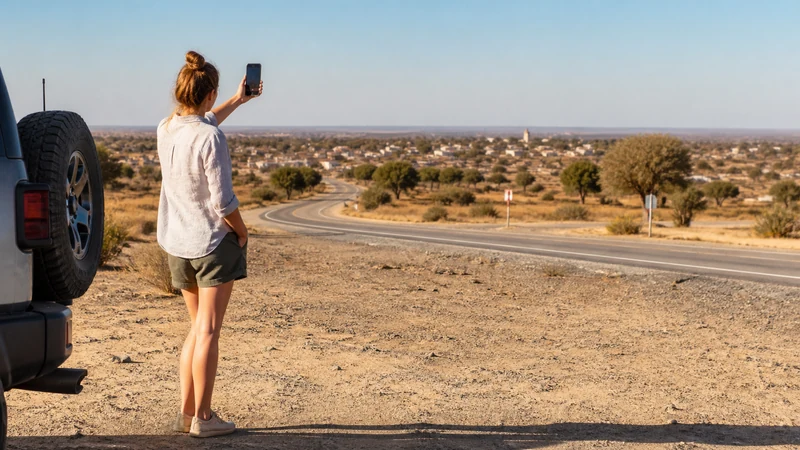

There’s no single “best” network in Botswana — the right answer depends heavily on where your trip actually takes you, since the three operators’ strengths don’t overlap evenly. A traveler doing a Gaborone business trip and one heading into the Delta on safari have genuinely different right answers.
Top Botswana eSIMs

Botswana eSIM
Fixed
1 GB, 7 days13.00$2 GB, 15 days28.50$3 GB, 30 days35.00$Unlimited
Unlimited, 1 day18.50$Unlimited, 3 days52.50$Unlimited, 5 days87.00$
For a safari-focused trip: Mascom
If your itinerary includes self-driving toward Kasane, Moremi, or other safari areas, Mascom is the clearer choice — it has the largest subscriber base in the country and, more usefully, the widest rural footprint of the three networks. This doesn’t mean Mascom reaches into the Okavango Delta or Central Kalahari, since nothing does, but for the towns, roads, and lodges on the edges of Botswana’s safari circuit, it consistently has the best chance of a signal.
For a city-based trip: any of the three work well
If you’re staying primarily in Gaborone, all three networks perform comparably — solid 4G across the CBD, Riverwalk, Game City, and most residential areas. Orange is frequently cited for consistent speeds and customer service in the city center specifically, while BTC sometimes offers the most competitive data pricing. For a Gaborone-only visit, the choice matters less than for a trip extending into rural areas.
For a mixed itinerary
Most tourist trips combine some city time with a safari component — exactly the combination that makes Mascom the practical default overall, since it performs competitively in towns while also reaching furthest into the areas a safari itinerary depends on. If your trip is genuinely mixed, defaulting to Mascom covers more of your route than choosing based on city performance alone.
What doesn’t change based on network choice
None of the three networks provide meaningful coverage inside the Okavango Delta, the Central Kalahari, or most of the deep safari interior. Choosing the “best” network affects your experience in towns and on roads, not inside genuinely remote wilderness areas — the Botswana safari connectivity guide covers what to expect once you’re past the point where network choice matters.
eSIM providers and which network they use
If you’re using an international travel eSIM rather than a local SIM, the provider’s underlying network partnership matters more than the eSIM brand itself — most travel eSIM providers in Botswana route through Mascom or Orange infrastructure. Check which network your specific eSIM plan uses before assuming it automatically gets Mascom’s rural advantage. The local SIM versus eSIM guide covers this alongside the broader decision between the two formats.
5G: not a deciding factor yet
5G exists only in parts of Gaborone at this point, and isn’t developed enough anywhere in the country to be worth choosing a network around. Solid 4G, available from all three carriers in the cities, covers what a typical visitor needs.
Registration is the same regardless of network
Whichever network you choose for a local SIM, Botswana’s mandatory passport registration applies equally — there’s no network that offers an easier registration process than another. The best SIM card guide covers the practical steps for getting set up at a carrier shop.
FAQ
Which network should I choose for a Botswana safari?
Mascom, given its wider rural footprint — the most useful advantage for trips involving self-driving or lodges outside major towns.
Does it matter which network I use if I’m only visiting Gaborone?
Not much — all three perform well in the city. Orange and BTC are reasonable alternatives for a city-only trip.
Do eSIM providers automatically use the best network?
Not necessarily — check which local network your specific eSIM plan routes through, since this varies by provider.
Does network choice matter inside the Okavango Delta?
No — none of Botswana’s networks have meaningful coverage there. The choice matters for towns and roads, not the deep wilderness.
Final Recommendation
For most visitors combining city time with any safari component, Mascom is the practical default given its wider rural reach. A city-only trip works fine on any of the three. Whichever you choose, remember that network choice stops mattering once you’re inside Botswana’s genuinely remote wilderness areas, where none of them reach.