


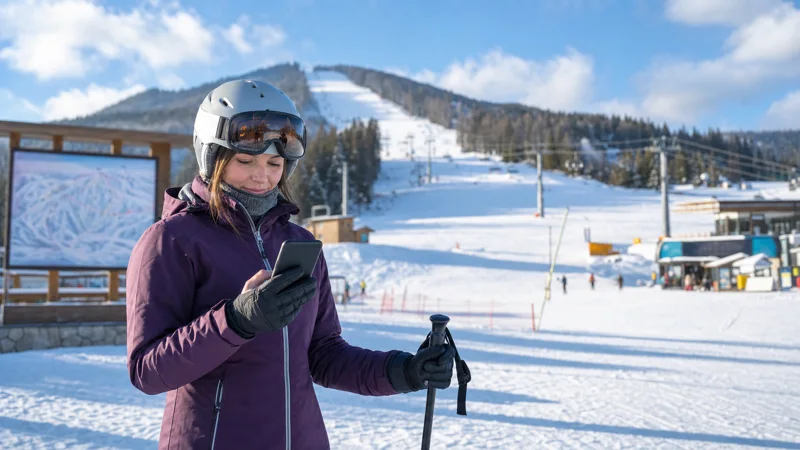

Internet for a Poland ski trip depends on where you are within the resort area. Zakopane and established resort facilities can have ordinary mobile service, while slopes, valleys and mountain roads may move in and out of usable coverage because terrain blocks radio signals.
Mobile data is helpful for transport, weather information and meeting companions, but it must not be the only safety tool on the mountain. Piste maps, accommodation details and emergency information should remain accessible offline.
NoveSIM travel eSIMs are data-only. We do not provide a Polish phone number, conventional calls or SMS. Internet messaging works where the partner network has service, but emergency calling arrangements should be confirmed independently.
Quick answer: Install and test the eSIM before travelling to the ski area, then download piste maps, transport details and the route to your accommodation. Expect stronger service in Zakopane and resort centres than on every slope. Keep the phone warm, carry a power bank and agree on an offline meeting point.
Top Poland eSIMs

Poland eSIM
Fixed
1 GB, 7 days€ 1.792 GB, 15 days€ 3.573 GB, 30 days€ 4.46Unlimited
Unlimited, 1 day€ 2.23Unlimited, 3 days€ 4.91Unlimited, 5 days€ 8.03
Europe Extra eSIM
Fixed
1 GB, 7 days€ 2.232 GB, 15 days€ 3.573 GB, 30 days€ 4.46Unlimited
Unlimited, 1 day€ 2.68Unlimited, 3 days€ 5.36Unlimited, 5 days€ 8.93Europe+ eSIM
Fixed
1 GB, 7 days€ 2.682 GB, 15 days€ 4.023 GB, 30 days€ 5.36Unlimited
Unlimited, 1 day€ 2.68Unlimited, 3 days€ 6.25Unlimited, 5 days€ 10.26Where can you expect coverage around Zakopane?
Zakopane is a major tourist destination with normal urban mobile infrastructure. Hotels, streets and transport areas in town are therefore more likely to provide consistent service than exposed or terrain-shadowed sections higher in the mountains.
Coverage changes over short distances in mountainous terrain. A signal at the lift base does not prove that every run or valley section will remain connected. The Zakopane internet guide covers connectivity in the town beyond skiing.
Do not rely on a live piste map
Download the official resort map and save the day’s planned meeting points before leaving accommodation. If a resort app offers offline information, test it with Airplane Mode enabled rather than assuming a previously opened screen will remain available.
Record the name and address of the accommodation in Polish and save the route from the final transport stop. An offline map is also useful when the network is busy at the start or end of the ski day.
Protect the phone and battery on the slopes
Cold temperatures can reduce battery endurance. Keep the phone in an inner zipped pocket, avoid exposing it unnecessarily and carry a compact power bank. A protective case helps against moisture and accidental impacts, but it does not make the device suitable for every weather condition.
Do not charge a phone that is wet or extremely cold. Let it reach a safe temperature and follow the manufacturer’s instructions. The broader Poland winter internet guide covers battery and seasonal city-travel preparation.
Plan group communication without assuming instant messages
Agree on a physical meeting place and time before separating. Messages may be delayed when one person is in a weak-signal area, has a flat battery or is wearing gloves that make the phone impractical to use.
A data-only eSIM supports app-based messaging but not conventional SMS. If the group relies on ordinary calls, confirm which line and roaming arrangement will provide them.
Prepare transport to and from the resort
Save the bus or train ticket, final stop and transfer details locally. Winter disruption can make live information valuable, but the original booking and accommodation contact must remain available without a connection.
If the journey includes a Polish train, consult the train internet guide. Drivers should download the route and use the road-trip guide for rural coverage preparation.
Choose a plan for the whole ski holiday
Maps, messages and weather checks consume relatively little data. Photo and video uploads, streaming and hotspot use consume much more. Accommodation WiFi can handle large uploads while the mobile allowance remains available for travel and time away from the hotel.
Check that the plan includes Poland, lasts through the departure day and uses a supported local partner network. Network and 4G/5G availability depend on the plan, device, location and local coverage. Review the Poland coverage guide before choosing by speed claims alone.
Ski-day offline checklist
- Download the piste map and resort transport information.
- Save the accommodation address and return route.
- Agree on a physical group meeting point.
- Charge the phone and power bank fully.
- Keep the phone protected in an inner zipped pocket.
- Check official safety and emergency information independently of mobile data.
What to do when data disappears
A short loss on a slope is more likely to reflect terrain than incorrect configuration. Wait until reaching a more open or populated location before changing settings. If data still does not return in Zakopane, verify the selected data line and the provider’s required roaming setting.
Keep the eSIM installed. Follow the Poland troubleshooting guide only after ruling out a temporary mountain coverage gap.
Related Articles
- Best eSIM for Zakopane
- Internet in Zakopane for tourists
- Mobile networks in Poland
- How much data for a Poland trip
FAQ
Does mobile data work at ski resorts in Poland?
It commonly works in resort towns and developed facilities, but coverage can vary on slopes and mountain roads because of terrain.
Will an eSIM work throughout the Tatra Mountains?
No provider can guarantee service throughout mountainous terrain. Download essential maps and safety information before leaving a strong connection.
Why does a phone battery drain faster while skiing?
Low temperatures can reduce usable battery capacity. Keep the phone close to the body and carry a charged power bank.
Should a ski group depend on messaging apps?
No. Use messaging when available, but agree on a physical meeting place and time in case a phone loses signal or power.
Final Recommendation
For internet on a Poland ski trip, prepare for strong service in Zakopane and more variable coverage on the mountain. Choose a plan covering the whole holiday, then test it before travelling to the resort.
Download piste maps, transport information and accommodation details, protect the phone from cold and moisture, and agree on offline group arrangements. Treat mobile data as useful support rather than the only navigation or safety system.