


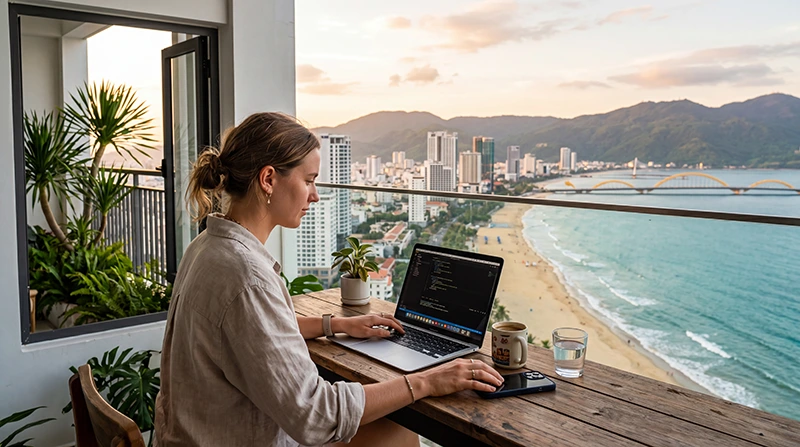

Reliable remote-work internet in Vietnam should combine a tested fixed connection with independent mobile data. Accommodation or coworking Wi-Fi can handle the normal workday, while a Vietnam eSIM provides a backup when the router, power or local connection fails.
A network that is adequate for browsing may still perform poorly during a video meeting or large upload. Test the actual desk, device, VPN and work applications before the first time-sensitive call.
We provide data-only travel eSIMs. We do not provide a Vietnamese telephone number, conventional calls or carrier SMS, although work calls and messaging platforms can use mobile data.
Quick answer: do not rely on one connection for remote work in Vietnam. Confirm the accommodation’s Wi-Fi at the intended desk, prepare an eSIM with enough data for essential calls and files, verify hotspot support, and keep critical documents available offline.
Top Vietnam eSIMs

Vietnam eSIM
Fixed
1 GB, 7 days€ 3.032 GB, 15 days€ 4.333 GB, 30 days€ 5.62Unlimited
Unlimited, 1 day€ 3.03Unlimited, 3 days€ 6.92Unlimited, 5 days€ 10.82
Compare current Vietnam eSIM plans, check the phone on the compatible-device list and review mobile internet in Vietnam before choosing a work backup.
Build a Primary and Backup Connection
The primary connection may be apartment, hotel or coworking Wi-Fi. The backup should not depend on the same router. A travel eSIM on the phone creates a separate route to the internet when its supported mobile network is available.
For critical work, identify a second physical location as well. A nearby coworking space or quiet café is more useful than troubleshooting one failing router throughout an important meeting.
Test the Actual Workload
- Join a video call from the desk where work will happen.
- Connect the required VPN and business applications.
- Upload and download a representative file.
- Test microphone, camera and power sockets.
- Switch to the phone hotspot and repeat the essential task.
Run tests at a similar time of day to the planned meeting where possible. Shared Wi-Fi performance can change when more guests are online.
Plan Mobile Data for Work
Email, chat and document editing are usually lighter than video meetings, cloud synchronisation and laptop tethering. Estimate the high-data tasks separately and keep a reserve for the final workday and onward journey.
Disable full-resolution photo backup, automatic software updates and entertainment downloads on the work eSIM. Confirm that hotspot use is supported by the selected plan and phone before relying on it.
Set Up the Vietnam eSIM
- Install the eSIM on reliable Wi-Fi before travel.
- Follow the purchased plan’s activation timing.
- Select it for Mobile Data after arrival.
- Enable Data Roaming on the travel eSIM.
- Disable automatic switching to the home SIM.
- Leave network selection on Automatic.
- Test the work apps with Wi-Fi switched off.
Calls and SMS on an enabled home line remain subject to its carrier’s roaming terms.
Plan for Travel Between Work Bases
Service can change between cities, buildings, rail or road routes and quieter destinations. Download tickets, accommodation details, work contacts and files needed for the next session before moving.
A strong connection in one city does not prove that the same partner network will perform identically throughout the itinerary. Avoid scheduling a critical call during a transfer.
Protect Work on Shared Wi-Fi
Confirm the network name with the property or coworking staff. Use the employer-approved VPN where required, keep device sharing disabled and avoid installing unexpected certificates or configuration profiles. Switch to mobile data when a public network behaves suspiciously.
If the eSIM Backup Fails
Check the selected data line, Data Roaming, validity, allowance and Automatic network selection. Toggle aeroplane mode briefly and restart once. Use data.esim if manual APN entry is required for NoveSIM.
Do not delete the installed profile. Keep it available while following the Vietnam eSIM troubleshooting guide or contacting Support.
Related Articles
FAQ
Is mobile data enough for remote work in Vietnam?
It can be a useful backup, but allowance, hotspot support, signal and local demand must suit the workload. A tested fixed connection remains preferable for routine heavy use.
How should I test accommodation Wi-Fi?
Test from the actual desk with the required VPN, video-call platform and a representative file transfer—not only a speed test near the router.
Can I hotspot a Vietnam eSIM to my laptop?
Hotspot availability depends on the purchased plan and phone. Confirm both before an important workday.
Does a NoveSIM Vietnam eSIM include a local number?
No. We provide mobile data without a Vietnamese number, conventional calls or carrier SMS.
Final Recommendation
Use tested accommodation or coworking Wi-Fi as the primary remote-work connection and a separately tested Vietnam eSIM as backup.
Measure the real workload, verify hotspot and VPN access, and reserve mobile data for essential calls and files.
Keep a second work location and critical documents offline so one router or mobile-network problem cannot cancel the workday.