
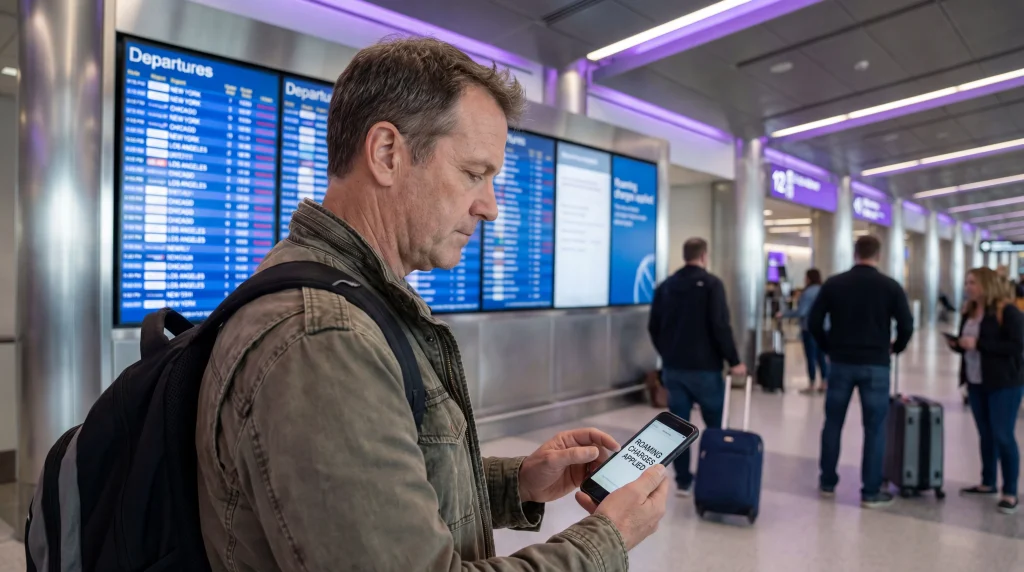

Many travelers visiting the United States wonder how much it costs to use their phone abroad.
International roaming allows your phone to connect automatically to local mobile networks when traveling overseas. However, roaming charges can sometimes be very expensive.
Tourists arriving in cities such as New York, Los Angeles, Miami, and Las Vegas often need mobile internet for:
- Maps and navigation
- Ride-hailing apps such as Uber and Lyft
- Hotel bookings and travel planning
- Messaging and social media
In this guide, we explain how roaming works in the USA, typical roaming prices, and whether alternatives like eSIM or local SIM cards are better for travelers.
How Roaming Works in the USA
When you enable international roaming on your phone, your device connects to one of the major US mobile networks.
The primary mobile operators in the United States include:
- AT&T
- T-Mobile US
- Verizon
Your home carrier partners with these networks to provide mobile service while you are traveling.
However, roaming charges depend entirely on your home mobile provider, not the US network.
Typical Roaming Prices in the USA
Roaming prices vary widely depending on your carrier and country of origin.
Typical roaming costs may include:
|
Service |
Typical Price |
|
Mobile data |
$5 – $15 per GB |
|
Calls |
$1 – $3 per minute |
|
SMS |
$0.25 – $0.50 per message |
Some carriers offer international roaming packages that include a daily fee for using your phone abroad.
For example, travelers may pay $10–$15 per day for roaming packages.
Advantages of Using Roaming
Roaming can sometimes be convenient for short trips.
Advantages include:
- No need to install a new SIM card
- Your phone number remains active
- Automatic network connection after arrival
This option may be useful for travelers staying in the United States for only one or two days.
Disadvantages of Roaming
Despite its convenience, roaming can also be expensive.
Common disadvantages include:
- High mobile data prices
- Limited data allowances
- Expensive calls and SMS
Because of this, many travelers prefer alternatives such as local SIM cards or eSIM plans.
Alternative: Using eSIM in the USA
One of the easiest ways to avoid roaming charges is installing an eSIM before traveling.
An eSIM is a digital SIM card that allows mobile data to be activated directly on a compatible smartphone.
If you’re unfamiliar with the technology, read our guide explaining how eSIM works.
Advantages of eSIM include:
- Lower mobile data costs
- Instant internet after landing
- No need to visit local stores
Travelers can explore USA eSIM plans for convenient connectivity.
For a full overview of internet options, see our guide on how to get internet in the USA as a tourist.
Alternative: Buying a Local SIM Card
Another option is purchasing a local prepaid SIM card in the United States.
Tourists can buy SIM cards from mobile operators such as AT&T, T-Mobile, or Verizon.
You can read our comparison guide on the best SIM card for the USA.
Local SIM cards usually offer larger data packages compared to roaming plans.
Roaming vs eSIM vs Local SIM
|
Option |
Cost |
Convenience |
Setup |
|
Roaming |
Expensive |
High |
Automatic |
|
Local SIM |
Moderate |
Medium |
After arrival |
|
eSIM |
Moderate |
Very high |
Before travel |
For many travelers, eSIM offers the best balance between price and convenience.
Final Thoughts
International roaming in the United States can be convenient but often comes with high mobile data costs.
While roaming may work for short trips, most travelers prefer more affordable options such as local SIM cards or travel eSIM plans.
Installing an eSIM before traveling can help ensure that you have internet access immediately after landing in the United States without paying expensive roaming fees.
Frequently asked questions
How much does roaming cost in the USA?
Roaming prices typically range between $5 and $15 per GB, depending on your mobile carrier.
Can I use my phone in the USA with roaming?
Yes. Most modern smartphones support international roaming and can connect to US mobile networks.
Is roaming cheaper than buying a SIM card?
In most cases, roaming is more expensive than using a local SIM card or travel eSIM.
Can I avoid roaming charges in the USA?
Yes. You can avoid roaming charges by using a local SIM card or installing an eSIM before traveling.
Roaming prices typically range between $5 and $15 per GB, depending on your mobile carrier.
Yes. Most modern smartphones support international roaming and can connect to US mobile networks.
In most cases, roaming is more expensive than using a local SIM card or travel eSIM.
Yes. You can avoid roaming charges by using a local SIM card or installing an eSIM before traveling.

