


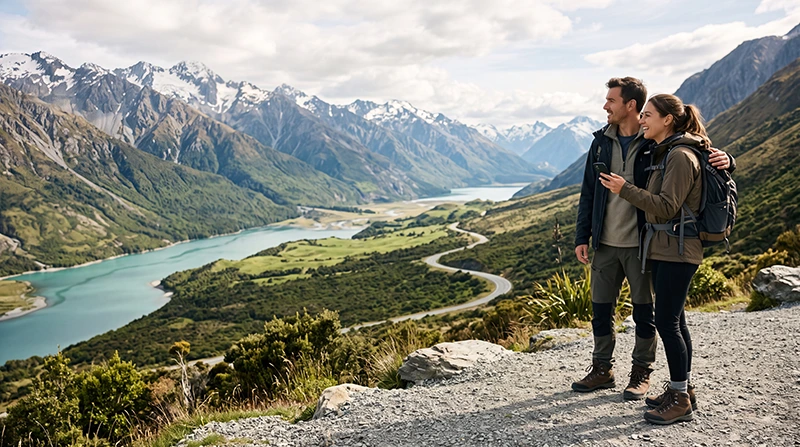

New Zealand has broad 4G service in populated areas, but coverage is not continuous across every road, valley, coast or walking track. A network claim covering most residents describes population reach, not the percentage of land with usable reception.
Visitors should check the current map for the exact route and overnight stops. Terrain, vegetation, buildings, congestion and an imported phone’s supported bands can change the real result.
NoveSIM plans are data-only, and the available partner network depends on the live plan. We do not guarantee 4G or 5G at a particular location.
Quick answer: Expect reliable 4G in major cities and many towns, but plan for gaps on remote highways, the South Island’s mountainous routes and hiking areas. Check the partner network’s map, make sure the phone supports Band 28, and download maps before leaving coverage.
Top New Zealand eSIMs

New Zealand eSIM
Fixed
1 GB, 7 days€ 2.202 GB, 15 days€ 3.963 GB, 30 days€ 5.28Unlimited
Unlimited, 1 day€ 2.64Unlimited, 3 days€ 6.61Unlimited, 5 days€ 10.57
Asia eSIM
Fixed
1 GB, 7 days€ 4.402 GB, 15 days€ 7.933 GB, 30 days€ 10.57Unlimited
Unlimited, 1 day€ 5.72Unlimited, 3 days€ 15.41Unlimited, 5 days€ 25.10What the Coverage Maps Actually Show
Spark and One NZ describe their maps as predictions of outdoor coverage rather than guarantees. Indoor construction, hills and distance from a cell site can reduce the signal. Both networks now focus on 4G and 5G; their legacy 3G shutdowns were completed in March 2026.
An overseas handset should support the frequencies used locally. Band 28 at 700 MHz is particularly important for wider rural reach, while other bands add capacity in populated areas.
North Island and South Island Differences
The North Island has extensive service around Auckland, Wellington and other population centres, but gaps remain possible in forested, coastal and remote interior areas. The South Island combines well-connected cities with long stretches shaped by mountains, valleys and low population density.
Do not choose a network from an island-wide label. Check Auckland to Rotorua, Queenstown to the West Coast, or any other route stop by stop. The South Island network guide covers that itinerary in more detail, while the national network comparison explains the wider choice.
Coverage on Road Trips and Scenic Routes
- Download the day’s route while still in a town.
- Save accommodation access instructions and ferry details offline.
- Do not depend on a live stream for entertainment between remote stops.
- Carry a charging cable or power bank; repeated network searching drains the battery.
- Tell another person the route when travelling beyond dependable service.
Mobile data helps with navigation and bookings, but offline preparation is part of the connectivity plan. The navigation-app guide explains which information to download.
Great Walks and Remote Hiking Areas
Reception can disappear beyond a trailhead and should never be treated as an emergency system. Download track information and weather updates beforehand, follow official safety advice and carry the equipment appropriate to the route. An eSIM cannot replace a personal locator beacon where one is recommended.
What to Do When the Signal Disappears
- Move to an open position only when it is safe to do so.
- Wait briefly for the phone to register again rather than repeatedly toggling settings.
- Keep automatic network selection enabled unless the plan’s support guidance asks for a manual test.
- Restart the phone after returning to a known coverage area.
- If other devices have service but the eSIM does not, follow the New Zealand troubleshooting guide.
Related Articles
FAQ
Does New Zealand have good 4G coverage?
Yes in cities, towns and many travelled areas, but not across every rural road or remote landscape. Check exact locations on the current network map.
Which phone band is important in rural New Zealand?
Band 28 at 700 MHz is important for broad 4G reach. Compatibility with one band does not guarantee service everywhere.
Will an eSIM work on both islands?
Yes wherever its partner network has compatible service. Crossing islands does not itself require another profile.
Is there mobile coverage on New Zealand Great Walks?
Coverage may be partial or absent. Prepare as though the route will not have dependable mobile service.
Final Recommendation
Choose a plan only after identifying its New Zealand partner network and checking the actual itinerary.
Use a compatible unlocked phone, keep automatic network selection on and save essential information offline.
Broad national coverage makes mobile data useful, but careful preparation matters most where New Zealand’s terrain creates the gaps.