


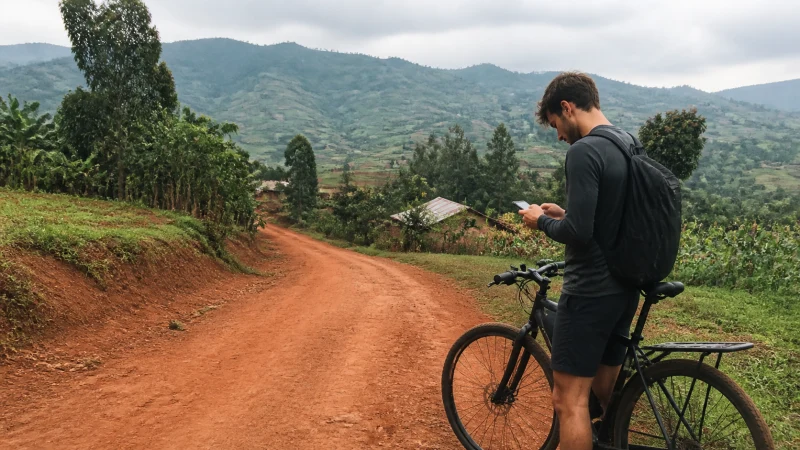

Rwanda’s rural coverage is genuinely stronger than in many comparable countries — 4G reaches roughly 85% of the population, and main roads connecting towns are generally well-covered. The real gaps are specific and well-documented: national parks, high elevations, and deep forest, rather than rural Rwanda as a whole.
Quick answer: Roads and towns across Rwanda’s “thousand hills” terrain generally maintain reasonable coverage. The specific exceptions are Nyungwe Forest (widely described as a dead zone), gorilla trekking routes above roughly 2,500 meters, and remote sections of Akagera National Park away from the main access roads.
Top Rwanda eSIMs

Rwanda eSIM
Fixed
1 GB, 7 days€ 22.662 GB, 15 days€ 43.993 GB, 30 days€ 61.76Unlimited
Unlimited, 1 day€ 20.88Unlimited, 3 days€ 60.87Unlimited, 5 days€ 100.86
Why Rwanda’s rural coverage outperforms the regional average
Rwanda’s small size, dense population, and significant government investment in telecommunications infrastructure (including the shared KTRN wholesale network historically underpinning both major operators) have combined to produce rural 4G coverage that’s genuinely strong by East African standards. This is different from countries where “rural” often means a hard absence of any network — in Rwanda, most rural towns and connecting roads have at least workable 4G.
Where coverage generally holds outside Kigali
Musanze, Rubavu, Huye, Nyanza, and the roads connecting them to Kigali generally maintain reliable coverage, reflecting both the country’s investment in infrastructure and the tourist traffic these routes carry toward gorilla trekking and Lake Kivu. Mountainous terrain — Rwanda’s nickname, the Land of a Thousand Hills, isn’t just poetic — can create brief signal dips in specific valleys even on otherwise well-covered routes, but this is minor compared to the country’s genuine dead zones.
Where it essentially disappears
Nyungwe Forest in the southwest is widely regarded as the country’s most significant connectivity dead zone, its dense canopy and remote location working against tower placement. Gorilla trekking routes above roughly 2,500 meters elevation in Volcanoes National Park lose signal even though the park headquarters and Kinigi maintain coverage. Akagera National Park has patchy 3G/4G along its main access roads, with remote bush areas away from those roads frequently offline entirely.
Border areas
Near Rwanda’s borders with Uganda, DR Congo, and Tanzania, coverage can behave somewhat unpredictably, occasionally picking up cross-border signal from neighboring networks — this is opportunistic rather than something to rely on, and inconsistent even within a short distance of any specific border crossing.
What this means for trip planning
The practical takeaway: plan around towns as your connectivity checkpoints, and treat the national parks — especially Nyungwe and the higher gorilla trekking elevations — as offline by default rather than assuming a weak-but-present signal. The Rwanda road trip guide covers preparing each leg of a longer drive with this pattern in mind.
Specific destinations worth checking individually
Coverage varies enough between Rwanda’s major attractions that it’s worth checking each one separately — the Volcanoes National Park guide, Nyungwe National Park guide, Akagera National Park guide, and Lake Kivu guide each cover what’s actually realistic to expect.
Network choice matters more here than in towns
In genuinely rural stretches, which network you’re on can make a real difference — MTN’s wider footprint gives it a real edge over Airtel in these areas specifically. The best network for Rwanda tourists guide covers this comparison.
FAQ
Does any Rwanda network cover Nyungwe Forest?
No — neither MTN nor Airtel has meaningful coverage there. This is a genuine gap, not a weak-signal situation.
Which network has the best rural coverage in Rwanda?
MTN, by a meaningful margin, though it still doesn’t cover Rwanda’s most remote forest and high-elevation areas.
Why is rural coverage better in Rwanda than many neighboring countries?
Rwanda’s small size, dense population, and significant infrastructure investment have produced unusually strong rural 4G coverage for the region.
Should I expect signal on the roads between towns?
Generally yes — main routes connecting Kigali, Musanze, and Rubavu maintain reasonable coverage, with only minor dips in specific valleys.
Is coverage better near the borders?
Sometimes, due to cross-border signal from neighboring countries, though this is inconsistent and not something to rely on.
Final Recommendation
Rwanda’s rural coverage is genuinely strong by regional standards, with clearly defined exceptions rather than broad rural gaps — Nyungwe Forest, high-elevation gorilla trekking routes, and remote Akagera are the specific areas to prepare for, while most towns and connecting roads maintain reasonable signal.