


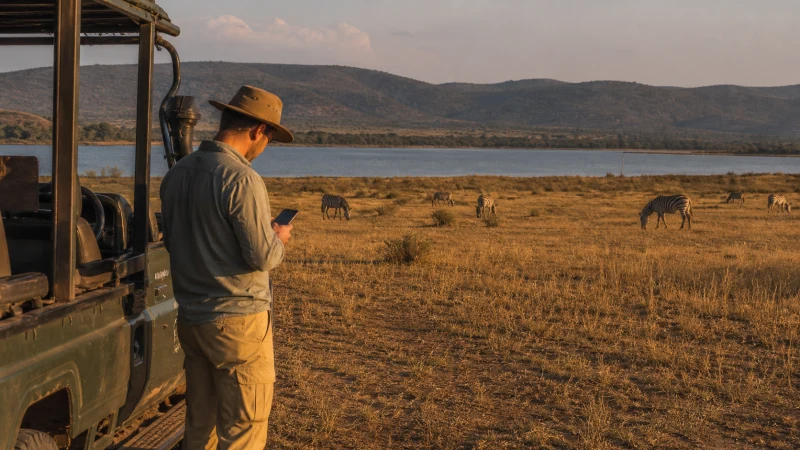

Akagera National Park is Rwanda’s answer to classic East African safari country — open savanna, lakes, and papyrus swamp rather than dense rainforest — and that difference in terrain actually works in visitors’ favor for connectivity compared to Volcanoes or Nyungwe.
Quick answer: Akagera generally holds better signal than Rwanda’s forest parks, since open savanna lets towers reach further than dense canopy does — expect functional though not fast 4G or 3G across most of the main game-drive routes, with weaker patches near the park’s more remote northern and western edges.
Top Rwanda eSIMs

Rwanda eSIM
Fixed
1 GB, 7 days€ 22.662 GB, 15 days€ 43.993 GB, 30 days€ 61.76Unlimited
Unlimited, 1 day€ 20.88Unlimited, 3 days€ 60.87Unlimited, 5 days€ 100.86
Why savanna coverage differs from forest parks
Unlike Volcanoes National Park or Nyungwe, where dense vegetation blocks signal almost entirely once you’re off the main road, Akagera’s open grassland and lower tree cover let mobile signal travel further from the towers serving the park’s edges and nearby towns. This doesn’t mean full coverage everywhere, but it’s a noticeably different experience from the near-total blackout typical of forest trekking.
Coverage on game drives
Most of the park’s main game-drive circuit, closer to the eastern and southern sections near the main entrance, retains workable signal for messaging and occasional browsing, useful for confirming lodge arrangements or sharing a sighting in something close to real time.
The northern approach from Nyagatare
Visitors approaching Akagera’s northern reaches, more commonly reached via Nyagatare than the main southern entrance, should expect a similar drop in coverage to the surrounding savanna districts — this part of the park sees far fewer visitors and correspondingly less network investment nearby.
Lake Ihema boat cruises
Boat safaris on Lake Ihema, one of Akagera’s most popular activities for spotting hippos and crocodiles, generally hold signal reasonably well close to shore, fading as the boat moves further out onto open water.
Lodges and camps in Akagera
Accommodation inside and around the park ranges from tented camps to a lodge overlooking the lake, and connectivity at each tends to reflect the general savanna pattern — usable mobile data rather than the complete blackout seen at some forest lodges elsewhere in the country.
Planning a self-drive or guided safari
Because coverage here is more forgiving than Rwanda’s forest parks, real-time navigation is more workable, though it’s still worth downloading offline maps as a backup for the park’s more remote tracks — the Google Maps in Rwanda guide covers setting this up before you go.
FAQ
Is there mobile signal in Akagera National Park?
Yes, more consistently than in Rwanda’s forest parks, thanks to the open savanna terrain, though it’s not uniform across the whole park.
Why is Akagera better covered than Volcanoes or Nyungwe?
Open grassland lets mobile signal travel further from nearby towers than dense forest canopy does.
Is the northern part of the park as well covered?
No — the northern sections, often reached via Nyagatare, see weaker coverage than the main southern entrance area.
Will I have signal on a Lake Ihema boat cruise?
Generally near shore, fading as you move further out onto the water.
Do lodges in Akagera have WiFi?
Some do, though most rely on the park’s generally workable mobile coverage rather than dedicated satellite setups.
Should I still download offline maps for Akagera?
Yes — coverage is better than in forest parks but not guaranteed everywhere, especially on remote tracks.
Final Recommendation
Akagera is the most connected of Rwanda’s national parks thanks to its open terrain, though the northern approach and remote tracks still warrant a backup plan. See the internet in Nyagatare guide if you’re approaching from the north.