


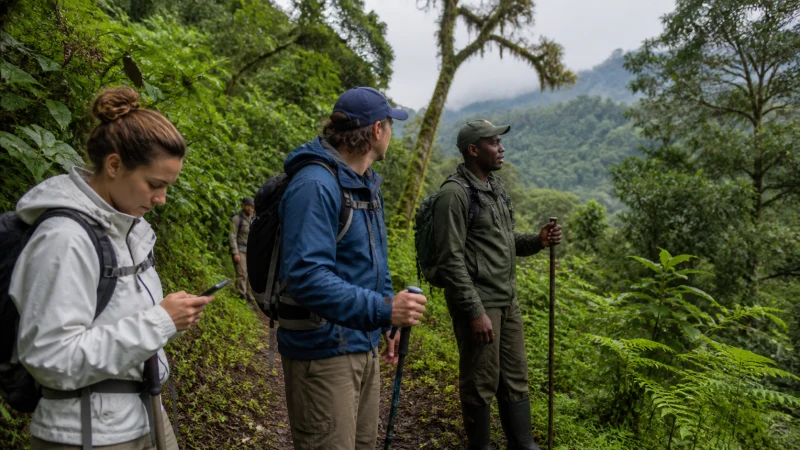

Gorilla trekking day has a rhythm most first-timers don’t expect: an early, well-connected briefing, then a hike that can run anywhere from thirty minutes to several hours through terrain with no mobile signal at all, followed by an hour face-to-face with a habituated gorilla family that most guides ask you to experience rather than film start to finish.
Quick answer: Plan around a hard cutoff rather than a gradual fade — coverage at the Kinigi park headquarters, where briefings happen, is solid, and then drops out almost entirely once you enter the forest itself. There’s no workaround for this; treat the trek as several offline hours and handle anything urgent before you set out.
Top Rwanda eSIMs

Rwanda eSIM
Fixed
1 GB, 7 days€ 22.662 GB, 15 days€ 43.993 GB, 30 days€ 61.76Unlimited
Unlimited, 1 day€ 20.88Unlimited, 3 days€ 60.87Unlimited, 5 days€ 100.86
The morning briefing at Kinigi
Gorilla permits are assigned and briefings held at Volcanoes National Park headquarters in Kinigi, just outside Musanze, where 4G coverage is reliable enough to handle last-minute messages, confirm pickup arrangements, or check trek group assignments before heading out.
Why signal disappears in the forest
Once trekking groups move into the bamboo and forest zones where the gorilla families range, dense vegetation and the absence of nearby towers combine to cut mobile signal almost completely. This isn’t a coverage gap that better equipment fixes — it’s simply outside the range of Rwanda’s mobile network infrastructure, similar to conditions inside Nyungwe’s deep forest trails.
How rangers stay in contact
Park rangers and trackers use dedicated radio systems rather than mobile networks to coordinate gorilla family locations and communicate with headquarters, which is part of why the park doesn’t rely on tourists’ phones for safety during the trek — guides carry the necessary equipment independently of whatever signal your device does or doesn’t have.
What this means for planning your day
Download anything you’ll want during the trek — offline maps, photos you plan to reference, messages you’re expecting — before leaving your lodge or the Kinigi briefing area, since there’s no predicting exactly when signal will return once you’re back down. The Google Maps in Rwanda guide covers setting up offline maps in advance.
Signal after the trek
Coverage returns once you’re back at the trailhead and descending toward the park boundary, and by the time you’re back in Musanze town, connectivity is fully back to normal. Most visitors find this the easiest time to upload trek photos and share the experience, once actually connected again.
FAQ
Will I have phone signal during gorilla trekking?
Generally no — coverage drops out almost entirely once trekking groups enter the forest.
Is there WiFi at the park briefing center?
The Kinigi briefing area has solid mobile coverage, which most visitors use instead of relying on WiFi.
How do rangers communicate without phone signal?
They use dedicated radio systems rather than mobile networks, independent of tourist phone coverage.
Can I call for help during a trek if needed?
Guides and rangers carry their own communication equipment for emergencies rather than relying on visitor phones.
Should I download maps or messages before the trek?
Yes — do this at your lodge or during the briefing, since signal won’t return until you’re back near the trailhead.
When will my phone reconnect after trekking?
Signal typically returns as you descend back toward the park boundary and is fully restored by the time you reach Musanze.
Final Recommendation
Treat gorilla trekking as a genuinely offline few hours rather than an inconvenience to work around — handle logistics at the Kinigi briefing, then let the trek itself be disconnected. See the internet in Musanze guide for coverage in the town you’ll return to afterward.