


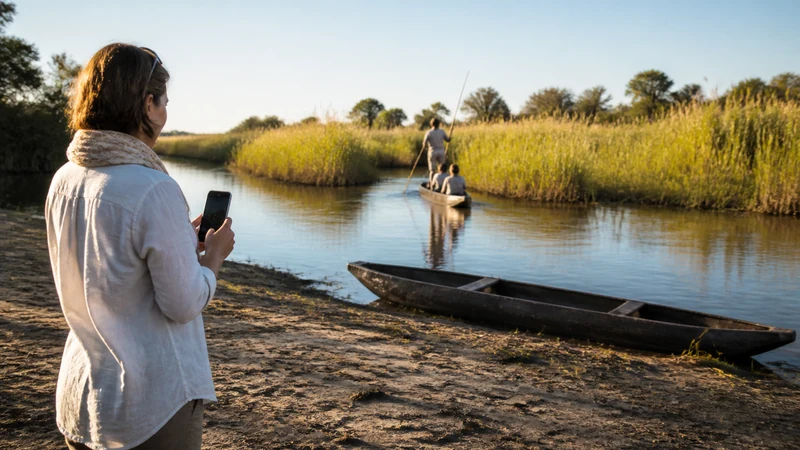

Maun has reliable 4G. The Delta itself, an hour’s light aircraft flight away, generally has none. That contrast catches people off guard more than almost anywhere else in Botswana — you leave a town with perfectly normal connectivity and land somewhere your phone becomes, functionally, just a camera.
Top Botswana eSIMs

Botswana eSIM
Fixed
1 GB, 7 days€ 11.552 GB, 15 days€ 25.333 GB, 30 days€ 31.10Unlimited
Unlimited, 1 day€ 16.44Unlimited, 3 days€ 46.65Unlimited, 5 days€ 77.31
Why the Delta is different from a typical coverage gap
This isn’t weak signal or an occasional dead spot — most camps inside the Delta are reached by light aircraft or mokoro (traditional canoe), well beyond any mobile tower’s reach, and that’s largely intentional. The remoteness is part of what the Delta sells as an experience. A small number of camps, like Chief’s Camp, have their own slow internet access; the rest rely on radio or satellite phone for communication, not ordinary cell service.
Lodge WiFi: increasingly common, still limited
More camps have been adding satellite-based WiFi in recent years, including a growing number running Starlink specifically. Where it exists, it’s generally fine for messaging and light browsing, but stutters or fails outright on video calls, and some properties ration access to brief check-in windows rather than leaving it on all day. Don’t assume a lodge has WiFi just because a nearby or similarly-priced property does — check with your specific camp directly.
What to settle before you fly in
- Confirm your flight and camp transfer details in writing while you’re still in Maun — once you’re airborne, there’s no way to check or change anything.
- Download offline maps of the wider Okavango region using the Google Maps in Botswana guide, though note that offline maps are of limited use once you’re on a mokoro or in a bush camp without roads.
- Save your camp’s coordinates, transfer arrangements, and any emergency contact information as screenshots rather than relying on reopening an email or message thread.
- Let someone outside the Delta know your rough itinerary and expected return, since you’ll likely be unreachable by ordinary means for the length of your stay.
How camps handle communication and emergencies
Camps in the Delta are not equipped to leave guests genuinely stranded — satellite phones and radio communication with the wider camp network are standard, even where guest WiFi doesn’t exist. If you have a specific medical or safety concern, raise it with your camp or tour operator before you fly in, since this is the channel that actually functions in an emergency, not your personal phone signal.
Your eSIM still matters — just not inside the Delta
A working eSIM is genuinely useful in Maun before and after your Delta stay: sorting out last-minute bookings, confirming the flight in, checking messages once you’re back. It simply won’t do anything once you’re airborne toward camp. The best network for Botswana tourists guide covers which operator to use for the Maun and surrounding legs of the trip.
Data planning for a Delta-inclusive trip
Since the days actually spent in the Delta use little to no data by necessity, the data budget for a Botswana trip is really about Maun, Gaborone, and any other towns on the itinerary — the Botswana data-use guide covers rough estimates that account for this pattern.
FAQ
Will my phone work at all in the Okavango Delta?
Generally no — most camps have no mobile signal. A small number offer satellite WiFi, which handles messaging but not much more.
How do I contact camp staff or my tour operator once I’m in the Delta?
Camps use radio and satellite phone for their own operations and emergencies — raise any specific concerns before you fly in, since this channel works even without guest WiFi.
Should I bring a satellite communicator?
For genuine peace of mind on a Delta trip, some travelers do, though most rely on the camp’s own satellite and radio systems rather than carrying their own device.
Is Maun a reliable place to sort out connectivity before flying in?
Yes — Maun has solid 4G, making it the right place to confirm bookings, download offline maps, and handle anything time-sensitive before you lose signal entirely.
Final Recommendation
Treat the Okavango Delta as fully offline for the length of your stay, regardless of which network or eSIM you’re using. Settle flight details, camp coordinates, and any time-sensitive communication while you’re still in Maun, and let the Delta be the disconnected experience it’s largely designed to be.