


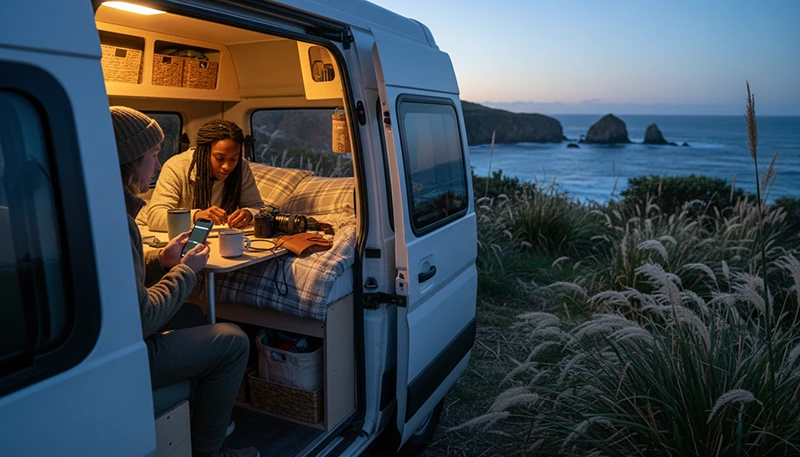

Mobile data is an important part of a New Zealand campervan trip. It helps you navigate to campsites, check weather and road conditions, find fuel or charging points, manage bookings and contact the rental company when your plans change.
Campervan travel also takes you beyond the main cities. You may drive through farmland, forests, mountain areas, national parks and remote coastal regions where mobile signal can vary. A suitable data plan is useful, but it should always be supported by offline maps and saved travel information.
Quick answer: a travel eSIM is usually the easiest way to arrange mobile data for a New Zealand campervan holiday. Install it before departure, select it for Mobile Data after arrival and enable Data Roaming on the travel eSIM. Download maps, campsite locations and booking confirmations before leaving towns because coverage cannot be guaranteed at every campsite or rural road.
Top New Zealand eSIMs

New Zealand eSIM
Fixed
1 GB, 7 days€ 2.182 GB, 15 days€ 3.933 GB, 30 days€ 5.24Unlimited
Unlimited, 1 day€ 2.62Unlimited, 3 days€ 6.54Unlimited, 5 days€ 10.47
Asia eSIM
Fixed
1 GB, 7 days€ 4.362 GB, 15 days€ 7.853 GB, 30 days€ 10.47Unlimited
Unlimited, 1 day€ 5.67Unlimited, 3 days€ 15.27Unlimited, 5 days€ 24.87Best Mobile Data Options for Campervan Travellers
| Option | Best For | Main Consideration |
|---|---|---|
| Travel eSIM | Convenient mobile data arranged before travel | Requires an unlocked eSIM-compatible phone |
| Local prepaid SIM | Travellers who want a New Zealand number | Usually purchased and activated after arrival |
| International roaming | Short trips with a suitable roaming package | May be expensive without an inclusive bundle |
| Campground WiFi | Large downloads and occasional browsing | Speed, range and availability vary |
| Pocket WiFi | Groups sharing one connection | Requires another device and regular charging |
Why Campervan Travellers Need Mobile Data
A campervan gives you flexibility, but it also requires more planning than a hotel-based holiday. You may need to make decisions while already on the road.
Mobile data can help you:
- Navigate to campsites and holiday parks.
- Check whether overnight parking is permitted.
- Open booking and check-in instructions.
- Find fuel stations or electric vehicle chargers.
- Locate dump stations and water refill points.
- Check weather warnings and road conditions.
- Contact the campervan rental company.
- Find supermarkets, pharmacies and laundries.
- Manage ferry and attraction reservations.
- Use messaging and internet-based calls.
It is particularly useful when weather, road closures or limited campsite availability force you to change your itinerary.
Using a Travel eSIM in a Campervan
A travel eSIM is a digital plan installed directly on a compatible smartphone. It can provide mobile data without replacing your primary SIM.
This is convenient for campervan travellers because the eSIM can usually be installed before departure. Once you arrive, you can connect while collecting the vehicle, navigating away from the rental depot and travelling towards your first overnight stop.
A travel eSIM is a practical choice when:
- You want mobile data immediately after landing.
- You prefer not to visit a local mobile shop.
- You want to keep your home SIM installed.
- You mainly use maps, messaging and online bookings.
- You plan to travel across several New Zealand regions.
- You want an independent connection instead of relying on campsite WiFi.
Browse New Zealand eSIM plans.
When a Local Prepaid SIM May Be Better
A local prepaid SIM may be preferable when you need a New Zealand telephone number, traditional calls or SMS.
Before buying one, compare:
- The included mobile data.
- The plan validity.
- Whether calls and SMS are included.
- Whether hotspot sharing is supported.
- How additional data can be purchased.
- Whether the displayed price includes an active package.
A physical SIM may require you to remove your home SIM unless your phone supports multiple active lines.
Compare a local SIM and eSIM for New Zealand.
How Much Mobile Data Do You Need?
Your ideal data allowance depends on the length of the trip and how many devices will use the connection.
| Campervan Trip Length | Suggested Starting Point |
|---|---|
| 3 to 5 days | 3 GB to 5 GB |
| 7 days | 5 GB to 10 GB |
| 10 to 14 days | 10 GB to 20 GB |
| 3 to 4 weeks | 20 GB or more |
| Remote work or frequent hotspot use | A larger allowance |
Navigation, messaging, weather applications and campsite searches usually consume less data than video streaming, video calls, cloud backup and laptop tethering.
Read how much data you need for New Zealand.
What Uses the Most Data in a Campervan?
| Activity | Typical Data Impact |
|---|---|
| Messaging and email | Low |
| Maps and campsite searches | Low to moderate |
| Internet audio calls | Moderate |
| Social media video | High |
| Video calls | High |
| Streaming films or television | Very high |
| Automatic photo backup | Very high |
| Laptop hotspot use | Varies significantly |
Automatic cloud backup is a common cause of unexpectedly high usage. Travel photographs and videos may begin uploading as soon as the phone detects a working data connection.
Can You Expect Mobile Data at Every Campsite?
No. Mobile coverage is generally easier to find in cities, towns and populated travel corridors. Signal may be limited or unavailable at remote camping areas.
Coverage can vary in:
- Mountain passes and deep valleys.
- National parks.
- Dense forest areas.
- Remote beaches and coastal roads.
- Sparsely populated rural regions.
- Basic campsites far from towns.
- Areas surrounded by steep terrain.
A loss of signal does not necessarily mean that the eSIM is incorrectly configured. Geography, distance from network infrastructure and local congestion may affect the connection.
Do not change advanced settings immediately when service disappears in a remote location. Continue towards a more open or populated area and check again.
North Island Campervan Coverage Planning
A North Island itinerary may include Auckland, Hamilton, Rotorua, Taupo and Wellington. Mobile data is useful for traffic, attraction bookings, weather forecasts and campsite searches.
Prepare offline information before travelling through rural Waikato, forested regions, volcanic landscapes or remote coastal areas.
You can also read the internet guide for a North Island road trip.
South Island Campervan Coverage Planning
South Island campervan trips often include longer driving distances, mountain routes and rapidly changing weather.
Download information before driving towards areas such as:
- Fiordland and Milford Sound.
- Aoraki Mount Cook.
- The West Coast.
- The Catlins.
- Remote parts of Canterbury and Otago.
Save the complete route, campsite coordinates, fuel stops and rental-company details before leaving a larger town.
See the internet guide for a South Island road trip.
Download Offline Maps Before Each Driving Day
Offline maps are essential because they can continue showing your route when mobile data is temporarily unavailable.
Before leaving a town or campground with WiFi:
- Download the complete driving area.
- Save your planned campsite location.
- Mark fuel or charging stops.
- Save dump stations and water points.
- Download an alternative route where possible.
- Take screenshots of access and check-in instructions.
Keep location services enabled. Your phone can often continue showing its position on a downloaded map even without a mobile connection.
Using Campground WiFi
Some commercial campgrounds and holiday parks offer WiFi, but the experience can differ greatly between locations.
Campground WiFi may:
- Work only near reception or shared facilities.
- Require a password or additional payment.
- Include time or data limits.
- Become slow during busy evening hours.
- Be unavailable at basic or remote sites.
Use WiFi for large downloads, software updates and media backup when the connection is reliable. Keep mobile data available for driving, navigation and urgent communication.
Can You Share Mobile Data with Other Devices?
Hotspot sharing may be available depending on the selected eSIM, prepaid SIM or roaming plan.
A hotspot can connect:
- A travel companion’s phone.
- A tablet.
- A laptop.
- A second navigation device.
Before connecting a laptop, disable automatic software updates, cloud synchronisation and large background downloads. These can consume several gigabytes without obvious warning.
One shared hotspot may be suitable for travellers who stay together. Separate data plans may be more practical when people split up for different activities.
How to Reduce Mobile Data Use
- Download maps through WiFi.
- Save music, podcasts and entertainment offline.
- Pause automatic photo and video backups.
- Disable automatic application updates.
- Turn off automatic video playback.
- Reduce streaming quality.
- Save campsite bookings and tickets locally.
- Disconnect hotspot users when they finish.
- Monitor usage through the phone settings.
Keep Your Phone Charged
Navigation, hotspot use and searching for a weak signal can drain a phone battery quickly. Carry a suitable charging cable and confirm which charging ports are available in the campervan.
A power bank is useful during walks, campsite stays and periods when the vehicle is not running. Download important information before the battery becomes low.
Can You Keep Your Home SIM Active?
Yes. A compatible Dual-SIM phone can use a travel eSIM for mobile data while keeping the primary SIM available for calls, SMS and verification messages.
To reduce accidental roaming costs:
- Select the travel eSIM for Mobile Data.
- Turn off Data Roaming on the primary SIM.
- Disable Automatic Data Switching.
- Check the selected line before making a traditional call.
Your home provider may still charge for calls, voicemail or certain messages while abroad.
Will WhatsApp Keep Your Existing Number?
Yes. WhatsApp normally continues using the telephone number already registered to your account while another SIM or eSIM provides mobile data.
Do not choose Change Number unless you intentionally want to move the account to another telephone number.
How to Check eSIM Compatibility
Check the manufacturer’s specifications for your exact phone model and regional version. The device must also be carrier-unlocked.
You can dial *#06#. An eSIM-compatible phone may display an EID together with one or more IMEI numbers.
You may also see Add eSIM, Add Cellular Plan, Add Mobile Plan or SIM Manager in the device settings.
Recommended eSIM Settings
| Setting | Recommended Value |
|---|---|
| Travel eSIM | Enabled after arrival |
| Mobile Data | Travel eSIM |
| Data Roaming on travel eSIM | On |
| Data Roaming on primary SIM | Off |
| Automatic Data Switching | Off |
| Network Selection | Automatic |
| APN | data.esim when required |
What If Mobile Data Does Not Work?
- Confirm that the plan includes New Zealand.
- Check that the travel eSIM is enabled.
- Select it for Mobile Data.
- Enable Data Roaming on the travel eSIM.
- Turn off Data Roaming on the primary SIM.
- Disable Automatic Data Switching.
- Leave Network Selection on Automatic.
- Check that the APN is data.esim.
- Turn Airplane Mode on for 30 seconds and turn it off.
- Wait several minutes for network registration.
- Restart the phone if necessary.
Move towards an open or populated area before changing more settings because the problem may be weak local signal rather than the plan itself.
Do not delete the eSIM while troubleshooting. The installation QR code may be valid for one installation only.
Campervan Mobile Data Checklist
- Choose validity covering the entire trip.
- Select enough data for maps, bookings and communication.
- Check whether hotspot sharing is supported.
- Confirm that the phone is unlocked and eSIM-compatible.
- Install the eSIM before departure where possible.
- Save the installation instructions offline.
- Download maps before long driving sections.
- Save campsite coordinates and access instructions.
- Mark fuel, charging, water and dump-station stops.
- Carry a charging cable and power bank.
- Pause automatic backups and updates.
- Do not rely only on campground WiFi.
- Do not expect continuous remote coverage.
Related New Zealand Travel Internet Guides
- New Zealand eSIM Plans
- Best eSIM for New Zealand
- Internet for a New Zealand Campervan Trip
- Internet for a New Zealand Road Trip
- Mobile Data for a New Zealand Road Trip
- Internet for a North Island Road Trip
- Internet for a South Island Road Trip
- How Much Data Do You Need for New Zealand?
FAQ
What is the best mobile data option for a New Zealand campervan trip?
A travel eSIM is usually the easiest option for travellers who mainly need mobile data. A prepaid SIM may be better when you also need a New Zealand telephone number.
Will mobile data work at every campsite?
No. Signal may vary at remote, forest, coastal and mountain campsites. Save maps and campsite information before leaving towns.
How much data do I need for a two-week campervan trip?
Approximately 10 GB to 20 GB is a useful starting point for navigation, messaging and bookings. Choose more for streaming, remote work or regular hotspot use.
Can I rely on campground WiFi?
Campground WiFi can be useful for large downloads, but speed, availability and range vary. It should supplement rather than replace mobile data.
Can I share my eSIM data with other travellers?
Hotspot sharing may be available depending on the selected plan. Check the plan conditions before relying on tethering.
Can I keep my normal SIM active?
Yes. Select the travel eSIM for Mobile Data, disable roaming on the primary SIM and turn off Automatic Data Switching.
What APN should I use for NoveSIM?
Use data.esim when manual APN configuration is required.
Final Recommendation
For most campervan travellers, a travel eSIM is the simplest way to arrange mobile data before arriving in New Zealand. It allows you to use maps, campsite searches and booking tools while keeping your primary SIM installed.
Choose enough validity and data for the complete journey, but combine your mobile plan with offline preparation. Download maps, campsite locations, fuel stops and important instructions before travelling into rural or remote regions.
Use campground WiFi when it is available for larger downloads, but keep mobile data as your main connection while driving.