


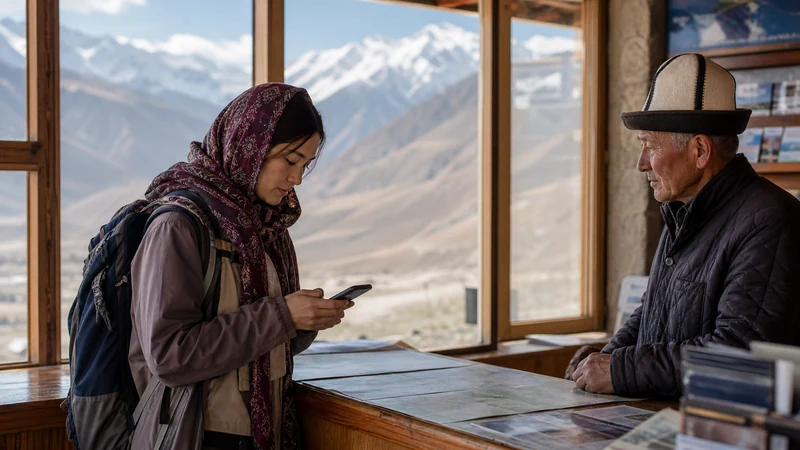

A Central Asia eSIM can serve a trip including Kyrgyzstan only when the specific package lists Kyrgyzstan and every other country where you intend to use it. A regional name is not enough to establish coverage, and a Kyrgyzstan-only plan should not be assumed to cover Kazakhstan or Uzbekistan.
For a Bishkek–Almaty journey or a longer itinerary continuing to Uzbekistan, start with the actual country sequence and dates. Then decide whether one eligible multi-country package or separate country plans better fits that journey.
Our NoveSIM travel eSIMs provide data, not a local phone number, conventional calls or SMS. Internet messaging and calling can use an available data connection; retain another calling option if your arrangements require ordinary telephone calls.
Quick answer: Check the included-country list before choosing a Central Asia plan. If it covers every stop and its validity fits the whole journey, one package may be suitable. Otherwise, arrange separate plans for the uncovered countries. Install according to each order’s instructions, save arrival details offline and do not expect a border crossing to provide uninterrupted mobile data.
Top Kyrgyzstan eSIMs

Kyrgyzstan eSIM
Fixed
1 GB, 7 days€ 3.182 GB, 15 days€ 5.913 GB, 30 days€ 8.19Unlimited
Unlimited, 1 day€ 5.46Unlimited, 3 days€ 12.28Unlimited, 5 days€ 19.11
Commonwealth of Independent States eSIM
Fixed
1 GB, 7 days€ 8.192 GB, 15 days€ 17.743 GB, 30 days€ 18.65Unlimited
Unlimited, 1 day€ 8.64Unlimited, 3 days€ 23.20Unlimited, 5 days€ 37.31Read the Central Asia eSIM Country List, Not Just Its Name
Write down the countries where you need mobile data, including overnight transit stops. Compare that list with the exact package description. “Asia”, “regional” and “global” describe a product’s scope, but they do not independently confirm that a particular destination is included.
For the Kyrgyzstan leg, the Kyrgyzstan eSIM product page is the starting point for available country-plan options. Its inclusion of Kyrgyzstan is not evidence that the same plan extends to a neighbouring country.
If a package’s country list is unclear, ask for confirmation before buying. Do not infer eligibility from an operator name, a map of the region or the fact that two countries share a land border. Access is determined by the purchased plan and its terms.
When One Package Is Simpler—and When Separate Plans Make Sense
One multi-country package can reduce the number of purchases and data-line changes, provided all required countries are included. You still need to check the allowance, validity, supported networks and any usage restrictions. A single purchase is convenient only if it fits the itinerary.
Separate country plans let you choose an allowance and duration for each leg. They also require more organisation: identify the right profile, know when each plan starts and confirm that the handset can keep the required profiles installed. Stored profiles and simultaneously active lines are not the same thing; device limits differ.
Neither approach is automatically cheaper. Compare the total cost of the eligible options for your dates rather than contrasting a whole-trip plan with an allowance that covers only a few days. Do not count an unused balance as transferable to another country unless the plan explicitly permits that use.
Match Validity to the Country Sequence
Imagine three nights in Kazakhstan, eight in Kyrgyzstan and four in Uzbekistan. Those dates are an example for organising the purchase, not a suggested route or a statement about border access. A whole-trip package needs enough validity for the full period in which you will use it; separate plans need to fit their individual legs.
Before installation, check what starts the validity period for each order. Installation, activation and first network connection are different events, and the trigger must come from the plan instructions. Do not apply the first package’s rule to every later purchase.
- Record the arrival and departure dates for every country where you need data.
- Note each selected plan’s included countries, allowance and validity-start rule.
- Check that the final day of each leg falls within the usable period.
- Save the order instructions and support details somewhere accessible offline.
- Recheck the plan dates if flights, accommodation or the country sequence change.
For allowance calculations, use the Kyrgyzstan data-planning guide for your actual online activities. On a shared multi-country allowance, data spent during the first leg leaves less for later stops; crossing a border does not by itself replenish it.
Prepare the Next Data Line Before You Need It
If you are using separate plans, install the next profile on a dependable connection when its instructions allow. Label profiles clearly by country or order so that you do not select an expired plan by mistake. Keep the activation details private.
The Kyrgyzstan installation guide explains the Kyrgyzstan setup. For a different country’s package, follow that order’s instructions instead of copying network or APN settings from the Kyrgyzstan plan.
When you arrive in the next country, select the eligible line for mobile data and apply its required settings. With one multi-country profile, you may not need to change the data line, but the phone still has to register on a permitted local network. Installation in advance is preparation, not a guarantee of immediate registration.
Keep the Border Transition Usable Without Internet
Save the next accommodation address, transport meeting point, booking confirmation and relevant map area before leaving a reliable connection. A location pin in a chat is not necessarily a downloaded map. Test that the information opens offline.
Mobile signal near a border does not prove that the selected package is valid in the country you have entered. Check your location, selected data line and package coverage before relying on the connection. Do not switch to home-SIM data simply because a travel line is taking time to connect; first understand your home provider’s roaming charges.
For the two-country details, use the Kyrgyzstan–Kazakhstan connectivity guide or the Kyrgyzstan–Uzbekistan connectivity guide. These connectivity resources do not establish whether a crossing is open or whether your documents permit entry. Check travel and entry arrangements separately with current official sources.
What to Check If the Same eSIM Stops Working in the Next Country
First confirm that the country is included in the package you actually bought, not merely in another package sold under a similar name. Then check validity, remaining allowance and the chosen mobile-data line. An installed profile can remain visible after its usable plan has expired.
Turn off Wi-Fi briefly and try loading a fresh page when you are in a place where you expect service. A cached map, old message or signal indicator alone is not a successful data test. If settings appear correct, follow the order’s troubleshooting instructions or contact support.
Keep the installed eSIM unless support explicitly instructs you to remove it. Deleting a profile does not add an excluded country or renew an expired allowance, and reinstallation may not be available. Have the order reference, exact phone model and present location ready for support.
Related Articles
FAQ
Can one eSIM cover Kyrgyzstan, Kazakhstan and Uzbekistan?
Potentially, if the exact purchased package explicitly includes all three countries. Do not assume that every Central Asia or Asia plan does. If any stop is excluded, arrange another eligible plan for that leg.
Do I need a separate eSIM for every Central Asian country?
Not necessarily. Separate plans are one option; a suitable multi-country package is another. Compare included countries, duration, allowance and total cost for your actual itinerary.
Should I install the next country’s eSIM before crossing?
Prepare it on a dependable connection when the order instructions allow, after checking what starts its validity. Installing early does not guarantee continuous reception or immediate registration across the border.
Does a multi-country data allowance reset in each country?
Do not assume so. Check whether the package has a shared allowance or another stated structure. If data is shared across the trip, usage in the first country reduces what remains for subsequent stops.
Final Recommendation
Choose a Central Asia eSIM by matching its included countries and validity to the complete journey. Use separate plans where coverage or dates make them the more suitable option, not because separate packages are universally required.
Prepare the profiles and saved instructions before changing countries. At each arrival, confirm the selected data line, plan eligibility and a working connection rather than relying on the profile’s presence alone.
Keep the first route, accommodation and transport details offline for every leg. A well-matched package simplifies the trip, but it does not remove border-transition delays or local coverage gaps.