


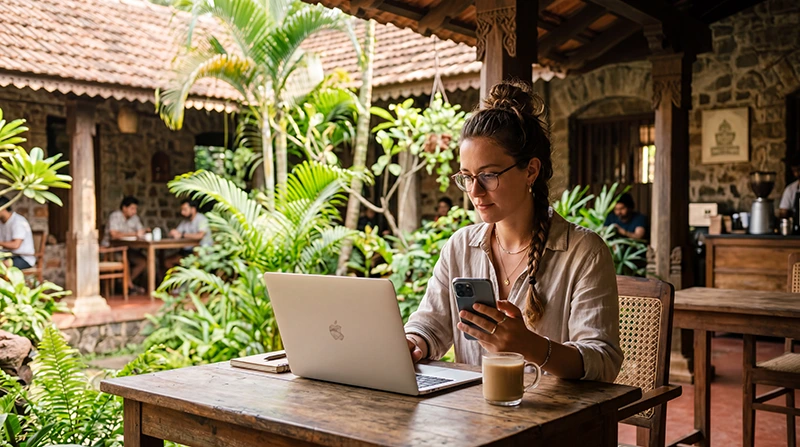

India has become an increasingly attractive destination for digital nomads, freelancers, entrepreneurs and remote employees. It offers affordable accommodation, an enormous variety of destinations, a growing coworking culture and access to major technology centres such as Bangalore, Hyderabad, Pune and Gurgaon.
Remote workers can choose between modern cities, coastal destinations, mountain towns, cultural centres and quieter wellness locations. You could spend one month working from Bangalore, move to Goa for the beach season, continue to Rishikesh for yoga and then explore Kerala or Rajasthan without leaving the country.
Reliable internet is essential for this lifestyle. Video meetings, cloud platforms, messaging apps, project-management tools, online payments and client communication all depend on a stable connection. Hotel or café WiFi may be suitable for some tasks, but digital nomads should always have a second connection available.
For most international remote workers, an India eSIM is one of the easiest ways to create that backup. It can be installed before departure and used for mobile data shortly after arriving in India without removing the regular SIM card.
Quick answer: use reliable accommodation or coworking WiFi as your primary work connection and keep an India eSIM active for mobile data, hotspot access, navigation and backup connectivity.
Top India eSIMs


Is India a Good Destination for Digital Nomads?
India can be an excellent destination for digital nomads who choose their location and accommodation carefully. Large cities often have strong fibre connections, widespread mobile coverage and a growing selection of coworking spaces. Popular tourist destinations also offer cafés and long-stay properties designed for remote workers.
The experience varies considerably between locations. A modern apartment in Bangalore may have fast and stable internet, while a beach hut in Goa or a guesthouse in the Himalayas may rely on a shared connection with variable speeds.
India is particularly attractive to digital nomads because of:
- Affordable long-stay accommodation.
- A large selection of coworking spaces.
- Strong mobile coverage in major cities.
- Numerous domestic travel destinations.
- Affordable food and local transport.
- A large English-speaking business community.
- Modern technology and startup districts.
- Different climates throughout the year.
What Is the Best Internet Setup for Remote Work in India?
The safest setup is to use two independent connections. Your primary connection can be fixed WiFi from an apartment, hotel or coworking space. Your secondary connection should be mobile data through an India eSIM or local SIM card.
| Connection | Best Use | Role in Your Setup |
|---|---|---|
| Apartment or hotel WiFi | Daily work and large files | Primary connection |
| Coworking WiFi | Meetings and focused work | Professional backup |
| India eSIM | Hotspot, travel and emergencies | Mobile backup |
| Café WiFi | Light work and short sessions | Occasional option |
| International roaming | Emergency access | Last resort |
Relying on a single WiFi network is risky. Even good accommodation can experience power interruptions, router problems or local service outages.
Why an India eSIM Is Useful for Digital Nomads
An eSIM is a digital mobile profile installed directly on a compatible smartphone. It lets you keep your primary SIM active while using a separate data plan in India.
For digital nomads, the main advantage is not only convenience. An eSIM also provides a second internet connection that can be used when accommodation WiFi becomes slow or unavailable.
- Install before travelling.
- No physical SIM replacement.
- Keep your regular phone number active.
- Use mobile data while travelling between cities.
- Connect a laptop through Personal Hotspot when supported.
- Continue using WhatsApp with your existing number.
- Avoid relying on public WiFi for every task.
- Use the same plan across supported locations in India.
India eSIM vs Local SIM Card for Remote Workers
| Feature | India eSIM | Local SIM Card |
|---|---|---|
| Install before arrival | Yes | Usually no |
| Physical SIM required | No | Yes |
| Local identity verification | No additional store visit | Usually required |
| Keep home SIM installed | Yes | Depends on the phone |
| Indian phone number | Usually no | Usually yes |
| Best for immediate connectivity | Excellent | Good after activation |
| Best for very long stays | Good | Very Good |
| Backup connection | Excellent | Excellent |
A local SIM may be useful if you plan to stay for several months or need an Indian phone number for local services. An eSIM is generally easier for short and medium-length stays or multi-city travel.
Best Cities in India for Digital Nomads
The quality of your remote-work experience depends heavily on the destination. Large technology centres usually provide the most reliable infrastructure, while beach and mountain destinations offer a better lifestyle but may require more careful accommodation selection.
| Destination | Internet Reliability | Best For |
|---|---|---|
| Bangalore | Excellent | Technology, startups and coworking |
| Hyderabad | Excellent | Business travel and modern infrastructure |
| Mumbai | Excellent | Business, finance and creative industries |
| Delhi and Gurgaon | Excellent | Corporate work and international connections |
| Goa | Very Good | Beach lifestyle and long stays |
| Kochi | Very Good to Excellent | Kerala travel and urban comfort |
| Varkala | Good to Very Good | Beach life, yoga and slower travel |
| Rishikesh | Very Good | Wellness, yoga and Himalayan access |
| Manali | Good to Very Good | Mountain lifestyle and seasonal stays |
| Jaipur | Very Good to Excellent | Culture, affordable accommodation and city life |
Remote Work in Bangalore
Bangalore, officially Bengaluru, is one of the best destinations in India for remote workers who prioritise infrastructure. The city has a large technology community, numerous coworking spaces, business hotels and apartments with strong fixed internet connections.
Popular remote-work districts include Indiranagar, Koramangala, Whitefield, HSR Layout and areas near the central business district.
Bangalore is well suited to:
- Software developers.
- Startup founders.
- Technology consultants.
- Remote corporate employees.
- Freelancers working with international clients.
Read the Bangalore internet guide.
Remote Work in Goa
Goa is one of India’s most popular digital nomad destinations. North Goa has more coworking spaces, cafés and nightlife, while South Goa offers quieter beaches and a slower lifestyle.
Internet quality varies by property. Modern villas and coworking spaces may have excellent fixed connections, while seasonal beach huts can provide slower shared WiFi.
Before booking a long stay, ask for a recent speed test and confirm whether the property has backup power and mobile signal indoors.
Remote Work in Kerala
Kerala combines coastal cities, beaches, backwaters and mountain destinations. Kochi generally offers the strongest infrastructure, while Varkala and Kovalam attract long-stay visitors looking for a beach and wellness lifestyle.
Remote workers should expect the most reliable fixed internet in urban hotels, modern apartments and dedicated coworking spaces. Guesthouse WiFi in quieter destinations can be more variable.
Remote Work in Rishikesh
Rishikesh is popular with yoga students, wellness travellers and digital nomads. Tapovan and the areas near the main yoga centres have cafés, guesthouses and long-stay accommodation with internet access.
It can be a good choice for email, content creation and normal online work. For important meetings, use verified accommodation WiFi and keep mobile data available as a backup.
Read the Rishikesh internet guide.
Remote Work in Manali and the Himalayas
Manali and other Himalayan towns offer spectacular scenery, cooler weather and a slower pace of life. However, remote work becomes more challenging as you move away from major towns.
Manali itself has hotels, cafés and long-stay properties with usable internet. Mountain roads, trekking routes and remote valleys may have weak or no coverage.
Digital nomads planning a Himalayan stay should:
- Choose accommodation with verified WiFi.
- Confirm whether backup power is available.
- Keep an India eSIM active.
- Download files before travelling into remote areas.
- Avoid scheduling critical meetings on travel days.
Coworking Spaces in India
India’s major cities have a large and growing coworking sector. Dedicated workspaces usually provide more reliable internet than cafés and offer desks, meeting rooms, air conditioning and backup power.
A coworking space is particularly useful when you need:
- Stable video meetings.
- A quiet work environment.
- High-speed file transfers.
- Professional meeting rooms.
- Long working hours.
- Backup power during outages.
Before booking a monthly pass, ask about internet redundancy, power backup, access hours and whether calls are allowed in open areas.
How to Test Accommodation WiFi Before Booking
Never rely only on a listing that says high-speed WiFi. Ask the host or hotel for current information.
Useful questions include:
- What is the latest download speed?
- What is the latest upload speed?
- Is the connection shared with the entire property?
- Does WiFi reach the room?
- Is there backup power?
- Is the router connected to fibre or mobile internet?
- Are video meetings commonly supported?
- Is there a desk and comfortable chair?
A screenshot of a recent speed test is more useful than a general promise of fast WiFi.
What Internet Speed Do Digital Nomads Need?
| Work Activity | Suggested Download Speed | Suggested Upload Speed |
|---|---|---|
| Email and messaging | 5 Mbps | 1 Mbps |
| Web-based office tools | 10 Mbps | 3 Mbps |
| HD video meetings | 15–25 Mbps | 5–10 Mbps |
| Large file uploads | 25 Mbps or more | 10 Mbps or more |
| Cloud development environments | 25 Mbps or more | 10 Mbps or more |
| 4K video work | 50 Mbps or more | 20 Mbps or more |
Latency and stability are also important. A connection with a high advertised speed can still be unsuitable for meetings if it regularly disconnects.
Using a Mobile Hotspot in India
A mobile hotspot lets you share your smartphone’s data connection with a laptop or tablet. It is useful when accommodation WiFi fails or when you need to work while travelling.
Hotspot use can consume data quickly and drain the phone battery. Keep the device connected to power when possible and monitor data usage regularly.
Before depending on hotspot access, confirm that:
- Your phone supports Personal Hotspot.
- Your eSIM plan permits hotspot use.
- Mobile coverage is strong in your location.
- You have enough remaining data.
- Automatic cloud backups are disabled.
How Much Data Do Digital Nomads Need in India?
| Work Style | Suggested Monthly Data |
|---|---|
| Light backup use | 10–20 GB |
| Regular maps, messaging and browsing | 20–30 GB |
| Frequent mobile hotspot use | 30–50 GB |
| Daily video meetings | 50 GB or more |
| Streaming and large uploads | Unlimited or high-data plan |
Your mobile data plan should not necessarily replace fixed WiFi. For many digital nomads, the eSIM is primarily a backup and travel connection.
Typical Remote-Work Data Usage
| Activity | Approximate Usage |
|---|---|
| Email and messaging | Very low |
| General browsing | 50–150 MB per hour |
| Cloud documents | 50–200 MB per hour |
| Audio calls | 30–100 MB per hour |
| Video meetings | 300 MB–1.5 GB per hour |
| HD streaming | 1–3 GB per hour |
| Large cloud backups | Depends on file size |
Recommended Mobile Settings
| Setting | Recommended Value |
|---|---|
| India eSIM | Enabled |
| Mobile Data | India eSIM |
| Calls and SMS | Primary SIM |
| Data Roaming on India eSIM | On |
| Data Roaming on primary SIM | Off |
| Automatic Data Switching | Off |
| Network Selection | Automatic |
| Preferred Network | 5G Auto or 4G/LTE |
| APN | data.esim if required |
India eSIM APN Settings
Most compatible phones configure the APN automatically. If your phone shows signal but mobile data does not work, use the following settings.
| Field | Value |
|---|---|
| Name | NoveSIM |
| APN | data.esim |
| Username | Leave blank |
| Password | Leave blank |
| Authentication | None |
Can You Keep Your Home SIM Active?
Yes. Most modern Dual SIM smartphones allow you to keep your primary SIM active for calls, SMS and verification codes while using the India eSIM for mobile data.
To reduce the risk of roaming charges:
- Disable Data Roaming on the primary SIM.
- Turn off Automatic Data Switching.
- Select the India eSIM for Mobile Data.
- Review your home operator’s call and SMS roaming rates.
Does WhatsApp Work with an India eSIM?
Yes. WhatsApp continues using your existing registered phone number while the India eSIM provides the internet connection.
You do not need to change your WhatsApp number. Messages, voice calls, video calls, file sharing and live location continue working normally.
Public WiFi Safety for Remote Workers
Digital nomads often work with confidential information, client accounts and payment systems. Public WiFi should therefore be used carefully.
- Confirm the official network name.
- Avoid unknown open hotspots.
- Use secure websites and trusted applications.
- Enable two-factor authentication.
- Disable file sharing.
- Avoid sensitive financial activity on public networks.
- Forget the network after leaving.
- Use your mobile connection for sensitive tasks when possible.
Power Cuts and Backup Connectivity
Temporary power interruptions can affect accommodation WiFi, particularly in smaller towns and remote destinations. Before booking a long stay, ask whether the property has a generator, inverter or battery backup.
Your phone and eSIM may continue working during a local power cut if the mobile network remains available. Keep a power bank charged and avoid allowing your laptop and phone batteries to fall too low.
Working While Travelling Between Indian Cities
Mobile data usually works during much of a train or road journey, but temporary gaps are normal. A moving connection should not be trusted for critical meetings.
Before a travel day:
- Download important files.
- Save tickets and accommodation details.
- Notify clients about limited availability.
- Reschedule critical meetings.
- Charge your laptop and power bank.
- Download offline maps.
What to Do If Mobile Internet Stops Working
- Confirm that the India eSIM is enabled.
- Select it for Mobile Data.
- Enable Data Roaming on the eSIM.
- Disable Automatic Data Switching.
- Keep Network Selection on Automatic.
- Verify that the APN is data.esim.
- Turn Airplane Mode on for 30 seconds.
- Turn Airplane Mode off and wait several minutes.
- Restart your phone.
Do not delete the eSIM during troubleshooting. If you are in a remote area, the issue may simply be limited local coverage.
How to Reduce Data Usage While Working Remotely
- Use accommodation WiFi for software updates.
- Pause automatic cloud backups.
- Disable automatic video playback.
- Reduce video-call quality when necessary.
- Download files before leaving reliable WiFi.
- Turn off background data for unnecessary apps.
- Upload large projects through coworking WiFi.
- Monitor hotspot usage on your phone.
Essential Apps for Digital Nomads in India
- Google Maps for navigation.
- WhatsApp for accommodation and driver communication.
- Google Translate for language support.
- Zoom, Google Meet or Microsoft Teams for meetings.
- Slack and project-management apps for work.
- Cloud storage apps for file access.
- Booking platforms for accommodation.
- Train and airline apps for domestic travel.
- Speed-test apps for checking WiFi quality.
- Currency and expense-tracking apps.
Related India Guides
- India eSIM
- Internet for Backpacking in India
- Best Mobile Data in India
- Unlimited Data in India
- Best Network in India for Tourists
- Local SIM vs eSIM in India
- How to Use an India eSIM
- India eSIM APN Settings
FAQ
Is internet reliable enough for digital nomads in India?
Yes, particularly in major cities and established tourist destinations. Choose accommodation with verified WiFi and keep mobile data available as a backup.
What is the best internet setup for remote work?
Use stable accommodation or coworking WiFi as your main connection and an India eSIM as a backup for hotspot access and travel days.
Which Indian city is best for digital nomads?
Bangalore is one of the strongest choices for technology and infrastructure, while Goa, Kochi, Rishikesh and Varkala offer attractive lifestyle alternatives.
Can I use my India eSIM as a hotspot?
Hotspot availability depends on the selected plan and device. Confirm that your plan supports Personal Hotspot before relying on it for laptop work.
How much mobile data do remote workers need?
For backup use, 20–30 GB may be sufficient. Frequent hotspot use, daily video meetings and large uploads may require 50 GB or more.
Can I keep my regular SIM active?
Yes. Most Dual SIM phones allow you to keep your primary SIM active while using the India eSIM for mobile data.
Does WhatsApp keep my existing number?
Yes. WhatsApp continues using your registered number while the India eSIM supplies the internet connection.
Do I need Data Roaming enabled?
Yes. Enable Data Roaming on the India eSIM and keep it disabled on your primary SIM.
What APN should I use?
If manual configuration is required for a NoveSIM India eSIM, use data.esim.
Final Recommendation
India can be an excellent destination for digital nomads who prepare a reliable two-connection setup. Use verified apartment, hotel or coworking WiFi for daily work and keep an India eSIM available for mobile data, hotspot access and emergencies.
Bangalore, Hyderabad, Mumbai and Delhi provide strong urban infrastructure, while Goa, Kerala, Rishikesh and Manali offer attractive lifestyle options. Internet quality varies more in beach huts, mountain guesthouses and remote areas, so always verify the connection before committing to a long stay.
Install your eSIM while connected to reliable WiFi, select it for Mobile Data after arriving in India, enable Data Roaming and keep Network Selection on Automatic.