


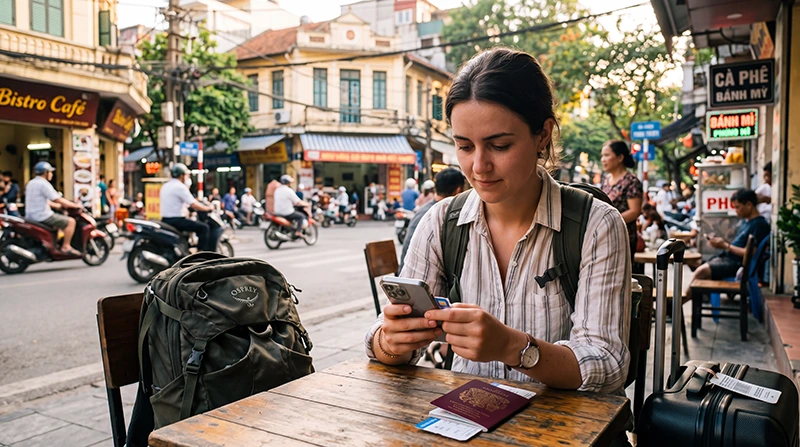

If you are planning a trip to Vietnam, one of the first things you should organize is internet access.
Modern travelers rely on mobile internet for navigation, transportation, communication, translation, hotel bookings, banking applications and travel planning. Whether you are visiting Hanoi, Ho Chi Minh City, Da Nang, Hoi An, Sapa, Ha Long Bay or Phu Quoc, staying connected can make your trip significantly easier.
Quick answer: The easiest way to get internet in Vietnam is by using an eSIM. It can be installed before departure and activated automatically when you arrive. Travelers without eSIM-compatible phones can use a local SIM card purchased in Vietnam.
Top Vietnam eSIMs

Vietnam eSIM
Fixed
1 GB, 7 days€ 3.052 GB, 15 days€ 4.363 GB, 30 days€ 5.67Unlimited
Unlimited, 1 day€ 3.05Unlimited, 3 days€ 6.98Unlimited, 5 days€ 10.91
Why You Need Internet in Vietnam
Many travel activities now depend on reliable internet access.
Visitors commonly use mobile data for:
- Google Maps navigation
- Grab transportation
- WhatsApp communication
- Translation apps
- Restaurant recommendations
- Hotel bookings
- Flight check-in
- Digital payments
- Tour reservations
- Social media sharing
Without internet access, even simple travel tasks can become much more complicated.
Ways to Get Internet in Vietnam
Travelers generally have four main options.
| Option | Best For | Main Advantage |
|---|---|---|
| eSIM | Most travelers | Install before travel |
| Local SIM Card | Phones without eSIM | Widely available |
| Roaming | Short trips | No setup required |
| Public WiFi | Backup use | Usually free |
Option 1: Get Internet with an eSIM
An eSIM is currently one of the most popular solutions for travelers visiting Vietnam.
Unlike a traditional SIM card, an eSIM is installed digitally.
Main advantages include:
- Install before departure
- No physical SIM card required
- Internet immediately after arrival
- No airport queues
- Keep your regular SIM active
- Useful for multi-country travel
- Fast activation process
For many travelers, an eSIM is the most convenient way to get internet in Vietnam.
How Does an eSIM Work?
An eSIM is a digital SIM profile that is downloaded directly to your phone.
The process is simple:
- Purchase the eSIM
- Receive a QR code
- Install the eSIM while connected to WiFi
- Travel to Vietnam
- Enable the eSIM after arrival
- Turn on Data Roaming
- Start using mobile internet
The installation process usually takes only a few minutes.
Option 2: Buy a Local SIM Card
Travelers whose phones do not support eSIM technology can use a traditional SIM card.
SIM cards are available at:
- Airports
- Mobile stores
- Tourist areas
- Convenience stores
- Retail outlets
This remains a reliable way to get internet access in Vietnam.
Option 3: Use Roaming
Most international mobile operators provide roaming services in Vietnam.
Roaming allows you to continue using your existing SIM card.
Advantages include:
- No installation required
- Keep your existing number
- Works immediately after arrival
However, roaming is often more expensive than eSIMs or local SIM cards.
Option 4: Use Public WiFi
Public WiFi is available throughout Vietnam.
You can often find WiFi in:
- Hotels
- Cafes
- Restaurants
- Shopping centers
- Airports
While useful, WiFi should generally be treated as a backup solution rather than your primary source of internet.
Internet at Vietnam Airports
Most international visitors arrive through major airports such as:
- Noi Bai International Airport (Hanoi)
- Tan Son Nhat International Airport (Ho Chi Minh City)
- Da Nang International Airport
- Cam Ranh International Airport
- Phu Quoc International Airport
WiFi and SIM card vendors are commonly available, but many travelers prefer having an eSIM ready before departure.
Mobile Networks in Vietnam
Vietnam has several major mobile operators.
- Viettel
- Vinaphone
- Mobifone
- Vietnamobile
Coverage quality can vary depending on location, terrain and local infrastructure.
Internet in Hanoi
Hanoi offers excellent connectivity for tourists.
Mobile internet is useful for:
- Old Quarter navigation
- Restaurant searches
- Grab rides
- Hotel communication
- Day trip planning
Internet in Ho Chi Minh City
Vietnam’s largest city is highly connected.
Travelers use mobile internet for transportation, business communication, navigation and travel planning.
Internet in Da Nang
Da Nang is one of Vietnam’s most popular beach destinations.
Internet access is useful for navigation, accommodation management, restaurant recommendations and remote work.
Internet in Hoi An
Hoi An is famous for its historic center and tourism infrastructure.
Reliable internet helps visitors explore attractions and organize transportation.
Internet in Sapa
Sapa’s mountain environment creates unique coverage challenges.
Coverage is generally available in town areas but can vary during trekking activities.
Offline maps are recommended for longer hikes.
Internet in Ha Long Bay
Travelers commonly use mobile internet for cruise bookings, transportation and communication.
Signal quality may vary depending on location and distance from shore.
Internet in Phu Quoc
Phu Quoc is one of Vietnam’s leading island destinations.
Mobile internet helps with beach navigation, transportation, restaurant recommendations and accommodation management.
Internet for Backpackers
Backpackers frequently travel between multiple destinations.
Internet is useful for:
- Hostel bookings
- Bus tickets
- Train schedules
- Travel communities
- Route planning
An eSIM can be particularly convenient because it avoids the need to search for SIM card vendors after arrival.
Internet for Digital Nomads
Vietnam is increasingly popular among remote workers.
Digital nomads often use mobile internet for:
- Video meetings
- Cloud platforms
- Remote collaboration
- Productivity tools
Many remote workers use mobile internet as a backup connection.
Internet for Business Travelers
Business travelers typically need internet immediately after arrival.
An eSIM allows internet access without visiting a mobile store, making it a popular choice for business trips.
Internet for Families
Families use internet access for:
- Navigation
- Restaurant searches
- Attraction bookings
- Emergency communication
- Travel planning
Reliable connectivity often makes family travel more comfortable.
How Much Data Do You Need in Vietnam?
| Trip Length | Recommended Data |
|---|---|
| 3 Days | 2–5 GB |
| 7 Days | 5–10 GB |
| 14 Days | 10–20 GB |
| 30 Days | 20–50 GB |
Most tourists use between 5GB and 10GB during a one-week trip.
Can You Keep Your Home SIM Active?
Yes.
Most modern smartphones support dual-SIM functionality.
This allows you to:
- Use a Vietnam eSIM for mobile data
- Keep your primary SIM active
- Receive banking messages
- Receive SMS verification codes
- Maintain access to your regular number
Does WhatsApp Work in Vietnam?
Yes.
WhatsApp works normally using either mobile data or WiFi.
Your existing number usually remains linked to your account.
Do You Need Data Roaming Enabled?
Yes.
Most travel eSIMs require Data Roaming to be enabled on the eSIM profile.
Recommended settings:
- Vietnam eSIM Data Roaming → ON
- Primary SIM Data Roaming → OFF
APN Settings for Vietnam eSIM
If manual configuration is necessary, use:
| Setting | Value |
|---|---|
| APN | data.esim |
| Username | Leave blank |
| Password | Leave blank |
What If Internet Does Not Work?
If your connection is not working:
- Enable Data Roaming
- Select the correct SIM for mobile data
- Check APN settings
- Use APN data.esim
- Restart your phone
- Turn Airplane Mode on for 30 seconds
- Wait for network registration
Most issues can be solved through device settings.
Related Vietnam Travel Guides
- Buy eSIM Vietnam
- Best eSIM for Vietnam
- Best SIM Card Vietnam
- Mobile Internet Vietnam
- Local SIM vs eSIM Vietnam
- Vietnam Roaming Charges
- Internet for Tourists in Vietnam
FAQ: How to Get Internet in Vietnam
What is the easiest way to get internet in Vietnam?
For most travelers, an eSIM is the easiest option because it can be installed before departure and activated after arrival.
Can I buy a SIM card in Vietnam?
Yes. SIM cards are widely available at airports, mobile stores and retail locations throughout Vietnam.
Does WhatsApp work in Vietnam?
Yes. WhatsApp works normally with mobile data or WiFi connections.
Can I keep my home SIM active?
Yes. Most dual-SIM phones allow you to keep your primary SIM active while using an eSIM for mobile data.
How much data do I need in Vietnam?
Most tourists use between 5GB and 10GB during a one-week trip.
Do I need Data Roaming enabled?
Yes. Most travel eSIMs require Data Roaming to be enabled on the eSIM profile.
What APN should I use?
If manual setup is necessary, use data.esim.
Is eSIM better than a local SIM card?
For many travelers, yes. eSIMs are generally more convenient because they can be installed before travel and activated after arrival.
Final Recommendation
Getting internet in Vietnam is easier than ever thanks to modern connectivity options.
While local SIM cards, roaming and public WiFi remain available, most travelers now prefer eSIMs because they offer fast setup, immediate connectivity and the convenience of keeping a home SIM active.
For a smooth travel experience across Vietnam, preparing your internet connection before departure is often the best approach.