


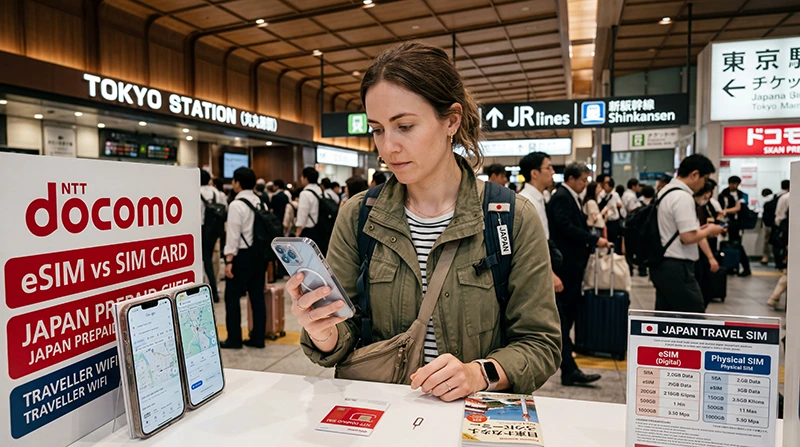

Choosing between an eSIM and a physical SIM card is one of the biggest decisions travelers make before visiting Japan.
Both options provide mobile internet access for maps, train schedules, translation apps, WhatsApp, and travel bookings — but the overall experience can feel very different.
Quick answer: for most modern travelers visiting Japan in 2026, eSIMs are usually the easier and more convenient option, while physical SIM cards can still work well for older phones without eSIM support.
Top Japan eSIMs


What Is an eSIM?
An eSIM is a digital SIM card built directly into your smartphone.
Instead of inserting a plastic SIM card, travelers install the eSIM digitally by scanning a QR code or using a direct activation link.
Most modern iPhones and many Android phones now support eSIM technology.
What Is a Physical SIM Card?
A physical SIM card is the traditional plastic SIM inserted into the phone.
Travelers usually buy Japanese SIM cards:
- At airports
- From vending machines
- At electronics stores
- Online before travel
The card must then be physically inserted into the phone.
Main Difference Between eSIM and SIM Card
| eSIM | Physical SIM Card |
|---|---|
| Digital installation | Physical card required |
| No SIM swapping needed | Main SIM often removed |
| Can be installed before travel | Usually installed after arrival |
| Instant activation possible | Manual insertion required |
| Best for modern phones | Useful for older phones |
Why Many Travelers Now Prefer eSIMs
Most modern travelers now choose eSIMs because they simplify the entire travel experience.
With a Japan eSIM, travelers can:
- Install internet before flying
- Use internet immediately after landing
- Avoid airport SIM card queues
- Keep their regular SIM active
- Travel without swapping SIM cards
- Switch plans digitally
This makes eSIMs especially useful for travelers moving between multiple cities across Japan.
Top Japan eSIMs
When a Physical SIM Card May Be Better
Physical SIM cards can still work well for:
- Older phones without eSIM support
- Travelers unfamiliar with eSIM setup
- Phones locked to specific carriers
- Budget devices without dual SIM support
For some travelers, using a traditional SIM card still feels simpler and more familiar.
Which Option Is Better for Japan Train Travel?
For many travelers, eSIMs are easier during train travel in Japan.
Tourists using Shinkansen trains and busy stations often prefer eSIMs because:
- Internet works immediately after arrival
- No SIM swapping is required
- No tiny SIM tray tools are needed
- Travel becomes simpler and faster
Reliable internet is extremely important for train schedules, Google Maps, and station navigation.
Read also: Internet for Japan train travel
Which Option Is Better for Google Maps?
Both eSIMs and SIM cards work very well with Google Maps.
However, many travelers now prefer eSIMs because they are faster to activate and easier to manage throughout the trip.
Read also: Google Maps in Japan
Can You Keep Your Main Number Active?
One of the biggest advantages of eSIMs is that many phones support dual SIM functionality.
This allows travelers to:
- Keep their regular SIM active
- Receive SMS verification codes
- Use WhatsApp normally
- Use the Japan eSIM for mobile data
With physical SIM cards, travelers often remove their main SIM temporarily.
Coverage in Japan
Both eSIMs and physical SIM cards usually connect through Japan’s strongest mobile networks such as:
- NTT Docomo
- KDDI / AU
- SoftBank
- Rakuten Mobile
Coverage is generally excellent across:
- Tokyo
- Kyoto
- Osaka
- Hiroshima
- Fukuoka
- Sapporo
- Shinkansen routes
Setup Comparison
| eSIM | Physical SIM Card |
|---|---|
| QR code activation | Physical insertion required |
| No SIM eject tool needed | SIM tray tool often needed |
| Can be installed remotely | Requires physical card delivery |
| Fast activation process | Manual setup required |
| No risk of losing SIM | Small cards can be misplaced |
How Much Data Do Travelers Need in Japan?
| Traveler type | Recommended data |
|---|---|
| Light traveler | 3GB–5GB |
| Average tourist | 10GB–20GB |
| Heavy social media use | 20GB+ |
| Remote workers | Large or unlimited plan |
| Content creators | Unlimited plan recommended |
Most tourists use more data than expected because they constantly use maps, translation apps, train schedules, and social media during the trip.
Should You Install the eSIM Before Flying?
Yes — absolutely.
Most experienced travelers now install the Japan eSIM before departure.
This allows internet to work immediately after arrival and helps avoid:
- Airport SIM card queues
- Navigation problems
- WiFi dependency
- Complicated setup after landing
Best Setup for Japan Travel
| Setting | Recommended option |
|---|---|
| Main SIM roaming | Off |
| Japan eSIM | On |
| Japan eSIM roaming | On if required |
| Mobile data line | Japan eSIM |
| Main SIM | Keep active for calls and SMS |
Related Japan Travel Guides
- Japan eSIM
- Pocket WiFi vs eSIM Japan
- Best mobile data for Japan travel
- Traveling Japan with eSIM
- Google Maps in Japan
- Internet for Japan train travel
- Using WhatsApp in Japan
FAQ: eSIM vs SIM Card in Japan
Is eSIM better than a SIM card in Japan?
For most modern travelers, yes. eSIMs are usually easier because they allow digital activation without swapping physical SIM cards.
Can I use eSIM in Japan?
Yes. Most modern smartphones support eSIM technology and work very well in Japan.
Can I keep my regular number while using a Japan eSIM?
Yes. Many modern phones support dual SIM functionality, allowing your primary SIM to remain active.
Are physical SIM cards still good for Japan travel?
Yes. Physical SIM cards still work well, especially for older devices without eSIM support.
Should I install my Japan eSIM before departure?
Yes. Most travelers now install the eSIM before flying so internet works immediately after arrival.
Does eSIM work on Japanese trains?
Yes. Japan generally has excellent mobile internet coverage across major train routes and cities.
Final Thoughts: eSIM vs SIM Card in Japan
Both eSIMs and physical SIM cards can work very well for traveling in Japan.
However, for most travelers in 2026, eSIMs are becoming the preferred option because they are faster, simpler, and easier to manage throughout the trip.
Physical SIM cards still remain useful for older devices, but many modern travelers now choose eSIMs for convenience and flexibility while exploring Japan.