


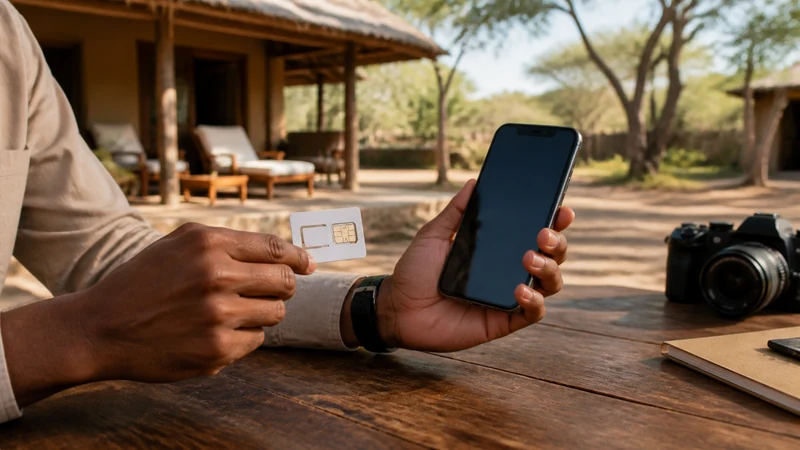

Buying a local SIM in Botswana is straightforward once you know where to go — the mistake most visitors make is assuming any shop selling a SIM starter pack can also activate a data bundle, which isn’t always true.
Top Botswana eSIMs

Botswana eSIM
Fixed
1 GB, 7 days€ 11.552 GB, 15 days€ 25.333 GB, 30 days€ 31.10Unlimited
Unlimited, 1 day€ 16.44Unlimited, 3 days€ 46.65Unlimited, 5 days€ 77.31
Where to actually buy one
Convenience stores and supermarkets sell SIM starter packs and airtime vouchers, but staff there often can’t activate data bundles properly. Official carrier shops — Mascom, Orange, or BTC branded locations — are the more reliable option, since staff can handle registration and data activation in the same visit. In Gaborone, look at Riverwalk, Game City, or Main Mall; in Maun, shops along the main road near Riley’s Hotel; Francistown, Kasane, and other larger towns have their own carrier shops too.
What registration actually involves
Botswana requires passport registration for any local SIM — no exceptions. Bring your passport to the shop; the process itself is usually quick, on the order of 5 to 15 minutes at an official location. This is a firm requirement, not something that can be skipped by buying from an informal vendor.
Which network to choose
Mascom has the widest rural footprint and is generally the strongest pick if your trip includes any safari component or self-driving outside the main towns. Orange is competitive on pricing and performs well in Gaborone and the southeast specifically. BTC leans urban, with decent coverage concentrated around Gaborone and Francistown. The mobile networks comparison and best network for tourists guide cover this choice in more depth.
What a typical tourist data bundle costs
Pricing shifts and is worth confirming with the carrier directly on arrival, but a 7-day tourist data bundle has typically run in the low tens of pula. Following a 2025 regulatory intervention, prepaid data rates across all three operators were reduced — Orange’s headline rate dropped by around 30%, Mascom’s by around 19% — so current pricing should be somewhat more favorable than older references suggest.
Airport SIM purchases: possible, but not guaranteed
Kiosks at Sir Seretse Khama International and Maun Airport sell SIMs, but hours can be limited, and landing late or on a Sunday can mean the kiosk is closed. If you’re relying on buying a SIM immediately on arrival, have a backup plan — either an eSIM installed before you fly, or a plan to visit a proper carrier shop in town shortly after landing.
If you’d rather skip the registration process entirely
An eSIM installed before departure avoids the registration stop and the airport kiosk uncertainty altogether. The local SIM versus eSIM guide covers the trade-off in detail — a local SIM tends to win on cost for longer stays, while an eSIM wins on convenience for shorter ones.
Once you have your SIM
If you’re heading beyond the towns where you registered, coverage drops significantly in Botswana’s safari areas regardless of which network your SIM is on — the Botswana safari connectivity guide covers what to prepare for once your trip moves into the wilderness.
FAQ
Where’s the best place to buy a SIM in Botswana?
An official carrier shop — Mascom, Orange, or BTC branded locations in Gaborone, Maun, Francistown, or Kasane — rather than a convenience store, since staff there can properly activate data bundles.
Do I need my passport to buy a SIM?
Yes — SIM registration with a passport is mandatory in Botswana, with no exceptions.
Which network’s SIM should I buy for a safari trip?
Mascom, given its wider rural reach compared to Orange or BTC.
Can I buy a SIM at the airport when I land?
Sometimes, but kiosk hours are limited and can be closed on Sundays or late arrivals — have a backup plan rather than relying on it entirely.
Final Recommendation
Buy your Botswana SIM at an official carrier shop rather than a convenience store, bring your passport for the mandatory registration, and choose Mascom if your trip includes any safari component. If you’d rather skip the process altogether, an eSIM installed before you fly covers most short tourist trips just as well.