


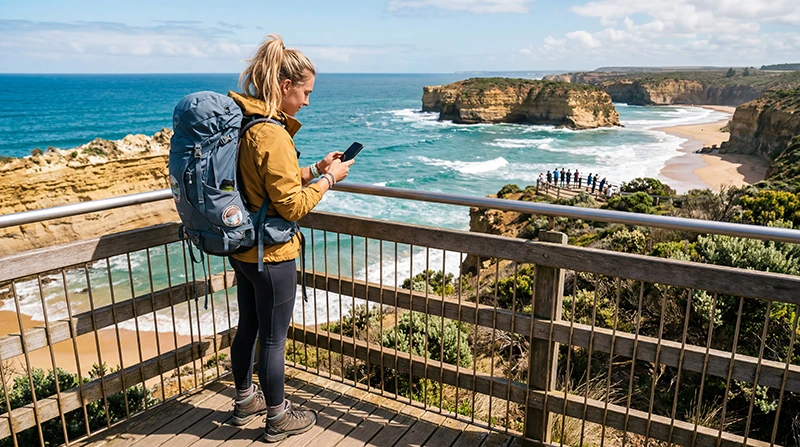

The best eSIM for backpacking Australia balances long validity, sensible data and coverage along your actual route. A cheap short plan can become expensive if it expires halfway through a multi-city trip.
Backpackers often move between hostels, buses, regional jobs and coastal stops, so offline preparation and top-up flexibility matter as much as the initial allowance.
NoveSIM travel eSIM plans are data-only. They support internet apps but do not provide an Australian number or traditional calls and SMS.
Quick answer: Choose a plan that covers the full backpacking period, works on an appropriate network for the route and allows enough data for navigation, bookings and messaging. Use hostel Wi-Fi for large downloads, but keep essential maps and tickets offline.
Top Australia eSIMs

Australia eSIM
Fixed
1 GB, 7 days€ 2.662 GB, 15 days€ 3.553 GB, 30 days€ 4.88Unlimited
Unlimited, 1 day€ 2.66Unlimited, 3 days€ 5.77Unlimited, 5 days€ 8.43
Asia eSIM
Fixed
1 GB, 7 days€ 4.442 GB, 15 days€ 7.993 GB, 30 days€ 10.65Unlimited
Unlimited, 1 day€ 5.77Unlimited, 3 days€ 15.53Unlimited, 5 days€ 25.29Choose the best eSIM for backpacking Australia by route
A Sydney–Melbourne itinerary has different coverage demands from regional work or an Outback detour. Mark every overnight stop and long transport leg, then inspect the named partner network’s current coverage.
If the route leaves populated coastal corridors, read the Outback mobile-data guide. An eSIM cannot provide a signal where its underlying network has none.
Budget for data you will actually use
Maps, messaging and bookings are light. Video, social uploads, cloud photo backup and hotspot use are heavy. Disable automatic downloads and use trusted accommodation Wi-Fi for operating-system updates.
The Australia data estimator helps turn your normal phone use into a trip allowance. For a longer stay, also compare the local-number benefits in the Australia SIM card guide.
Check these details before purchase
- Validity covers every travel day.
- Top-up or replacement is possible without visiting a shop.
- Hotspot use is permitted if sharing costs with a companion.
- The phone is eSIM-compatible and carrier-unlocked.
- Activation timing is clear before installation.
Set up before the first hostel check-in
- Install the eSIM on reliable Wi-Fi before departure.
- Label it clearly and retain the home SIM for verification messages if needed.
- Save maps, accommodation addresses and tickets offline.
- On arrival, select the eSIM for data and follow its roaming instruction.
- Test the connection before starting the next travel leg.
If manual APN entry is required for NoveSIM, use data.esim. Do not delete the installed eSIM during troubleshooting unless support explicitly tells you to do so.
Related Articles
- Choose an Australia data plan
- Internet for an Australian working holiday
- Australia road-trip eSIM planning
FAQ
How much data does an Australia backpacker need?
It depends on trip length and video use. Maps and messages need relatively little; streaming, uploads and tethering can multiply daily consumption.
Is hostel Wi-Fi enough?
It can reduce mobile use but may be slow, shared or unavailable during transport. Mobile data is useful for arrivals, navigation and last-minute booking changes.
Should a working-holiday traveller buy a local SIM?
A local service may be better when an Australian number is needed for months. An eSIM is useful for immediate arrival data or shorter stays.
Can an eSIM cover the entire Outback?
No. Coverage depends on the network, terrain and location, and long remote sections can have no ordinary mobile service.
Final Recommendation
Pick the best eSIM for backpacking Australia from the route and total trip length, not simply the lowest entry price.
Install before departure, control background downloads and keep the setup details available offline.
For regional legs, combine the plan with offline maps and realistic expectations about coverage gaps.