
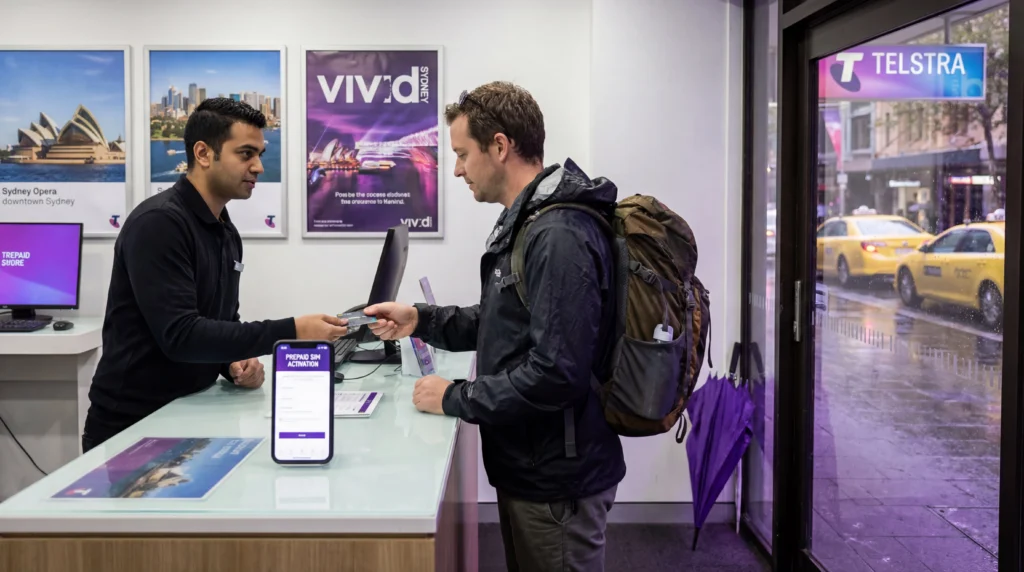

The best SIM card for Australia depends on whether you need a local telephone number or simply reliable travel data. A local prepaid SIM is appropriate when ordinary calls and SMS matter; a travel eSIM is usually easier for a short tourist visit.
This guide compares both choices without treating an eSIM product page as a substitute for physical-SIM information. It covers registration, airport buying, network selection, coverage, hotspot use and the practical value of a local number.
A NoveSIM travel eSIM is data-only and does not provide a local number, traditional voice calls or SMS. You can keep your primary SIM active for those services while using the eSIM for maps, email, browser access and internet messaging.
Quick answer: choose a local prepaid SIM if you specifically need a Australia number and can complete the local purchase and verification process. Choose the Australia travel eSIM if immediate data, advance installation and keeping your existing SIM are more important.
Top Australia eSIMs
Which SIM Option Is Best for a Tourist in Australia?
For a short holiday, an eSIM is normally the lower-friction choice. You can install it on a compatible unlocked phone before departure, leave it switched off until the appropriate activation point, and select it as the mobile-data line after arrival. This removes store opening hours and physical card handling from the arrival plan.
A local prepaid SIM becomes the better answer when a local telephone number is a real requirement rather than a vague preference. Examples include hosts who accept only normal calls, SMS verification that rejects foreign numbers, or an extended stay where a domestic bundle fits your usage. Before choosing it, include registration time, travel to the shop and top-up rules in the comparison.
Travellers should also compare the local SIM versus eSIM trade-offs and review the destination’s broader tourist internet guidance. The cheapest headline allowance is not automatically the best option when activation is difficult or coverage is weak on the planned route.
Physical SIM vs Travel eSIM
| Question | Local prepaid SIM | Travel eSIM |
|---|---|---|
| When can you prepare it? | Usually after purchase and local activation | Before departure on a compatible unlocked device |
| Local telephone number | Usually included | No; NoveSIM plans are data-only |
| Identity or registration | Local rules and operator checks apply | No local physical-SIM shop visit |
| Keep home SIM installed | Only with dual-SIM hardware or another slot | Usually yes on dual-SIM/eSIM phones |
| Airport queue | Possible | Not required |
| Hotspot and 5G | Depends on plan, device and coverage | Depends on plan, device, network and coverage |
Check eSIM device compatibility and confirm that the phone is carrier-unlocked. Compatibility alone does not guarantee 5G: the plan, radio bands, local partner network, device software and exact location all matter.
Documents and Registration Requirements
Australian telcos must collect customer information and verify identity when activating prepaid mobile service. Be ready to provide your name, date of birth, home address and an accepted identity document. A passport is commonly relevant for visitors, but the provider controls the approved verification route.
Use official operator instructions at the time of purchase because identification rules and accepted documents can change. The primary reference used for this update is the ACMA prepaid mobile identity-check guidance. A reseller’s informal statement should not override a regulator or operator requirement.
Keep the purchase receipt and the SIM packaging until activation is confirmed. The ICCID or other card information may be needed for support. Do not hand an unlocked phone or passport to an unknown street seller, and do not buy a card registered under someone else’s identity.
Should You Buy at the Airport or in the City?
Sydney, Melbourne, Brisbane and Perth airports may offer staffed or retail options, but activation still needs identity verification. A city operator shop is preferable if the phone needs compatibility support. Prepare an eSIM before an immediate road trip.
Airport purchase is reasonable when you need a local number immediately and a staffed official counter can complete activation. City purchase is better when you want to compare several plans, ask detailed coverage questions or resolve identity verification without boarding pressure.
- Check the counter’s actual opening hours for your arrival day.
- Confirm that the advertised price includes the SIM, plan and any activation charge.
- Ask the staff to show that mobile data, calls and SMS work before leaving.
- Keep airport Wi-Fi available until activation is complete.
- Do not assume a convenience-store cashier can troubleshoot registration.
Which Mobile Operators Serve Australia?
Telstra, Optus and Vodafone are the main networks tourists compare. Metropolitan coverage does not predict remote highways or the Outback. Check each route, carry offline maps and do not treat mobile data as an emergency communications guarantee.
The principal names a tourist will encounter are Telstra, Optus and Vodafone. This is not a ranking: coverage quality is route-specific, and a low-cost brand may use another company’s network. Check the destination network guide and the regulator or operator coverage map for the addresses that matter to you.
Coverage maps are predictions, often focused on outdoor availability. Building materials, crowding, terrain, weather, device bands and temporary network load can change the result. Download essential tickets and accommodation details before a rural journey, ferry trip or late-night transfer.
Do You Need a Local Telephone Number?
An Australian number helps with local calls, SMS and accommodation or work contacts. A data-only travel eSIM is sufficient for most short holidays but not for services that insist on an Australian number.
Keeping the home SIM active can preserve your existing number, but roaming charges may apply to calls, SMS or accidental data. Set the travel eSIM as the mobile-data line, disable mobile data switching when appropriate and review the destination’s roaming guidance.
Internet calls and messages use data, so WhatsApp, Signal, FaceTime and similar services can continue with a data-only plan. Bank and account SMS still arrive through the home line, subject to the home operator’s roaming conditions.
Hotspot, Tethering and 5G Limitations
Never assume that “unlimited” means unrestricted full-speed tethering. A plan may include a fair-use threshold, slower service after a quota, a separate hotspot allowance or network-management conditions. Read the exact plan terms before using a phone as the primary connection for a laptop or family group.
5G depends on plan eligibility, device support, software, frequency bands, selected network and local coverage. A phone may display 4G even where an operator advertises 5G. Strong 4G is normally sufficient for navigation, messaging, bookings and standard video calls.
Estimate usage with the destination data guide. Download offline maps and media over trusted Wi-Fi, and reserve hotspot use for tasks that genuinely need a larger screen.
How to Prepare Before Departure
- Confirm that your phone is unlocked and supports eSIM if you plan to use one.
- Decide whether a local number is essential for the trip.
- Compare coverage for every major stop, not only the arrival city.
- Read registration and identification requirements from an official source.
- Save offline copies of tickets, accommodation details and the eSIM installation instructions.
- Install the eSIM using stable Wi-Fi, but follow the plan’s activation guidance before enabling it.
- After arrival, select the intended data line and enable data roaming for the travel eSIM when required.
Use the relevant installation guide and activation guide. If automatic connection fails, restart the phone, verify the data line and roaming setting, and use manual network selection only when needed. Do not delete an installed eSIM unless support instructs you to do so.
Is One SIM Enough for an Australian Road Trip?
Not always. Coverage gaps can exist between towns even when the destination itself is served. Tell someone your route, download offline navigation, carry appropriate emergency equipment and never rely on a second mobile network as a substitute for remote-area planning.
Related Articles
- Australia Esim
- Best Network In Australia For Tourists
- Internet Australia Tourists
- Mobile Internet Australia
- How To Get Internet Australia
- Best Way To Get Internet Australia
- Local Sim Vs Esim Australia
- Australia Roaming Charges
- How Much Data For Australia Trip
- Australia Esim Apn
- Australia Esim Iphone
- Australia Esim Android
- Install Australia Esim
- How To Activate Australia Esim
- Australia Esim Not Working
- Why Is My Australia Esim Slow
FAQ
What is the best SIM card for tourists in Australia?
A travel eSIM is usually best for short data-focused visits, while a local prepaid SIM is better when a domestic number and conventional calls or SMS are essential.
Can a tourist buy a local prepaid SIM?
Usually yes, subject to the operator’s current registration, identity and activation rules. Carry an original passport and buy through an official channel.
Is an airport SIM more expensive?
It can be. Airport counters optimise for convenience and may offer fewer packs. Compare the total price, activation support and plan validity rather than the SIM price alone.
Does a NoveSIM travel eSIM include a local number?
No. NoveSIM travel eSIM plans are data-only. Keep your home SIM or choose a local physical SIM if you need ordinary calls, SMS or a domestic number.
Will hotspot and 5G work?
Availability depends on the selected plan, phone, network, region and local coverage. Check the exact plan terms before relying on tethering or 5G.
Final Recommendation
Choose a local prepaid SIM in Australia when a local number is genuinely necessary and you are prepared to complete the official purchase and verification process. Buy from an operator or authorised retailer and test the service before leaving.
Choose a travel eSIM for simpler arrival data, advance installation and dual-SIM flexibility. Confirm compatibility, keep the eSIM installed, and use the correct data-line and roaming settings after arrival.
Whichever option you choose, check coverage for your real itinerary, keep offline essentials and treat hotspot and 5G as plan-dependent features rather than guarantees.


