


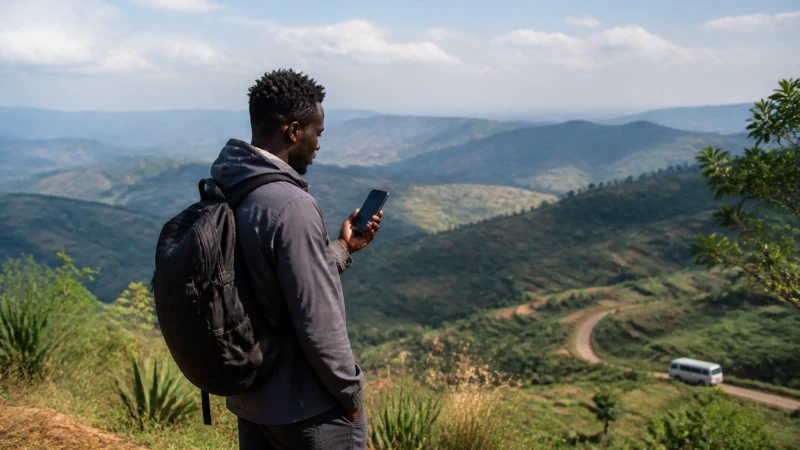

Rwanda gives tourists a genuinely simple choice — MTN or Airtel — and the right pick depends less on general reputation and more on whether your specific itinerary stays within Kigali or extends toward the country’s more remote parks and border regions.
Quick answer: MTN is the safer default overall, given its wider geographic footprint and earlier infrastructure investment, particularly useful if your trip includes Akagera National Park or areas near the Tanzanian border. Airtel is a solid, often slightly cheaper alternative if you’re staying mainly within Kigali.
Top Rwanda eSIMs

Rwanda eSIM
Fixed
1 GB, 7 days€ 22.662 GB, 15 days€ 43.993 GB, 30 days€ 61.76Unlimited
Unlimited, 1 day€ 20.88Unlimited, 3 days€ 60.87Unlimited, 5 days€ 100.86
For a safari or multi-region trip: MTN
If your itinerary includes Akagera National Park, border areas, or generally covers more ground outside Kigali, MTN is the clearer choice — it has the largest coverage footprint in the country and was one of Africa’s first markets to get commercial 5G, a sign of its ongoing infrastructure investment. This doesn’t mean MTN reaches into Nyungwe’s deep forest or above the tree line on gorilla trekking routes, since nothing does, but for the towns and roads connecting Rwanda’s tourist circuit, MTN consistently has the best chance of a usable signal.
For a Kigali-focused trip: either works, Airtel often cheaper
If you’re staying primarily in the capital — a business trip, a short city stay before or after a park visit — both networks perform comparably well, and Airtel is frequently cited as slightly cheaper on data bundles specifically within Kigali. For a Kigali-only visit, the choice matters less than for a trip extending into rural areas.
For gorilla trekking specifically
Neither network reaches meaningfully above roughly 2,500 meters on the actual trekking routes, so the choice here matters more for the drive to and from Musanze and the time spent at the park headquarters and Kinigi, both of which have reasonable coverage from either operator. The gorilla trekking connectivity guide covers this specific activity in detail.
What doesn’t change based on network choice
Nyungwe Forest’s deep interior, remote sections of Akagera, and high-elevation trekking routes all have limited to no coverage from either network — this is a genuine infrastructure gap rather than something a “better” carrier fixes. The rural coverage guide covers where these gaps are most pronounced.
eSIM providers and which network they use
If you’re using an international travel eSIM rather than choosing a local SIM directly, check which Rwandan network the plan actually partners with — most connect through MTN, though some use Airtel. The local SIM versus eSIM guide covers this alongside the broader format decision.
Registration is identical regardless of network
Whichever network you choose, Rwanda’s mandatory in-person passport registration applies equally — the best SIM card guide covers the practical buying process, which is the same for both operators.
FAQ
Which network should I choose for a Rwanda safari?
MTN, given its wider footprint useful for Akagera and border-adjacent areas.
Does network choice matter for a Kigali-only trip?
Not much — both perform well in the capital; Airtel is often slightly cheaper.
Does network choice matter for gorilla trekking?
Not on the trek itself, since neither network reaches the higher elevations — it matters more for the drive to and from Musanze.
Do eSIM providers automatically use the best network?
Not necessarily — check which Rwandan network your specific eSIM plan routes through, since this varies by provider.
Does registration differ between MTN and Airtel?
No — both require the same in-person passport presentation for foreigners.
Final Recommendation
For most visitors combining Kigali with any national park or safari component, MTN is the practical default given its wider footprint. A Kigali-only trip works fine on either network, with Airtel sometimes offering a slight price edge. Whichever you choose, remember that network choice stops mattering once you’re inside Rwanda’s most remote wilderness areas, where neither reaches.