


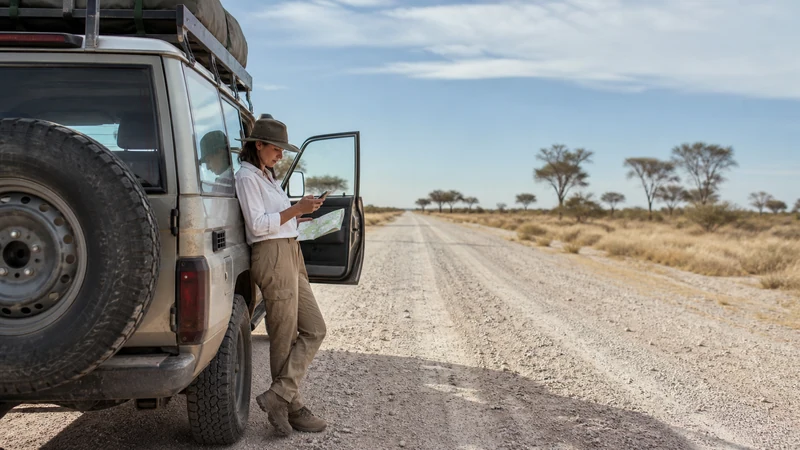

Botswana’s size — roughly 580,000 square kilometers with a population concentrated in a handful of towns — means rural coverage follows a specific pattern: reasonably good along the tarred highways connecting major towns, and essentially absent across most of the country’s protected wilderness areas.
Top Botswana eSIMs

Botswana eSIM
Fixed
1 GB, 7 days€ 11.552 GB, 15 days€ 25.333 GB, 30 days€ 31.10Unlimited
Unlimited, 1 day€ 16.44Unlimited, 3 days€ 46.65Unlimited, 5 days€ 77.31
What “rural” means differently in Botswana
In many countries, rural coverage means weaker signal in farmland or small villages. In Botswana, “rural” often means genuinely empty terrain — national parks, game reserves, and vast stretches between towns with very low population density. Network operators build coverage where paying subscribers live, and much of Botswana’s most visited terrain — the areas tourists specifically travel to see — has few or no permanent residents to justify tower infrastructure.
Where coverage generally holds outside towns
The tarred highways connecting Gaborone, Francistown, Nata, Maun, and Kasane generally have workable coverage for stretches of the drive, though with real gaps in between. Mascom’s wider rural footprint means it tends to reach furthest along these routes and into surrounding areas. This is different from safari-area coverage, which is a separate and generally much weaker picture.
Where it essentially disappears
The Okavango Delta, most of the Central Kalahari Game Reserve, large stretches of the Trans-Kalahari Highway, and much of the deep interior of parks like Moremi have no coverage from any network. This isn’t a weak-signal situation to troubleshoot — it’s genuinely unserved territory, and treating it that way in your planning matters more than trying to find a workaround.
The role of cross-border signal
Near international borders, coverage can behave unexpectedly — towers in neighboring Namibia, for instance, sometimes reach into the northern fringe of Chobe National Park, giving that area better connectivity than its remoteness would otherwise suggest. This is opportunistic rather than something Botswana’s own infrastructure was built to provide, and it’s inconsistent even within a short distance of the border.
What this means for trip planning
The practical takeaway: plan around towns as your connectivity checkpoints, and treat everything between and beyond them — especially safari areas — as offline by default rather than assuming a weak-but-present signal. The Botswana road-trip connectivity guide covers preparing each leg of a longer drive with this pattern in mind, and the Botswana safari connectivity guide covers the wilderness areas specifically.
Specific destinations worth checking individually
Coverage varies enough between Botswana’s major safari areas that it’s worth checking each one separately rather than assuming a general rural pattern applies evenly — the Okavango Delta, Chobe National Park, Moremi Game Reserve, and Central Kalahari guides each cover what’s actually realistic to expect.
Network choice matters more here than in towns
In genuinely rural stretches, which network you’re on can be the difference between a working connection and nothing — Mascom’s wider footprint gives it a real edge over Orange or BTC in these areas specifically. The best network for Botswana tourists guide covers this comparison.
FAQ
Does any Botswana network cover the Okavango Delta?
No — none of the three operators have meaningful coverage there. This is a genuine gap, not a weak-signal situation.
Which network has the best rural coverage in Botswana?
Mascom, by a meaningful margin, though it still doesn’t cover Botswana’s most remote wilderness areas.
Why is coverage better near Chobe’s northern edge than elsewhere?
Cross-border signal from towers in Namibia sometimes reaches into that specific area, though it’s inconsistent even within a short distance.
Should I expect signal on the roads between towns?
Partially — main tarred routes generally have workable coverage for stretches, but expect real gaps, sometimes for hours, particularly on longer routes.
Final Recommendation
Botswana’s rural coverage follows the road network and population centers closely, meaning most of the country’s celebrated wilderness — exactly what draws visitors — has no mobile signal at all. Plan around towns as connectivity checkpoints, choose Mascom if rural reach matters to your itinerary, and treat safari areas as offline by default.