


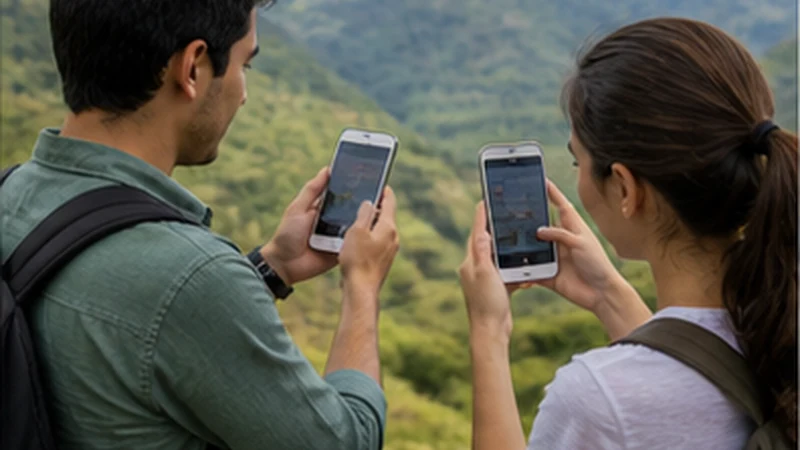

The best mobile network in Guatemala is not the same at every address or for every task. Recent nationwide measurements favour Claro for several experience and speed categories, while Tigo leads the coverage-experience measure and 5G availability; the useful choice still depends on the route and the networks a selected SIM or eSIM can access.
A network award is evidence about aggregated user experience during a defined period. It is not a promise that the winning operator will work inside a particular Antigua hotel, beside a Lake Atitlán village, on a volcano trail or at a remote section of the road to Petén.
NoveSIM Guatemala plans are data-only. They support internet applications through available partner access but do not include a Guatemalan number, ordinary calls or SMS.
Quick answer: Claro is the stronger evidence-based choice when overall mobile experience and speed are the main criteria; Tigo deserves equal consideration when route coverage and time connected to 5G matter more. A travel-eSIM user must first check which partners the exact product can use. For a multi-stop trip, judge both networks against the route instead of selecting a nationwide winner from one metric.
Top Guatemala eSIMs

Guatemala eSIM
Fixed
1 GB, 7 days€ 5.772 GB, 15 days€ 9.323 GB, 30 days€ 11.98Unlimited
Unlimited, 1 day€ 5.32Unlimited, 3 days€ 17.75Unlimited, 5 days€ 24.85
Central America eSIM
Fixed
1 GB, 7 days€ 7.102 GB, 15 days€ 11.543 GB, 30 days€ 15.53Unlimited
Unlimited, 1 day€ 6.66Unlimited, 3 days€ 16.42Unlimited, 5 days€ 26.18What “Best Mobile Network in Guatemala” Can Mean
Opensignal’s February 2026 Guatemala report analysed measurements collected from 1 October to 29 December 2025. In that report, Claro retained the lead across all overall-experience awards and won the 5G-experience categories. Tigo led Coverage Experience and 5G Availability.
Those results answer different questions:
- Overall-experience awards describe aspects of the experience observed while users were connected, including speed and application performance.
- Coverage Experience assesses the geographic extent of places where users experienced a mobile connection, rather than only population coverage.
- 5G Availability measures the proportion of time that 5G users had an active 5G connection.
It would therefore be inaccurate to flatten the report into “Claro is best everywhere” or “Tigo has the best signal everywhere”. Claro won more experience categories; Tigo’s coverage result may matter more to a traveller moving through varied terrain. Both results are national aggregates, not address-level tests.
Claro or Tigo: Choose the Metric That Matches the Trip
| Tourist priority | Evidence to weigh first | Important limitation |
|---|---|---|
| Fast general use in connected areas | Claro’s overall-experience and speed results | A national average does not predict one room or street |
| Movement across a broader route | Tigo’s Coverage Experience lead | Coverage Experience does not mean uninterrupted service |
| Seeing 5G more often | Tigo’s 5G Availability lead | More 5G time does not by itself mean better application performance |
| 5G performance while connected | Claro’s 5G-experience awards | The phone, plan and location must all permit 5G |
| Travel-eSIM use | The product’s supported partner access | A traveller cannot force an unsupported network |
The correct answer can change within the same trip. A traveller may care about speed during two workdays in Guatemala City, then care more about any usable connection while moving towards Lake Atitlán or Petén.
A Travel eSIM Does Not Equal a Local Claro or Tigo Plan
Local network reports measure the experience of users on the operators being compared. A travel eSIM is a roaming product with its own partner agreements, routing, network priority and technical configuration. Even when it registers on a familiar brand, its experience does not have to match a local subscriber’s plan exactly.
The NoveSIM Guatemala product information checked on 2 September 2026 lists potential access through Claro and Comunicaciones Celulares S.A. with 5G, plus Movistar with 3G. Comunicaciones Celulares S.A. is associated with the Tigo operation, but the exact product labels and available access should be checked again at purchase because partner information can change.
This list describes possible access, not a guaranteed choice at every location. The phone normally selects among networks permitted by the installed profile. If a network is visible in manual search but rejects registration, visibility is not proof that the plan is authorised to use it.
How the Decision Changes by Itinerary
Guatemala City and Antigua
Urban and major tourist areas provide more opportunities for cellular coverage than remote routes, but they introduce building and congestion effects. A network can perform well outside and poorly behind thick walls, in a lower-floor room or at a crowded venue. If work connectivity matters, ask the accommodation about both mobile reception in the actual room and fixed Wi-Fi; the operator’s national award cannot answer either question.
Lake Atitlán
Steep terrain and separate lakeside settlements make a single lake-wide recommendation unreliable. Service in Panajachel does not prove the same performance at another village, on the water or inside accommodation built against a slope. Choose a product with suitable partner access, but keep the address, ferry information and map offline.
Petén, Tikal and Semuc Champey
For remote attractions, the relevant question is not which operator wins nationally but whether any usable signal exists at the precise point and time. Do not turn a network choice into a safety system. Tickets, meeting instructions, return transport and essential contact details should remain available without data.
Road travel
A coverage lead can improve the probability of service over a varied route, yet roads still cross gaps caused by terrain and infrastructure. Navigation should be downloaded in advance. If the journey is operationally important, a second connection on a genuinely different network can offer more resilience than buying a larger allowance on the same one.
Check Whether Your Phone Can Use the Available Network
Network choice is constrained by the exact handset. Regional variants can support different frequency bands, and an unlocked phone can still lack a band used for a particular layer of local service. Confirm the precise model rather than assuming every version of the same phone family behaves identically.
A 5G-capable label is not enough. The device must support the relevant implementation, the plan must allow it and 5G must be available locally. Falling back to 4G is not automatically a fault. For maps, messages and ordinary browsing, a stable 4G connection can be more useful than an intermittent 5G indicator.
Automatic Selection Is the Correct Default
Leave network selection on Automatic when the eSIM first registers. The profile and device can then attempt a supported available partner without the traveller guessing which operator should work. Give registration time after landing or after emerging from an area with no signal.
Manual selection is a controlled diagnostic, not a permanent optimisation ritual. Use it only after confirming that the line is active, roaming is enabled on the travel profile and automatic registration has failed in a plausible coverage area. Record the result of one supported option, wait for registration and return to Automatic after testing.
Repeatedly tapping every visible network makes the diagnosis harder. “Forbidden” or “unable to connect” may simply show that the selected profile cannot use that network under current partner arrangements.
Test the Network Against the Real Task
A speed test consumes data and answers only one part of the question. Start with the task that matters: load the map, send a message, open the booking or join the work service. For remote work, check upload behaviour and call stability as well as download speed. For navigation, consistency matters more than an impressive peak result.
Run comparisons from the same device, place and time where possible. Moving from a window to the centre of a room can affect the result more than the national ranking. If two people compare different phones and plans, the outcome includes device and provisioning differences—not only network quality.
Signal bars are also not a cross-network benchmark. Manufacturers do not present them as a calibrated speed measurement, and strong radio signal can coexist with congestion or slow backhaul.
When a Second Network Is More Valuable Than a Winner
Some journeys benefit from redundancy rather than a single “best” choice. A local SIM on one network and a travel eSIM capable of another can reduce dependence on one outage or local coverage gap, provided the phone supports the intended dual-SIM arrangement.
That strategy is most relevant for work, remote driving or coordination with others. It is unnecessary for many ordinary holidays and should not replace offline preparation. Two data plans cannot create coverage where neither accessible network has service, and they do not provide satellite emergency communication.
For a complete destination-by-destination view, use the Guatemala eSIM coverage guide. For choosing among eSIM products rather than operators, use the Guatemala eSIM buying guide.
If the Preferred Network Will Not Connect
First verify that the Guatemala eSIM is selected for mobile data, Data Roaming is enabled on that line and automatic data switching is off. Toggle Airplane Mode briefly and retry in a permitted open position. Use data.esim only if manual APN entry is specifically required.
Do not delete the installed eSIM because Claro, Tigo or another listed option is temporarily unavailable. A QR code may allow only one installation. Keep the profile and contact NoveSIM Support with the order reference, exact phone model, current location, network names shown and wording of any registration error.
Related Articles
FAQ
Is Claro or Tigo the best network in Guatemala?
It depends on the criterion. Opensignal’s February 2026 report favours Claro across overall-experience awards, while Tigo leads Coverage Experience and 5G Availability. Neither result guarantees performance at a specific address.
Which Guatemala network is better for rural travel?
Tigo’s national Coverage Experience lead is relevant evidence, but it is not a rural-route guarantee. Check the actual itinerary, supported access for the selected plan and offline alternatives for remote stops.
Can a Guatemala travel eSIM use both Claro and Tigo?
Only if the exact product currently supports access to both. Read its live network information; seeing an operator in the phone’s manual search does not mean registration is authorised.
Should I select Claro or Tigo manually?
Keep selection Automatic first. Manual selection is useful only as a temporary, measured diagnostic when automatic registration has failed and the chosen network is supported by the plan.
Final Recommendation
The best mobile network in Guatemala depends on the task and route. Use Claro as the evidence-led starting point for several experience and speed measures, and give Tigo particular weight when geographic coverage experience is the priority.
For a travel eSIM, check partner access before debating operator rankings. The best network on paper has no value if the selected product or exact handset cannot use it.
Match the decision to the route and task, leave automatic selection enabled initially and keep critical information offline. Where connectivity is genuinely important, access to a second network can be more useful than declaring one permanent winner.