


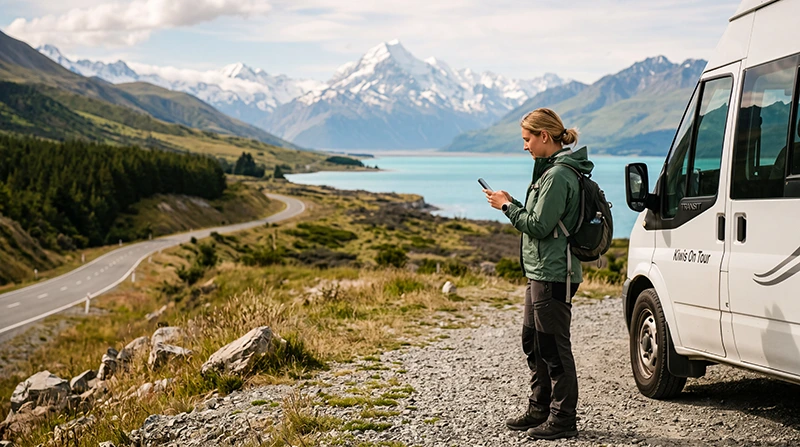

The best SIM card for New Zealand depends less on the largest advertised data allowance and more on where you are going. Mobile service in Auckland or Wellington is a different problem from connectivity on a South Island road trip, in a national park or at a remote campervan stop.
Quick answer: Choose a local prepaid SIM when you need a New Zealand number or conventional calls and SMS. Choose a travel eSIM when mobile data and setup before arrival matter more. For a road trip, check the underlying network’s coverage for the complete route, download offline maps and never treat mobile service as an emergency-communication guarantee.
Top New Zealand eSIMs

New Zealand eSIM
Fixed
1 GB, 7 days€ 2.182 GB, 15 days€ 3.933 GB, 30 days€ 5.24Unlimited
Unlimited, 1 day€ 2.62Unlimited, 3 days€ 6.54Unlimited, 5 days€ 10.47
Asia eSIM
Fixed
1 GB, 7 days€ 4.362 GB, 15 days€ 7.853 GB, 30 days€ 10.47Unlimited
Unlimited, 1 day€ 5.67Unlimited, 3 days€ 15.27Unlimited, 5 days€ 24.87Which SIM option is best for New Zealand tourists?
Begin with the communication task rather than the product format:
- City holiday: mobile data for maps, bookings, transport and messaging;
- Road trip: coverage along highways and around overnight stops;
- Campervan travel: hotspot use, larger data needs and offline preparation;
- Long stay: a renewable plan and potentially a local number;
- Australia and New Zealand trip: one eligible regional plan or two country plans.
A data-only eSIM is usually sufficient for a short holiday when communication happens through WhatsApp, FaceTime, Messenger or email. A local prepaid SIM becomes more useful when accommodation hosts, employers or local services need to call a New Zealand number.
New Zealand prepaid SIM versus travel eSIM
| Need | Local prepaid SIM | Travel eSIM |
|---|---|---|
| New Zealand number | Often included | Not included with NoveSIM data-only plans |
| Setup before departure | Sometimes available | Yes |
| Physical SIM slot | Usually required | Not required |
| Calls and carrier SMS | Depends on the bundle | Use internet-based apps |
| In-person purchase | Common | Not required |
NoveSIM travel eSIMs provide mobile data. We do not provide a New Zealand phone number, conventional calls or carrier SMS. Keep the primary SIM active if you need messages sent to your existing number, subject to the home carrier’s roaming rules.
Where to buy a New Zealand prepaid SIM
Local prepaid SIMs are sold by mobile-network shops and other retailers in major towns and cities. Buying from a staffed shop gives you a chance to confirm the included services and get help with activation.
Airport purchase can be convenient, but the choice may be smaller than in the city. Check the actual bundle rather than relying on a “tourist SIM” label. Visitors arriving in Auckland can compare immediate options in the Auckland Airport internet guide.
Main mobile networks in New Zealand
New Zealand has three established mobile network operators: Spark, One NZ and 2degrees. Each operates national 4G and 5G networks, while smaller brands can provide service through one of the main networks.
No network is strongest at every address or on every road. Check official coverage maps for your accommodation, ferry terminals and the roads between overnight stops. A national population-coverage figure can look impressive while still leaving gaps across sparsely populated land.
The New Zealand network guide for tourists explains how to compare coverage for an actual itinerary.
Coverage on a New Zealand road trip
Service is normally easier in Auckland, Wellington, Christchurch, Queenstown and other populated areas. Coverage can become intermittent on rural roads, through mountain terrain and near remote hiking or camping locations.
Before driving:
- download the route in an offline map;
- save accommodation addresses and check-in instructions;
- store ferry, bus and activity tickets offline;
- tell someone the planned route when travelling remotely;
- do not rely on an eSIM or local SIM as the only emergency tool.
An eSIM uses a partner mobile network; it cannot provide signal where that network has no terrestrial coverage.
Best setup for Auckland and other cities
For a city-focused trip, plan validity and data allowance are often more important than small coverage differences. Maps, ride information, restaurant searches, messaging and digital tickets make up most daily use.
A travel eSIM is convenient when you want data ready soon after landing. A local SIM is appropriate when you also need a domestic number or expect frequent conventional calls.
Best setup for a South Island itinerary
For Christchurch, Queenstown and a multi-stop South Island route, investigate the roads between destinations rather than checking only the towns. Mountain passes, valleys and remote stretches can behave differently from urban centres.
Choose a plan with enough validity for delays and itinerary changes. Keep essential navigation offline even when the selected network’s map shows expected coverage.
Best setup for campervan travel
Campervan travellers often use more data because they research campsites, weather, routes and activities throughout the day. Laptop tethering and streaming can increase usage quickly.
Check these points before purchase:
- whether hotspot use is permitted;
- any daily high-speed or fair-use limit;
- coverage around planned campsites;
- whether the plan can be topped up or renewed;
- how much content can be downloaded over Wi-Fi.
How much data should you buy?
Light map and messaging use needs much less data than video calls, streaming or cloud photo uploads. A road trip can also generate extra use through continuous navigation and daily travel research.
Reduce consumption by downloading map areas, playlists and video before leaving Wi-Fi. Pause automatic photo backup and app updates on mobile data. Use the New Zealand travel data guide to estimate an allowance for the full trip.
Do you need 5G?
5G can be useful in supported urban locations, but it should not determine the entire purchase. A compatible 4G connection is sufficient for maps, messaging, browsing and most travel tasks.
5G availability depends on the phone, network, plan and location. A 5G symbol in Auckland does not mean that the same service will continue throughout a rural itinerary.
New Zealand-only plan or Australia–New Zealand plan?
A country plan is normally the clearest choice for a New Zealand-only trip. If the itinerary also includes Australia, compare an eligible regional plan against separate country plans.
Confirm the country list, total validity, data allowance and hotspot policy. One regional eSIM is convenient when both countries are included, but two country plans may provide clearer or larger allowances.
Prepare the phone before departure
- Confirm that the exact phone model supports eSIM if choosing a digital plan.
- Make sure the device is carrier-unlocked.
- Install the travel eSIM on reliable Wi-Fi.
- Follow the plan’s activation rule so validity does not begin too early.
- Label the lines clearly.
- On arrival, select the travel eSIM for cellular data and enable data roaming when required.
If the eSIM does not connect, keep it installed while checking the data line, roaming setting and network registration.
Related Articles
- Best eSIM for New Zealand
- Mobile internet in New Zealand
- Best New Zealand network for tourists
- Internet at Auckland Airport
FAQ
What is the best SIM card for tourists in New Zealand?
Choose a local prepaid SIM when you need a New Zealand number. Choose a travel eSIM when data and setup before arrival are more important. Coverage for the actual route matters more than the format.
Can tourists buy a prepaid SIM in New Zealand?
Yes. Prepaid SIMs are available from network shops and other retailers. Check the current bundle, activation process and included calls, texts and data before paying.
Will one SIM cover a complete New Zealand road trip?
No provider can guarantee uninterrupted service on every remote road or hiking route. Check network maps and keep navigation, tickets and accommodation details available offline.
Does a NoveSIM New Zealand eSIM include calls and SMS?
No. NoveSIM travel eSIMs are data-only and do not include a local number, conventional calls or carrier SMS. Internet-based apps can use the mobile-data connection.
Final Recommendation
Use a local prepaid SIM when a New Zealand number is essential. For a short holiday centred on mobile data, a travel eSIM is usually simpler to prepare. Road-trip and campervan travellers should make network coverage, hotspot policy and offline planning the deciding factors, rather than choosing only by price or advertised data volume.