


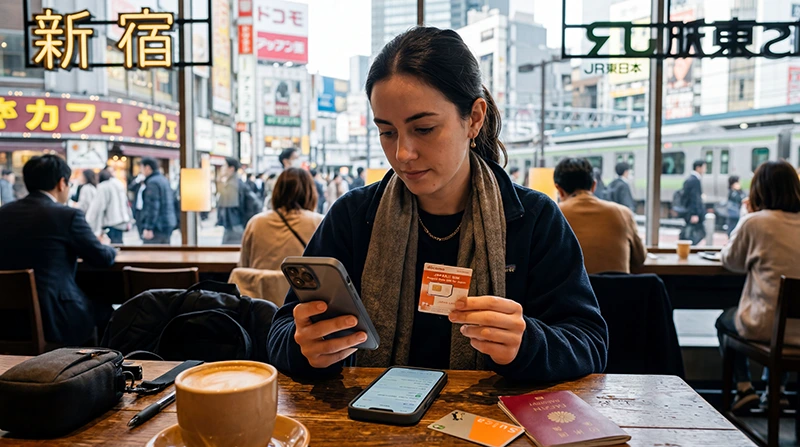

Choosing between a local SIM card and an eSIM is one of the biggest connectivity decisions travelers make before visiting Japan.
Both options provide mobile internet across Japan, but they differ significantly in convenience, setup, flexibility, and travel experience.
Quick answer: for most tourists visiting Japan in 2026, eSIMs are usually easier and more convenient than local SIM cards because they can be activated digitally before arrival and work immediately after landing.
Top Japan eSIMs


What Is the Difference Between a Local SIM and an eSIM?
| Local SIM Card | eSIM |
|---|---|
| Physical plastic SIM card | Digital SIM installed electronically |
| Inserted into the phone manually | Installed through QR code or app |
| Requires SIM swapping | No physical SIM change needed |
| Usually bought after arrival | Can be activated before travel |
| Main SIM often removed | Main SIM can stay active |
Why Many Tourists Now Prefer eSIMs in Japan
Most modern travelers now choose eSIMs because the experience is significantly easier.
With a Japan eSIM, travelers can:
- Buy internet before departure
- Install the eSIM before flying
- Use mobile internet immediately after landing
- Avoid airport SIM card queues
- Keep their regular SIM active
- Switch plans digitally
For short trips and tourism, this convenience is often the biggest advantage.
Top Japan eSIMs
When a Local SIM Card May Be Better
A local SIM card can still make sense if:
- Your phone does not support eSIM
- Your device is older
- You are staying in Japan for a longer period
- You prefer traditional physical SIM setup
- You want to buy directly from a Japanese store
However, local SIM cards usually require more setup after arrival.
Convenience Comparison
| Feature | Local SIM | eSIM |
|---|---|---|
| Activation speed | Slower | Very fast |
| Airport setup required | Usually yes | No |
| Can be prepared before travel | Limited | Yes |
| Requires physical SIM removal | Yes | No |
| Works immediately after landing | Sometimes | Usually yes |
Coverage Differences in Japan
In most cases, local SIM cards and eSIMs use the same major Japanese networks.
The main networks in Japan include:
- NTT Docomo
- KDDI / AU
- SoftBank
- Rakuten Mobile
Because many eSIM providers connect to these same networks, coverage quality is often very similar.
Where Coverage Works Best in Japan
- Tokyo
- Osaka
- Kyoto
- Hiroshima
- Sapporo
- Nagoya
- Fukuoka
- Shinkansen routes
- Major train stations
Japan generally has excellent nationwide mobile coverage for travelers.
Price Comparison: Local SIM vs eSIM
| Option | Typical pricing | Overall value |
|---|---|---|
| Local SIM card | Medium | Good for longer stays |
| Japan eSIM | Usually lower or similar | Excellent for tourists |
| Airport SIM | Often expensive | Convenient but costly |
| International roaming | Usually highest cost | Least cost-effective |
For most short-term travelers, eSIMs usually offer the best balance between convenience and price.
Can You Keep Your Main Number Active?
This is one of the biggest advantages of eSIM technology.
With an eSIM, most modern phones allow travelers to:
- Keep their primary SIM active
- Receive SMS verification codes
- Use WhatsApp normally
- Use the Japan eSIM only for mobile data
With a physical local SIM card, travelers often need to remove their normal SIM entirely.
Which Option Is Better for Short Trips?
For most short Japan trips, eSIMs are usually the better choice because they:
- Save time
- Require less setup
- Avoid airport queues
- Work immediately after landing
- Reduce travel stress
This is especially useful when arriving after a long international flight.
Which Option Is Better for Long Stays?
For longer stays in Japan, some travelers still choose local SIM cards because:
- Large local plans may offer more data
- Some local plans include Japanese phone numbers
- Physical SIMs may support longer-term contracts
- Some local providers offer extended packages
However, many long-term travelers still prefer eSIMs because of flexibility and easier management.
eSIM vs Pocket WiFi in Japan
| eSIM | Pocket WiFi |
|---|---|
| No extra hardware | Requires separate device |
| No extra charging | Battery charging required |
| Easy daily use | Useful for groups |
| Instant setup | Pickup and return needed |
| Best for solo travelers | Can connect multiple devices |
Many travelers now prefer eSIMs because they avoid carrying additional devices around Japan.
How Much Data Do Travelers Need in Japan?
| Traveler type | Recommended data |
|---|---|
| Light traveler | 3GB–5GB |
| Average tourist | 10GB–20GB |
| Heavy social media user | 20GB+ |
| Remote worker | Large or unlimited plan |
| Content creator | Unlimited plan recommended |
Japan trips often consume more mobile data because travelers constantly use maps, train apps, translation tools, and social media.
Should You Install the eSIM Before Flying to Japan?
Yes — absolutely.
Most experienced travelers now install the Japan eSIM before departure.
This allows internet to work immediately after landing and helps avoid:
- Airport SIM queues
- WiFi dependency
- Navigation problems
- Complicated setup after arrival
Best Setup for Japan Travel
| Setting | Recommended option |
|---|---|
| Main SIM | Keep active for calls and SMS |
| Main SIM roaming | Off |
| Japan eSIM | On |
| Japan eSIM roaming | On if required |
| Mobile data line | Japan eSIM |
Common Problems With Local SIM Cards in Japan
- SIM card setup after arrival
- Airport queue delays
- Need to remove primary SIM
- Phone compatibility issues
- Incorrect APN configuration
- Difficulty understanding Japanese setup instructions
Many of these problems are avoided entirely with eSIMs.
Related Japan Travel Guides
- Japan eSIM
- Best eSIM for Japan
- Buy eSIM Japan
- Best SIM card Japan
- Mobile internet Japan
- Internet Japan tourists
- Japan roaming charges
FAQ: Local SIM vs eSIM in Japan
Is eSIM better than a local SIM card in Japan?
For most tourists, yes. eSIMs are usually easier because they can be activated before arrival and do not require a physical SIM swap.
Do local SIM cards and eSIMs use the same networks in Japan?
Usually yes. Many eSIM providers connect to the same major Japanese networks as local SIM cards.
Can I keep my normal number while using a Japan eSIM?
Yes. Most modern phones allow your primary SIM to stay active while the Japan eSIM handles mobile data.
Are local SIM cards cheaper than eSIMs in Japan?
Not always. For many tourists, eSIMs now offer very competitive pricing with significantly more convenience.
Should I install my Japan eSIM before departure?
Yes. Most travelers now install the eSIM before flying so internet works immediately after landing.
Is Pocket WiFi better than eSIM in Japan?
Pocket WiFi can work well for groups, but most solo travelers now prefer eSIMs because they are lighter and easier to use.
Final Thoughts: Local SIM vs eSIM in Japan
Both local SIM cards and eSIMs work well in Japan, but the overall experience is very different.
Local SIM cards still make sense for some travelers with older devices or longer stays, but eSIMs are now usually the easiest option for tourists because they activate digitally and work immediately after arrival.
For most travelers visiting Japan in 2026, a Japan eSIM remains one of the fastest, simplest, and most convenient ways to stay connected throughout the trip.