


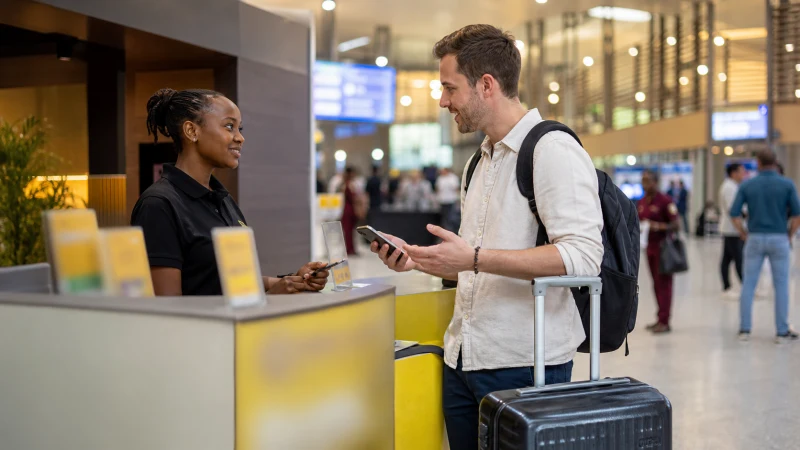

Buying a SIM card at Kigali International Airport is straightforward once you know where to actually look — the kiosks sit just outside the arrivals hall rather than inside the terminal itself, a detail that’s tripped up more than a few travelers expecting a shop before customs.
Quick answer: Clear customs and baggage claim, walk out through the covered pathway (roughly 50 meters to the parking area), and look for the MTN and Airtel kiosks just outside arrivals. Bring your passport — registration is mandatory — and expect data bundles starting around 2,000 RWF for a few gigabytes, with the SIM itself costing about 500 RWF.
Top Rwanda eSIMs

Rwanda eSIM
Fixed
1 GB, 7 days25.50$2 GB, 15 days49.50$3 GB, 30 days69.50$Unlimited
Unlimited, 1 day23.50$Unlimited, 3 days68.50$Unlimited, 5 days113.50$
Where the kiosks actually are
Kigali International Airport is small and easy to navigate, with a single terminal handling both domestic and international flights. There’s no SIM card store inside the terminal itself — after clearing customs and collecting your luggage, you walk outside and follow the covered pathway toward the parking lot, where dedicated MTN and Airtel kiosks are located just outside the arrivals hall.
What you’ll need
Bring your passport — Rwanda requires physical passport presentation for any SIM registration, with no exceptions, and this applies at the airport kiosks the same as anywhere else in the country. The process itself is quick once you’re being served, typically completed in a few minutes.
What it costs
SIM cards are commonly priced around 500 RWF (roughly $0.35-0.50 USD), with data bundles starting from about 2,000 RWF for a few gigabytes — inexpensive by most international standards, and a genuine reason many visitors choose a local SIM over a pricier travel eSIM for anything beyond a very short stay.
The late-night staffing issue
Both kiosks are typically open to meet incoming international flights, but late-night staffing can be thin — if you’re landing on a late flight, don’t assume the kiosks will be fully staffed or that the wait will be short. This is one of the more common reasons travelers arrive with a pre-installed eSIM instead, covered in the local SIM versus eSIM guide.
Which network to choose
MTN has the wider overall coverage footprint, a safer choice if your trip extends toward Akagera or border areas; Airtel is competitive and often slightly cheaper, particularly within Kigali. The mobile networks guide covers this comparison, and the best network for tourists guide covers matching your choice to your specific itinerary.
Setting up mobile money
Once registered, setting up mobile money on your new SIM is worth doing early in your trip — it’s widely used in Rwanda for everything from moto-taxi fares to small vendor payments, and having it ready from day one avoids fumbling with cash for every small transaction.
If you’d rather skip the kiosk entirely
An eSIM installed before you fly means you’re online the moment you land and switch off airplane mode, without needing to find the kiosk or navigate the registration queue. The Rwanda eSIM installation guide covers this alternative.
FAQ
Is there a SIM shop inside Kigali Airport’s terminal?
No — the MTN and Airtel kiosks are located just outside the arrivals hall, past customs and baggage claim.
Do I need my passport?
Yes, without exception — registration requires physical passport presentation at the point of sale.
What if I land late at night?
The kiosks are typically open for international arrivals, but staffing can be thin late at night — consider a pre-installed eSIM as a backup.
How much does a SIM and data bundle cost at the airport?
Roughly 500 RWF for the SIM, with data bundles starting around 2,000 RWF for a few gigabytes.
Which network should I choose at the airport kiosk?
MTN for wider coverage if your trip extends beyond Kigali, or Airtel if you’re staying mainly in the capital and want a slightly better price.
Final Recommendation
Buying a SIM at Kigali Airport is quick and affordable once you know the kiosks sit just outside arrivals rather than inside the terminal — bring your passport, and consider a pre-installed eSIM as backup if you’re landing late at night when staffing may be thinner.