


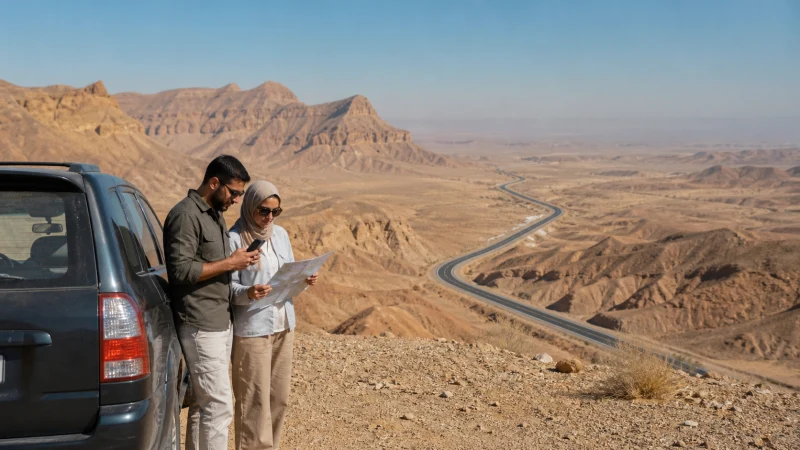

Saudi Arabia’s sheer size makes a road trip here a genuinely different undertaking than a similar journey through a smaller country — a circuit touching Riyadh, the Red Sea coast, AlUla’s ancient sites, and the mountains of Asir can easily involve more driving distance than crossing several European countries combined.
Quick answer: Saudi Arabia’s major highways connecting its cities carry strong, consistent 4G throughout, with coverage dropping only on the more remote desert stretches and rural detours covered elsewhere in this cluster. No single stretch of a typical circuit keeps you offline for more than a few hours, though the country’s scale means those hours add up more than they would elsewhere.
Top Saudi Arabia eSIMs

Saudi Arabia eSIM
Fixed
1 GB, 7 days3.50$2 GB, 15 days6.00$3 GB, 30 days8.50$Unlimited
Unlimited, 1 day3.50$Unlimited, 3 days9.00$Unlimited, 5 days12.00$
The main highway corridors
Roads connecting Riyadh to Jeddah, Dammam, and the other major cities all carry regular traffic and correspondingly strong coverage — the Riyadh to Jeddah guide and Riyadh to Dammam guide cover two of the country’s busiest corridors specifically.
Where coverage drops off
Detours into mountain regions like Asir, or genuinely remote desert stretches approaching the Empty Quarter, follow a more variable pattern — the remote areas mobile internet guide covers this in more depth, and it’s worth expecting rather than assuming constant signal on these specific legs.
Planning a multi-region circuit
A common route might run Riyadh to Jeddah along the coast, north to AlUla’s heritage sites, then south through Madinah and Makkah before heading to Taif and Asir’s mountains — each leg has its own coverage character, from Riyadh’s dense urban signal to the elevation-based drop-off in the mountains, so it’s worth reviewing each stop’s specifics rather than assuming uniform coverage throughout.
Navigation on the road
Real-time navigation works well on Saudi Arabia’s main highways but becomes less reliable on desert detours and mountain roads, which is why downloading offline maps in advance is worth doing before setting off from a major city.
Staying connected between stops
A data bundle sized for the whole trip, rather than repeated small top-ups, tends to work better on a road trip where you’re not always near a shop when you need to renew — the how much data guide covers bundle sizing, and this matters more here than in a smaller country given how much ground a typical circuit covers.
Choosing a network for a long circuit
Since switching networks partway through a road trip is inconvenient even if technically possible, choosing STC upfront for any circuit extending into desert or mountain regions generally avoids the coverage gaps that Mobily and Zain see more often outside the main cities — the best SIM card guide covers matching a network to your specific route.
FAQ
Is mobile coverage reliable on Saudi Arabia’s main highways?
Yes, generally — the corridors connecting the major cities carry decent 4G for most of the drive.
Where does coverage drop off on a road trip?
Mainly in mountain regions like Asir, and on remote desert stretches away from the main highways.
Can I rely on real-time navigation for the whole trip?
Only on the main highways — download offline maps for anywhere you’ll be off them.
Should I buy one big data bundle or top up along the way?
A bundle sized for the whole trip is usually more practical than relying on repeated top-ups on the road.
Which network is best for a long circuit around Saudi Arabia?
STC generally offers the most consistent nationwide coverage for a route extending into desert or mountain regions.
How long will I be without signal on a typical circuit?
Rarely more than a few hours at a time, mostly during specific remote detours.
Final Recommendation
Saudi Arabia’s main highways stay well covered, but plan around the specific gaps in mountain and remote desert regions rather than assuming uniform coverage. Check each stop’s dedicated guide, starting with the mobile internet in Saudi Arabia guide if you haven’t set up connectivity yet.