


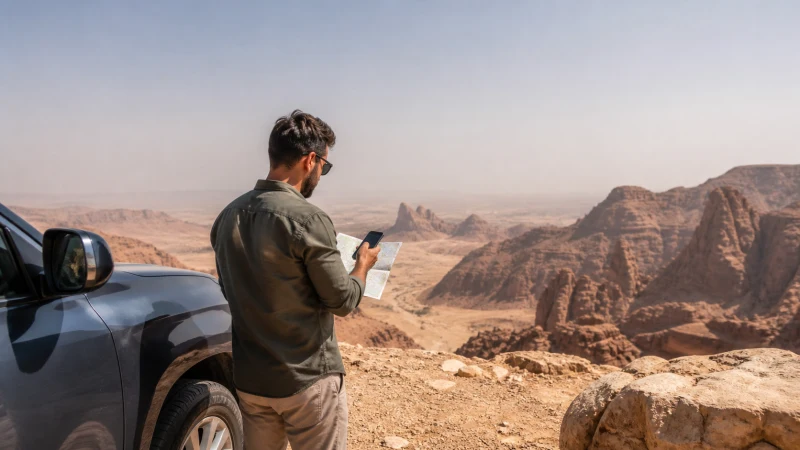

For mobile internet in Saudi Arabia’s remote areas, check the actual route and the networks authorised by your package, then prepare to travel without continuous data. Reception on a road, at a camp and behind nearby terrain can differ; a national operator ranking is not a route survey.
This guide concerns journeys away from towns, including desert roads, camping and excursions towards the Rub’ al Khali, or Empty Quarter. It does not promise signal along every main highway or declare an entire region disconnected without location-specific evidence.
Our NoveSIM travel eSIMs provide data. We do not provide a Saudi telephone number, conventional calls or SMS with these plans. Internet communication depends on a usable connection; a travel eSIM is not satellite communication equipment.
Quick answer: Check each important stop and the route between stops against the permitted network’s coverage information. Download directions and camp or pickup details, agree communication arrangements with your organiser and prepare for sections without service. Do not assume STC access, uninterrupted highway reception or mobile coverage throughout an expedition.
Top Saudi Arabia eSIMs


Check the Route Before Choosing an Operator
Write down the intended road, overnight stops, camp entrance and planned excursions. A city name is insufficient when the location you need is outside it. Ask the organiser for coordinates or a precise meeting point rather than searching for an approximate place name after leaving town.
The official CST coverage-map service supports checking a selected location. Compare the relevant operator information with the networks your subscription permits. A coverage indication helps with planning, but it is not a guarantee of working data in every vehicle or at every point.
Read the current Saudi Arabia package details before buying. Do not choose a travel eSIM on an assumption that it uses STC or can switch freely among all domestic networks. The Saudi SIM-card guide covers choosing local service if you need capabilities beyond travel data.
Main Highways Still Need an Offline Fallback
A busy highway does not prove uninterrupted reception. Check the stretches that matter to your itinerary rather than extending a successful connection in Riyadh or Jeddah to the whole drive. Download the route and planned stops while you have suitable access.
For that particular journey, the Riyadh-Jeddah guide separates flight preparation from road travel. Do not treat a generic statement about major corridors as evidence for a different road or detour.
Save accommodation access instructions and any transport booking on the device. Check that the saved information opens without internet before departure; a link in an email is not an offline copy.
Off-Highway Stops Need Their Own Location Check
For camping, dune visits or photography, ask about the precise site and the access route. Reception near a main road does not establish service at a camp beyond it, and distance from the road alone cannot predict the result.
Agree how your group will meet and communicate if messages cannot be sent. Do not make live location sharing the only record of a meeting point. The photography guide covers managing uploads; taking pictures offline and transferring them later preserves data and avoids making the visit depend on reception.
Planning a Visit Towards the Empty Quarter
Use the actual itinerary supplied for the expedition, not a region-wide claim of either guaranteed coverage or no coverage anywhere. Confirm the organiser’s communication arrangements, pickup details and return plan before leaving a connected location.
Prepare for loss of mobile service wherever it would otherwise prevent an essential task. Offline maps help you access saved information, but they do not provide communication and are not a substitute for appropriate expedition preparation. For walking excursions elsewhere, the hiking connectivity guide addresses the separate data-planning task.
Discuss a Communication Backup with the Organiser
For a remote or multi-day itinerary, ask what communication equipment and procedures the organiser uses when mobile service is unavailable. A satellite device may be part of that arrangement, but buying or carrying one alone does not establish that it is suitable, permitted or ready to use for the trip.
If such equipment is proposed, confirm its service coverage, active subscription, power needs, operating instructions and applicable requirements with the provider and organiser. Do not rely on an unfamiliar device as an untested emergency plan. This guide does not assess a particular satellite product or its local permissions.
Use a Working Connection to Prepare, Not to Predict
- Download the route, meeting locations and next accommodation instructions.
- Open the saved files without Wi-Fi or mobile data to confirm offline access.
- Check package validity and remaining allowance for the whole journey.
- Save the communication and return arrangements agreed with your organiser.
- Charge the phone and any equipment you expect to use during the trip.
The Saudi road-trip guide covers the wider journey preparation. If your data line fails before departure, investigate the settings and package rather than assuming the location is the cause. Do not delete an installed eSIM unless support instructs you to do so.
Related Articles
FAQ
Which network is best for remote travel in Saudi Arabia?
No single operator is established here as best for every remote itinerary. Compare coverage for your actual route and stops, and confirm that the selected subscription permits that network.
Can I assume mobile data works along a major desert highway?
No. Check the planned corridor and prepare offline directions. A road’s traffic or importance does not guarantee uninterrupted reception through your package.
Is the whole Empty Quarter without mobile coverage?
This guide does not establish that region-wide claim. Check the specific expedition and its communication arrangements, and prepare for mobile service to be unavailable when you need it.
Do I need a satellite device for a remote expedition?
Discuss the communication plan with the organiser. If satellite equipment is proposed, confirm suitability, service, applicable requirements and how it will be used; a travel eSIM does not replace it.
Final Recommendation
For Saudi Arabia’s remote areas, choose connectivity from the permitted network and the specific journey, not an unsupported national ranking.
Save directions and essential documents before departure, and agree a communication plan that remains usable when mobile data is unavailable.
Treat reception as location-dependent. Prepare remote-road, camp and expedition arrangements individually without assuming either continuous highway service or identical conditions throughout a desert region.