
 Български

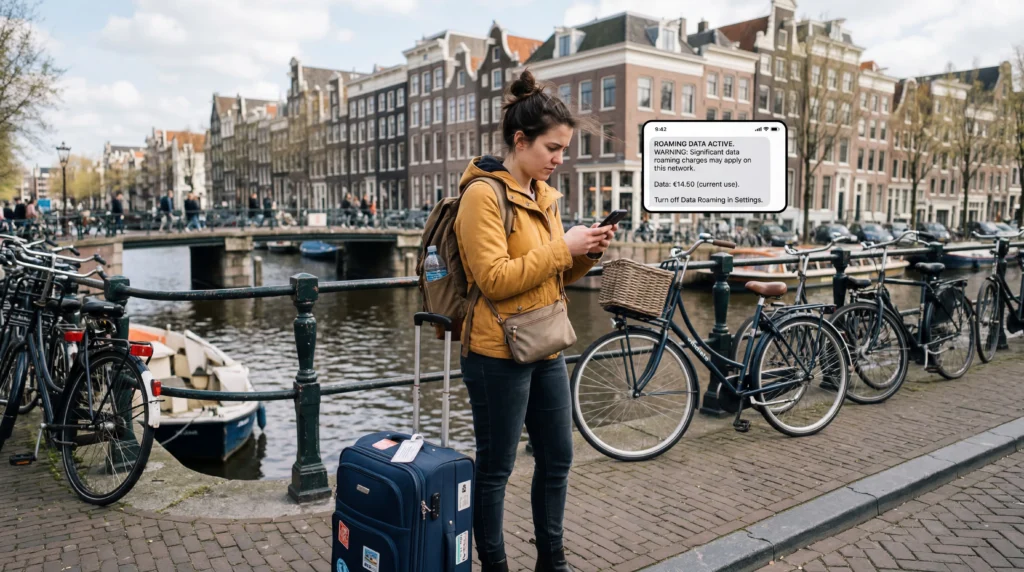
The Netherlands is one of the most visited destinations in Europe, attracting millions of travelers each year. Visitors arrive to explore cities such as Amsterdam, Rotterdam, and The Hague.
While traveling in the Netherlands, tourists rely heavily on mobile internet for:
- navigation and maps
- public transport apps
- restaurant bookings
- messaging and social media
Many travelers initially use their home mobile plan through international roaming. However, roaming charges in the Netherlands can vary depending on your mobile provider and country of origin.
This guide explains how roaming works in the Netherlands, potential roaming costs, and alternative ways to stay connected while traveling.
How Roaming Works in the Netherlands
When roaming is enabled, your phone connects to a Dutch mobile network through a roaming agreement between your home carrier and a local operator.
The main mobile networks in the Netherlands include:
- KPN
- Vodafone Netherlands
- Odido (formerly T-Mobile Netherlands)
Your home carrier determines whether roaming is included in your plan or charged separately.
Roaming for EU Travelers
Travelers from EU countries usually benefit from the “Roam Like at Home” regulation.
This means EU mobile users can typically use their domestic mobile plans in the Netherlands without additional roaming fees.
However, fair-use limits may still apply depending on the provider.
Roaming Costs for Non-EU Travelers
Visitors coming from outside the European Union may experience higher roaming charges.
The exact cost depends on the home mobile carrier.
| Service | Typical Cost |
| Mobile Data | High per-GB charges |
| Voice Calls | International roaming rates |
| SMS | Per-message charge |
Because roaming costs can increase quickly, travelers often consider alternative connectivity options.
Alternative: Local SIM Card in the Netherlands
Many tourists choose to buy a prepaid SIM card after arriving.
SIM cards can be found in:
- airports
- mobile operator stores
- electronics retailers
- supermarkets
Learn more:
Best SIM Card for the Netherlands
If you arrive in Amsterdam, see:
Alternative: Travel eSIM
Travel eSIM plans have become increasingly popular among international travelers.
An eSIM allows you to activate mobile data digitally without inserting a physical SIM card.
Advantages include:
- instant activation
- no need to visit stores
- predictable data pricing
Learn more:
Or read:
How to Get Internet in the Netherlands as a Tourist
Roaming vs SIM Card vs eSIM
| Option | Convenience | Cost | Setup |
| Roaming | Very high | Often expensive | Automatic |
| Local SIM | Medium | Usually cheaper | After arrival |
| eSIM | Very high | Predictable pricing | Before travel |
Final Thoughts
Roaming in the Netherlands works automatically but can become expensive depending on your mobile provider.
EU travelers often benefit from roaming regulations, while visitors from outside the EU may face higher data charges.
For predictable mobile internet costs, many travelers prefer using a local SIM card or a travel eSIM plan.
FAQ
Is roaming free in the Netherlands?
EU travelers usually benefit from the “Roam Like at Home” regulation, which allows them to use their domestic plan in the Netherlands.
How expensive is roaming in the Netherlands?
The cost depends on your mobile carrier. Travelers from outside the EU may pay higher roaming rates.
Can tourists buy SIM cards in the Netherlands?
Yes. Prepaid SIM cards are widely available at airports, electronics stores, and mobile operator shops.
Is eSIM a good alternative to roaming in the Netherlands?
Yes. Many travelers use travel eSIM plans for predictable pricing and instant internet access.