


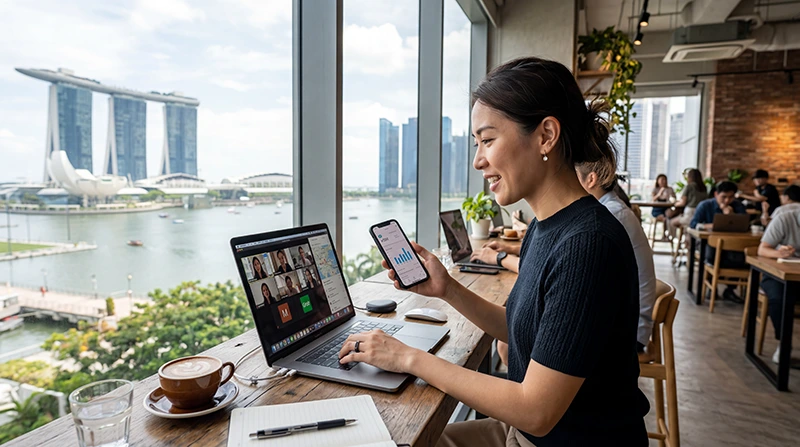

Singapore is one of Asia’s strongest destinations for remote work, business travel, digital productivity, conferences, and short-term professional stays.
Whether you are working from a hotel, coworking space, cafe, airport lounge, business district, serviced apartment, or between meetings, reliable internet is essential for video calls, email, cloud tools, messaging apps, hotspot use, VPN access, file uploads, and daily planning.
Quick answer: For many remote workers in Singapore, the best setup is a combination of stable WiFi for heavy laptop work and a Singapore eSIM as mobile data backup for hotspot, maps, Grab, WhatsApp, email, and urgent work while moving around.
Top Singapore eSIMs


Why Remote Workers Need Reliable Internet in Singapore
Remote work depends on more than basic browsing. You may need stable connectivity for long video calls, cloud documents, project tools, messaging platforms, file uploads, calendar updates, authentication codes, and backup hotspot.
- Zoom calls
- Microsoft Teams meetings
- Google Meet sessions
- Slack and work chats
- Email and calendar sync
- Cloud storage access
- Google Drive, OneDrive, Dropbox
- VPN and company systems
- Remote desktop tools
- Laptop hotspot backup
Best Internet Options for Remote Work in Singapore
| Option | Best For | Main Limitation |
|---|---|---|
| Singapore eSIM | Mobile backup, hotspot, travel days, work between locations | Requires eSIM-compatible unlocked phone |
| Hotel WiFi | Laptop work, longer calls, larger downloads | Quality varies by hotel and room location |
| Coworking WiFi | Focused work, meetings, stable desk setup | Requires booking or day pass |
| Public WiFi | Light tasks in cafes or malls | Not ideal for sensitive business work |
| International Roaming | Corporate plans with roaming included | Provider-dependent cost, speed, and limits |
Why Singapore eSIM Is Useful for Remote Work
A Singapore eSIM gives your phone mobile data without replacing your physical SIM card.
You can install it before departure while connected to WiFi. After arriving in Singapore, select the eSIM for mobile data, enable data roaming on the eSIM line, and use mobile internet where coverage is available.
- Useful immediately after arrival
- Works while moving between hotels, meetings, and coworking spaces
- Can support hotspot if the plan and device allow it
- Useful when hotel WiFi is weak
- Works for email, maps, Grab, WhatsApp, and work apps
- No airport SIM card queue
- No physical SIM card swap
- Can keep your primary SIM active on many modern phones
Remote Work After Arriving at Changi Airport
Some remote workers need internet immediately after landing at Changi Airport.
Mobile data can help with urgent email, calendar changes, hotel directions, Grab pickup points, WhatsApp messages, meeting reminders, flight changes, and first-day work planning.
If your Singapore eSIM is already installed, you can usually connect after landing by selecting the eSIM for mobile data and enabling data roaming.
Remote Work from Hotels in Singapore
Hotel WiFi is often useful for laptop work, but quality can vary depending on the hotel, room location, number of guests, and time of day.
A Singapore eSIM can act as backup if hotel WiFi becomes unstable during an important task.
- Email and chat backup
- Calendar access
- Emergency hotspot
- Video call fallback
- Cloud document access
- Grab and navigation after work
Remote Work from Coworking Spaces
Singapore has a strong coworking culture, and many remote workers use coworking spaces for focused work, meetings, networking, and stable desk setups.
Even when coworking WiFi is available, mobile data can be useful as backup for authentication, messaging, navigation, and hotspot if needed.
Remote Work from Cafes
Cafes can be convenient for light work, but they are not always ideal for long calls or sensitive business tasks.
Public WiFi may be slower, shared, or less secure than private mobile data. A Singapore eSIM gives you a more flexible option when cafe WiFi is unavailable or unreliable.
Remote Work from Marina Bay
Marina Bay is popular with business travelers and remote professionals because of hotels, offices, conference venues, restaurants, and premium work-friendly environments.
Mobile data helps with maps, Grab, restaurant meetings, hotel work, coworking access, and urgent work communication while moving around the area.
Remote Work from Orchard Road
Orchard Road is convenient for remote workers staying in central hotels or serviced apartments.
Mobile internet helps with shopping breaks, restaurant bookings, hotel access, Grab rides, MRT routes, and work communication between meetings or desk sessions.
Remote Work from Chinatown and Little India
Chinatown and Little India are useful areas for travelers who want central accommodation, food options, MRT access, and more local atmosphere.
Mobile data helps remote workers navigate, find cafes, stay connected while walking, manage hotel communication, and coordinate transport.
Remote Work from Sentosa
Some remote workers combine work and leisure by staying in Sentosa resorts or visiting the island between work sessions.
Mobile internet is useful for hotel communication, beachside planning, attraction tickets, Grab rides, WhatsApp, and backup access to work apps.
Remote Work During Business Events and Conferences
Remote workers attending conferences in Singapore may need internet for event apps, QR check-ins, networking messages, live schedule updates, LinkedIn, email, and urgent client work.
Venue WiFi can become crowded during large events, so a Singapore eSIM can provide useful backup connectivity.
Using Hotspot for Remote Work in Singapore
Hotspot can be very useful when WiFi is weak or unavailable.
Before depending on hotspot, check whether your eSIM plan and device support hotspot sharing.
Hotspot is helpful for:
- Messaging apps
- Cloud documents
- Light file transfers
- Calendar updates
- Urgent laptop tasks
For long video calls, large uploads, or heavy cloud syncing, WiFi is usually better when available.
How Much Data Do You Need for Remote Work in Singapore?
| Remote Work Style | Recommended Data |
|---|---|
| Email, chat, maps, light browsing | 5GB – 10GB |
| Short work trip with occasional hotspot | 10GB – 20GB |
| Frequent video calls | 20GB – 30GB |
| Daily hotspot and cloud work | 30GB – 50GB+ |
| Heavy remote work and video meetings | Unlimited data recommended |
What Uses the Most Data When Working Remotely?
- Zoom video calls
- Microsoft Teams video meetings
- Google Meet sessions
- Screen sharing
- Cloud file uploads
- Cloud backups
- Remote desktop tools
- Large downloads
- Laptop hotspot usage
- Software updates
Email, Slack messages, WhatsApp text, Google Maps, Grab, calendar sync, and basic web browsing usually use much less data.
How to Reduce Data Usage While Working Remotely
- Use hotel or coworking WiFi for large downloads
- Turn off automatic cloud backups on mobile data
- Disable app and system auto-updates on hotspot
- Use audio calls instead of video when possible
- Lower video call quality if connection is limited
- Download documents before leaving WiFi
- Pause photo and file sync while using hotspot
- Close unused background apps
- Use mobile data mainly as backup for urgent tasks
Singapore eSIM vs Hotel WiFi for Remote Work
| Work Need | Hotel WiFi | Singapore eSIM |
|---|---|---|
| Laptop work in room | Usually best | Backup via hotspot |
| Work while moving | No | Yes |
| Grab and maps | No | Yes |
| Emergency email | Only in hotel | Yes |
| Backup during WiFi issues | No | Yes |
| Large downloads | Better option | May consume data quickly |
Singapore eSIM vs Public WiFi for Remote Work
Public WiFi can help with light tasks, but it may not be ideal for business use.
| Remote Work Need | Public WiFi | Singapore eSIM |
|---|---|---|
| Private work communication | Less ideal | Better |
| Walking between locations | No | Yes |
| Grab, maps, WhatsApp | Limited | Yes |
| Backup connection | Unreliable | Yes |
| Stable work access | Depends on location | More flexible |
Singapore eSIM vs Roaming for Remote Work
International roaming may work well if your home or company plan includes Singapore and provides enough data.
However, roaming costs, speed limits, fair usage policies, hotspot rules, and daily charges depend on your provider.
A Singapore eSIM gives you a separate travel data option and can help keep your primary SIM active for calls, SMS, and authentication codes.
Using VPN with Singapore eSIM
Many remote workers use a VPN for company systems.
A VPN can be important for security, but it may sometimes slow mobile data or affect certain apps.
If your eSIM works but feels slow, test the connection briefly with VPN disabled, then reconnect VPN if required for work.
Security Tips for Remote Work in Singapore
- Use trusted WiFi networks when possible
- Use VPN for company systems if required
- Avoid sensitive work on unknown public WiFi
- Keep your device locked
- Use two-factor authentication
- Do not leave laptop or phone unattended
- Use mobile data as a safer backup for urgent tasks
Can You Keep Your Primary SIM Active?
Yes. Many modern phones support dual SIM functionality.
You can use your Singapore eSIM for mobile data while keeping your primary SIM active for SMS verification codes, calls, banking messages, work authentication, and WhatsApp on your existing number.
To avoid unwanted roaming charges, keep data roaming disabled on your primary SIM and enable it only on the Singapore eSIM line.
Do You Need Data Roaming Enabled for Singapore eSIM?
Yes. Most travel eSIM plans require data roaming to be enabled on the Singapore eSIM line.
This does not mean you need to enable data roaming on your primary SIM. Enable data roaming only on the Singapore eSIM line if you use it for mobile data.
APN Settings for NoveSIM Singapore eSIM
| Setting | Value |
|---|---|
| APN | data.esim |
| Username | Leave blank |
| Password | Leave blank |
How to Set Up Singapore eSIM for Remote Work
- Choose your Singapore eSIM plan before travel.
- Install the eSIM while connected to WiFi.
- Arrive in Singapore.
- Turn off airplane mode.
- Select the Singapore eSIM for mobile data.
- Enable data roaming on the eSIM line.
- Test browser, email, WhatsApp, Google Maps, and work apps.
- Test hotspot if you plan to use laptop backup.
Remote Work Troubleshooting Checklist
If your remote work apps do not load properly, check:
- Singapore eSIM is selected for mobile data.
- Data roaming is enabled on the eSIM line.
- Airplane mode has been refreshed for 30 seconds.
- Your phone has been restarted.
- APN is set to data.esim if manual APN is needed.
- VPN is not blocking traffic.
- Hotspot is not overloaded by background updates.
- You are in an area with good signal.
Do Not Delete Your eSIM First
If mobile data does not work immediately, do not delete your eSIM first.
Some eSIM profiles cannot be installed again after removal. Check mobile data selection, data roaming, APN settings, airplane mode, restart, VPN, and network selection before deleting anything.
Before Working Remotely from Singapore
- Check if your phone supports eSIM
- Make sure your phone is carrier unlocked
- Install your Singapore eSIM before departure if possible
- Download important work files in advance
- Save hotel and coworking addresses
- Confirm VPN access before travel
- Estimate your data usage
- Keep your QR code and installation instructions accessible
- Carry a power bank for long work days
Where to Find Your NoveSIM eSIM Details
Your NoveSIM QR code, installation instructions, and eSIM details are available:
- In your confirmation email
- Under My Account → Orders → View → eSIM details
Related Singapore Business and Remote Work Guides
- Internet for Business Travel Singapore
- Best eSIM for Business Travel Singapore
- Digital Nomad Internet Singapore
- Best Data Plan Singapore Business
- eSIM for Conferences in Singapore
More Singapore Internet Guides
- Singapore eSIM
- Best eSIM for Singapore
- Mobile Internet Singapore
- Internet Singapore Tourists
- Best Mobile Data Singapore
- Unlimited Data eSIM Singapore
- How Much Data Do You Need for Singapore?
FAQ: Remote Work in Singapore
Can I work remotely from Singapore?
Yes. Singapore is a strong destination for remote work, business travel, coworking, conferences, and digital productivity.
What is the best internet setup for remote work in Singapore?
For many remote workers, the best setup is hotel or coworking WiFi for heavy laptop work plus a Singapore eSIM for mobile backup and hotspot.
Can I use hotspot with a Singapore eSIM?
Hotspot may be available depending on your eSIM plan and device settings. Check plan rules before relying on hotspot for laptop work.
How much data do I need for remote work in Singapore?
Light remote work may need 10GB to 20GB, while frequent video calls, hotspot, and cloud work may require 30GB, 50GB, or unlimited data.
Do Zoom, Teams, and Google Meet work with Singapore eSIM?
Yes. These apps work with mobile data, but video calls use much more data than email or messaging.
Do I need data roaming enabled for Singapore eSIM?
Yes. Most travel eSIM plans require data roaming to be enabled on the Singapore eSIM line.
Can I keep my home SIM active?
Yes. Many dual SIM phones allow you to keep your home SIM active while using the Singapore eSIM for mobile data.
What APN should I use for NoveSIM Singapore eSIM?
If manual APN editing is available, use data.esim and leave username and password blank.
Final Recommendation
Remote work in Singapore is practical when you combine reliable WiFi with mobile data backup.
For most remote workers, a Singapore eSIM is useful for arrival connectivity, hotspot backup, Grab, Google Maps, WhatsApp, email, business apps, and urgent work tasks while moving between hotels, coworking spaces, meetings, and airports.