


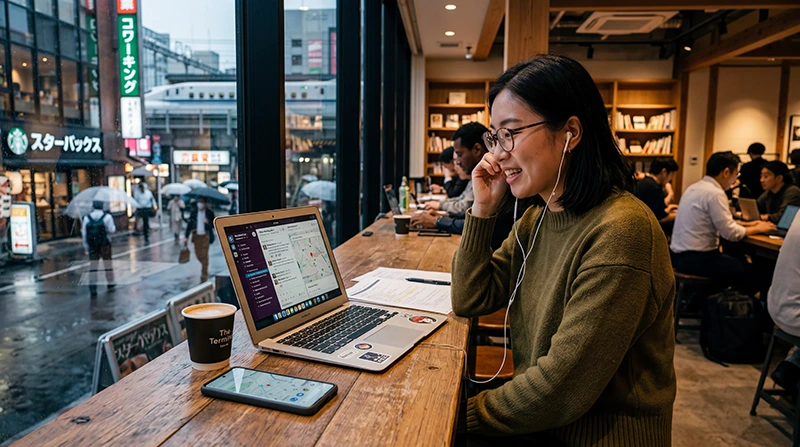

Japan has become one of the world’s most attractive destinations for remote workers thanks to its fast infrastructure, safe cities, reliable transport, and excellent internet coverage.
Quick answer: for most remote workers in Japan, a reliable eSIM with strong nationwide coverage and large or unlimited data is usually the best internet solution because it allows stable connectivity while moving between cities, trains, coworking spaces, cafés, and hotels.
Top Japan eSIMs


Why Reliable Internet Matters for Remote Work in Japan
Remote workers depend heavily on stable internet access throughout the day.
Most digital nomads and remote employees use:
- Zoom and Google Meet calls
- Slack and messaging apps
- Cloud storage services
- Remote desktop software
- VPN connections
- Google Maps navigation
- Hotspot tethering for laptops
- Streaming and uploads
Because many travelers move frequently between cities, trains, cafés, and hotels, reliable nationwide coverage becomes extremely important.
Best Internet Options for Remote Work in Japan
| Internet option | Best for | Main advantage |
|---|---|---|
| Japan eSIM | Most remote workers | Instant mobile internet anywhere |
| Pocket WiFi | Teams and multiple devices | Shared internet connection |
| Public WiFi | Temporary use | Free access |
| Hotel WiFi | Stationary work sessions | Stable indoor connection |
| International roaming | Emergency use | No setup required |
Why Many Remote Workers Prefer eSIMs
Most digital nomads now prefer eSIMs because they simplify travel and remote work significantly.
With a Japan eSIM, remote workers can:
- Install internet before flying
- Use internet immediately after landing
- Avoid airport SIM card queues
- Keep their regular SIM active
- Use hotspot tethering for laptops
- Work while traveling between cities
This flexibility makes eSIMs especially useful for remote workers constantly moving between Tokyo, Kyoto, Osaka, Fukuoka, and Sapporo.
Top Japan eSIMs
Best Networks for Remote Work in Japan
The strongest Japanese mobile networks generally include:
- NTT Docomo
- au by KDDI
- SoftBank
- Rakuten Mobile
For remote workers, networks using NTT Docomo or au are often considered the safest options because of their strong nationwide and train-route coverage.
Can You Work Reliably on Japanese Trains?
Yes.
Japan generally has excellent mobile internet coverage on:
- Shinkansen bullet trains
- Tokyo subway systems
- JR train routes
- Regional rail systems
Many remote workers use travel time productively while moving between cities.
Temporary signal drops may still happen in tunnels or underground stations.
Read also: Internet for Japan train travel
Unlimited Data vs Limited Plans
| Plan type | Best for | Main advantage |
|---|---|---|
| Unlimited data | Heavy remote work | No need to monitor usage |
| 10GB–20GB plans | Light remote work | Lower cost |
| 30GB+ plans | Frequent calls and uploads | More flexibility |
Remote work activities such as video calls, hotspot tethering, cloud syncing, and file uploads can consume large amounts of data quickly.
Read also: Unlimited data eSIM Japan
Can You Use Hotspot Tethering?
Usually yes.
Many Japan eSIM plans support hotspot tethering, allowing travelers to connect laptops and tablets directly through the phone.
This is especially useful when:
- Working from trains
- Using coworking spaces
- Traveling between cities
- Working from cafés or hotels
- Using backup internet connections
Best Cities in Japan for Remote Workers
| City | Why remote workers like it |
|---|---|
| Tokyo | Excellent infrastructure and coworking spaces |
| Osaka | Lower costs and strong internet |
| Kyoto | Relaxed atmosphere and cafés |
| Fukuoka | Growing startup scene |
| Sapporo | Good quality of life and stable networks |
Can Public WiFi Replace Mobile Internet?
Usually not.
Japan has public WiFi in many locations:
- Train stations
- Hotels
- Convenience stores
- Cafés
- Shopping centers
However, public WiFi may still:
- Disconnect frequently
- Require registration
- Feel unstable during busy hours
- Offer inconsistent speeds
Because of this, most remote workers still rely heavily on private mobile internet.
Best Phone Settings for Remote Work in Japan
| Setting | Recommended option |
|---|---|
| Main SIM roaming | Off |
| Japan eSIM | On |
| Japan eSIM roaming | On if required |
| Mobile data line | Japan eSIM |
| Hotspot | Enabled if supported |
| 5G mode | Auto or enabled |
Can You Keep Your Main Number Active?
Yes.
Most modern smartphones support dual SIM functionality, allowing remote workers to:
- Keep their regular SIM active
- Receive SMS verification codes
- Use WhatsApp normally
- Use the Japan eSIM for mobile data
This setup is especially useful for banking apps, authentication codes, and business communication.
Related Japan Travel Guides
- Japan eSIM
- Best eSIM for digital nomads Japan
- Unlimited data eSIM Japan
- Best network in Japan for tourists
- Best internet option Japan
- How much data do you need for Japan
- Google Maps in Japan
FAQ: Remote Work Internet in Japan
What is the best internet option for remote work in Japan?
For most remote workers, a Japan eSIM with large or unlimited data is usually the easiest and most flexible option.
Is Japan good for digital nomads?
Yes. Japan offers excellent infrastructure, fast internet, reliable transport, and safe cities for remote workers.
Can you work remotely on Japanese trains?
Yes. Japan generally has excellent mobile internet coverage across Shinkansen routes and major train systems.
Should remote workers get unlimited data in Japan?
Unlimited data is usually recommended for heavy video calls, hotspot usage, cloud syncing, and uploads.
Can I use hotspot tethering with a Japan eSIM?
Many Japan eSIM plans support hotspot tethering for laptops and tablets.
Can I keep my normal number while using a Japan eSIM?
Yes. Most modern phones allow your primary SIM to stay active while the Japan eSIM handles mobile data.
Final Thoughts: Remote Work Internet in Japan
Reliable internet is essential for remote work in Japan, especially for digital nomads moving between cities, coworking spaces, cafés, and train routes.
For most travelers in 2026, a Japan eSIM remains one of the easiest and most convenient ways to stay connected while working remotely across the country.