


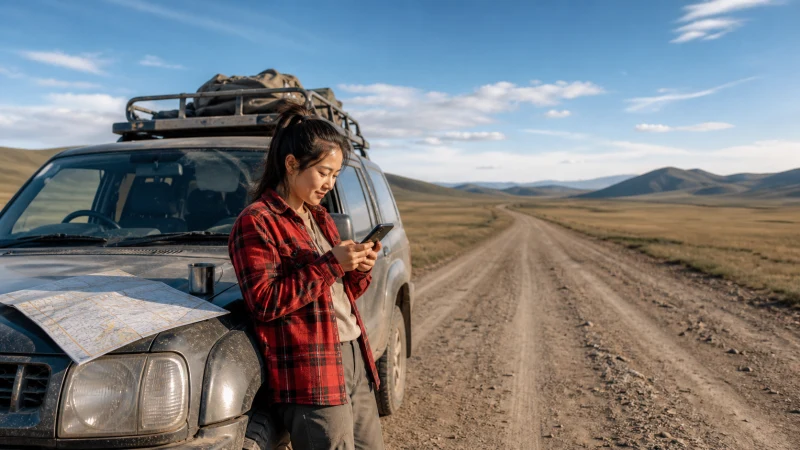

Planning internet on a Mongolia road trip requires an offline-first approach. Mobile data is useful in Ulaanbaatar, aimag centres and some settlements, but long stretches of steppe, desert and mountain road can have weak or no usable signal.
The practical goal is not to stay connected every minute. It is to download what you need at reliable stops, keep the phone ready when coverage returns and make sure navigation and safety plans still work without a network.
NoveSIM Mongolia plans are data-only. They can support maps, messages and internet calls where a partner network is available, but they do not include a Mongolian number, conventional calls or SMS.
Quick answer: install your Mongolia eSIM before departure, download the complete route and alternatives offline, save driver and accommodation details, and assume there will be coverage gaps outside towns. Never use mobile service as the only safety system on a remote drive.
Top Mongolia eSIMs


What internet on a Mongolia road trip is really like
Mongolia’s population and mobile infrastructure are concentrated around Ulaanbaatar, provincial centres and inhabited corridors. A signal in a town does not mean the road to the next stop has continuous coverage. Distance, terrain and the serving network all matter.
Road conditions also change the connectivity problem. A route that appears short on a map may take hours on unpaved tracks, while an unexpected detour can move the vehicle away from the planned coverage corridor. Check the broader picture in the Mongolia eSIM coverage guide, but treat every coverage map as indicative rather than guaranteed.
Build the itinerary around reliable connection points
Before each driving leg, identify the last likely place with dependable data and the next town, camp or hotel where you expect to reconnect. Use that stop to update weather information, confirm the next booking and download any changed route.
- Save the full route, not only the next turn, in an offline navigation app.
- Pin fuel, water, medical help and accommodation locations.
- Keep addresses and phone numbers as screenshots or notes.
- Share the route and expected arrival time with a responsible contact.
- Agree in advance what the group will do if arrival is delayed.
For a Gobi itinerary, use the more specific Gobi Desert connectivity guide. Desert travel requires a stronger backup plan than an urban day trip.
Choose between a travel eSIM, local SIM and roaming
| Option | Useful for | Road-trip limitation |
|---|---|---|
| Travel eSIM | Data ready on arrival and simple dual-SIM use | Needs an unlocked compatible phone and cannot create coverage where no partner signal exists |
| Local SIM or eSIM | Travellers who need a domestic offer or local number | Purchase, identification and current tourist terms must be confirmed |
| Home roaming | Keeping the existing line for a short trip | Price and fair-use rules depend on the home carrier |
| Camp or hotel Wi-Fi | Large downloads at overnight stops | May be slow, shared or unavailable |
A second SIM can add flexibility, but two mobile plans are not two independent safety systems if both rely on infrastructure absent from the area.
Set up the eSIM before leaving Ulaanbaatar
Confirm that the exact handset supports eSIM and is carrier-unlocked. Install the profile on a stable private connection before travel and label it clearly. Installation is not always the same as activation, so follow the validity instructions supplied with the selected plan.
When the plan should connect, select the Mongolia eSIM for Mobile Data, enable Data Roaming on that line and disable mobile-data switching. Keep roaming off on the home SIM unless you intentionally want to use the home carrier. Leave network selection automatic first. If manual APN entry is required for NoveSIM, use data.esim with blank username and password.
Control data and battery between stops
Navigation itself is usually less demanding than video, cloud photo backup or laptop tethering. Download entertainment, language packs and software updates before the drive. Pause automatic backups and check which apps can use mobile data.
Power can become as important as the data allowance. Carry a charged power bank and an appropriate vehicle adapter, keep the phone out of direct sun and avoid relying on a single charging cable. Weak-signal searching can drain a battery quickly; Airplane Mode can conserve power during a known no-service section, but turn it off when approaching the next settlement.
The Mongolia data calculator guide helps size the plan for navigation, messaging and media use.
What to do when the signal disappears
No bars in open country may simply mean there is no serving network nearby. Repeatedly changing settings will not solve a genuine coverage gap. Continue with the offline plan and check again near the next inhabited area.
If other phones have service but the eSIM does not, confirm that the line is enabled and selected for data, Data Roaming is on for that line and Airplane Mode is off. Restart the phone and allow time to register. Try manual network selection only when the current plan instructions name permitted networks. Do not delete the eSIM unless NoveSIM Support instructs you to do so.
If the itinerary includes the Trans-Mongolian Railway
A phone on the train connects to terrestrial mobile towers, not to the railway itself. Reception is therefore more likely near Ulaanbaatar, provincial centres and stations, with gaps possible across long rural sections. Carriage construction and congestion can weaken an otherwise available signal, so download tickets, entertainment and arrival details before boarding.
A Mongolia-only plan should not be assumed to continue after the train crosses into Russia or China. Check the covered countries and activation rules for every plan before departure, and keep border documents, onward tickets and accommodation addresses available offline.
Related Articles
- Best eSIM for Mongolia Travel
- Mobile Internet in Mongolia
- Mongolia eSIM Coverage
- Mobile Internet in the Gobi Desert
FAQ
Is there continuous mobile coverage on Mongolia’s main roads?
No. Coverage can be useful around cities and settlements, but long gaps are possible even when the route connects well-known destinations.
Will an eSIM improve signal in remote Mongolia?
An eSIM changes how a mobile plan is installed; it does not amplify signal. It works only where an allowed partner network provides usable coverage.
Should I carry two mobile plans?
A second plan may offer flexibility, but it does not replace offline maps, a shared itinerary, vehicle preparation or an appropriate emergency communication plan.
Can I rely on live navigation throughout the trip?
No. Download the entire route and alternatives before leaving a reliable connection, and keep essential locations and contacts available offline.
Final Recommendation
Use internet on a Mongolia road trip as a helpful layer in the journey plan, not as its foundation.
Prepare the eSIM and offline route before departure, reconnect deliberately in towns, protect phone battery and share the itinerary with someone who is not in the vehicle.
If the journey enters genuinely remote country, follow local operator and tour advice and carry a communication method suited to the risk and distance.