


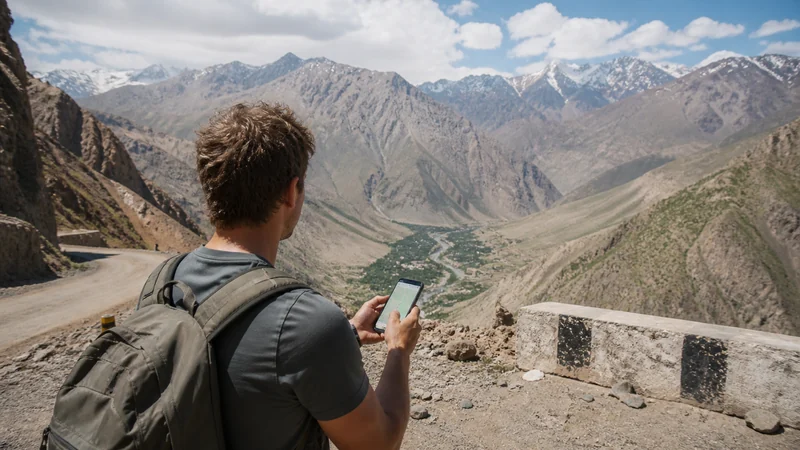

Mobile internet Tajikistan planning should begin with geography, not a promise of uniform nationwide service. Dushanbe and other populated centres are the easiest places to connect, while mountain roads, deep valleys and sparsely populated eastern areas require offline preparation.
A travel eSIM uses local mobile infrastructure; it does not have separate towers or stronger radio reach than the partner network available at your location. Your phone, building, terrain, congestion and selected plan all affect the result.
Quick answer: Expect the most practical service in cities and populated corridors, variable connectivity between towns and substantial gaps on remote mountain routes. Use an eSIM or local SIM for ordinary travel data, but save essentials offline.
Top Tajikistan eSIMs


Mobile Internet Tajikistan: The Decision Framework
The practical decision depends on the traveller’s route, device and current plan terms. The sections below separate those factors so the recommendation remains useful without relying on a generic ranking or a blanket coverage promise.
Where Travellers Can Reasonably Expect Service
Dushanbe offers the strongest overall environment for initial setup, account access and testing. Khujand and other regional centres may also provide usable service, but no article can guarantee a particular speed at a hotel, station or street. Indoor construction and local congestion can matter as much as the city name.
Between towns, coverage tends to follow settlements and transport corridors rather than every kilometre of road. Prepare downloads before leaving a reliable connection. The Tajikistan eSIM coverage guide explains how to interpret network and device limits.
Choose Between eSIM, Local SIM and Wi-Fi
A pre-installed travel plan is useful when you want maps and messages soon after landing. Start with the best eSIM for Tajikistan guide and verify live plan terms on the destination page. A physical SIM may suit a longer stay or a traveller who needs a local number; compare that option in the local SIM guide.
Hotel and café Wi-Fi can reduce mobile-data use but should not be treated as universal or secure. Avoid sensitive transactions on an unfamiliar open network unless you use suitable protection, and never postpone essential route downloads until the last available hotspot.
Dushanbe, Khujand and Regional Stops
Use the capital as the place to confirm that the line connects, download large files and correct settings before travelling farther. If you land there, the Dushanbe Airport internet guide separates airport Wi-Fi, eSIM preparation and later SIM shopping.
For Khujand, Panjakent, Istaravshan, Bokhtar, Kulob, Vahdat and Tursunzoda, the useful principle is the same: test at the actual accommodation and do not infer rural performance from an urban speed test. These city variants do not need separate SEO pages because the preparation and user task are substantially identical.
The Pamirs Need a Different Plan
Khorugh can be a place to reconnect and prepare, but the high-mountain journey beyond populated points should be treated as intermittently or completely offline. Read mobile internet on the Pamir Highway for route-specific preparation.
Store maps, permits, contact details, accommodation information and translations on the device. Carry power and agree on meeting points. Cellular data is helpful when present, but it is not an emergency guarantee in remote terrain.
Settings That Prevent Common Problems
Check device compatibility, install on Wi-Fi and select the travel eSIM for Mobile Data. Enable Data Roaming on that line only and leave network selection automatic. The guide to eSIM data roaming explains why this setting is normally required.
If data fails, use data.esim only when a manual APN is required. Do not delete the eSIM during routine troubleshooting. Use the Tajikistan troubleshooting guide, the general no-internet checklist or support.
Family and Winter Travel Are Planning Scenarios
Families should store the same accommodation and driver details on more than one device, agree on an offline meeting point and prevent children’s devices from using automatic video or app updates. These steps change device management, not the underlying network coverage.
Winter travel adds shorter battery life, possible power interruptions and weather-related route changes. Charge whenever dependable electricity is available, protect phones and power banks from cold and refresh the offline route before leaving a town. A separate winter SIM or family network does not exist; both scenarios belong inside the national connectivity plan.
Related Articles
- how NoveSIM works
- NoveSIM FAQ
- eSIM help centre
- best eSIM for travel
- install eSIM on iPhone
- install eSIM on Android
- eSIM APN settings
- eSIM hotspot guidance
- check phone eSIM support
- contact NoveSIM Support
- all eSIM destinations
- Tajikistan eSIM plans
- Pamir mobile internet
FAQ
Is mobile internet available in Tajikistan?
Yes, especially in populated areas, but availability and performance vary sharply by location and terrain.
Can I rely on data along the whole Pamir Highway?
No. Plan for long gaps and keep essential information offline.
Is an eSIM stronger than a local SIM?
No. Both depend on available local networks; the partner access and exact location determine coverage.
What APN does NoveSIM use?
Use data.esim if manual APN entry is required.
Final Recommendation
Mobile internet Tajikistan use is practical when expectations follow the route: connected cities, variable roads and offline remote stretches.
Choose a plan for convenience or a local SIM for specific longer-stay needs, then test the connection before leaving a populated centre.
Keep maps, bookings and critical contacts offline so that a coverage gap remains an inconvenience rather than a disrupted journey.