


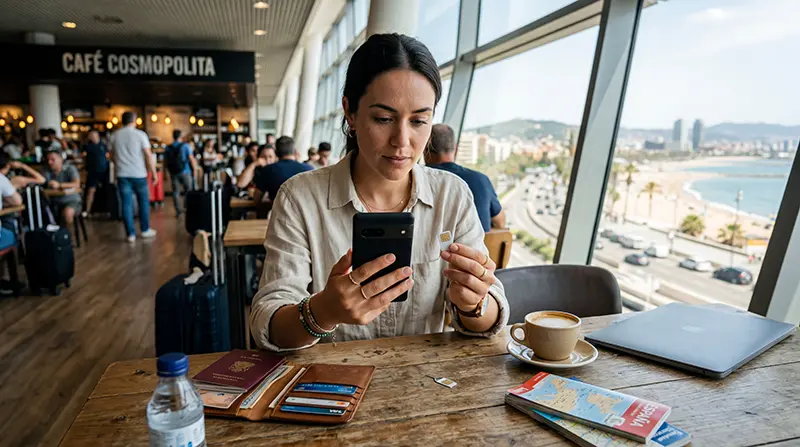

Both an eSIM and a Spanish prepaid SIM can provide mobile data, but they solve the arrival-day problem differently. An eSIM can be installed before departure; a local SIM normally requires a compatible physical slot and a purchase after arrival.
The choice is not simply digital versus plastic. Travellers should compare whether they need a Spanish phone number, whether the handset is unlocked, how quickly they need data and how important it is to keep the home SIM in place.
NoveSIM travel eSIMs are data-only. We do not provide a Spanish telephone number, conventional calls or SMS; supported messaging and calling apps work over data.
Quick answer: Choose an eSIM for immediate data, digital installation and keeping the physical home SIM in the phone. Consider a Spanish prepaid SIM when a local number or included local calls are essential and you are comfortable buying and registering it after arrival.
Top Spain eSIMs

Spain eSIM
Fixed
1 GB, 7 days€ 1.762 GB, 15 days€ 3.523 GB, 30 days€ 4.40Unlimited
Unlimited, 1 day€ 2.20Unlimited, 3 days€ 4.84Unlimited, 5 days€ 7.93
Europe Extra eSIM
Fixed
1 GB, 7 days€ 2.202 GB, 15 days€ 3.523 GB, 30 days€ 4.40Unlimited
Unlimited, 1 day€ 2.64Unlimited, 3 days€ 5.28Unlimited, 5 days€ 8.81Europe+ eSIM
Fixed
1 GB, 7 days€ 2.642 GB, 15 days€ 3.963 GB, 30 days€ 5.28Unlimited
Unlimited, 1 day€ 2.64Unlimited, 3 days€ 6.16Unlimited, 5 days€ 10.13Spain eSIM and Prepaid SIM at a Glance
| Feature | Travel eSIM | Spanish prepaid SIM |
|---|---|---|
| Purchase | Online before travel | Usually shop or airport purchase |
| Physical slot | Not required | Required unless sold as a local eSIM |
| Local number | Not with NoveSIM data-only plans | Often included; check the tariff |
| Identification | Follow online order requirements | Identity registration may be required |
| Keep home SIM installed | Yes, on a compatible dual-SIM phone | Not if it occupies the only physical slot |
When an eSIM Is the Better Fit
An eSIM suits travellers who need maps, accommodation messages or transport apps immediately after landing. Installation can be completed on dependable WiFi before departure, avoiding a queue or a search for an open mobile shop.
It is also useful when the physical SIM must remain in the phone for bank messages or an existing number. Select the eSIM for Mobile Data, keep Data Roaming off on the home line and disable automatic data switching to reduce accidental carrier roaming.
When a Spanish SIM Card Makes More Sense
A local prepaid SIM deserves consideration when the trip requires a Spanish number for ordinary voice calls or SMS. It may also suit a long stay when a current domestic offer provides the right combination of data and local services.
Check the retailer’s identification rules, activation process, plan renewal and whether assistance is available in a suitable language. Airport convenience can carry a different price or plan selection from city shops; compare the complete package rather than assuming every prepaid offer is identical.
Coverage and Speed Are Not Decided by SIM Format
Being an eSIM does not automatically make a connection faster or slower than a plastic SIM. Performance depends on the subscribed plan, authorised network, phone bands, location, indoor conditions, congestion and temporary network changes.
Review the live eSIM product for its listed partner networks and coverage. For a prepaid SIM, check the specific Spanish operator’s current map and tariff. No national plan guarantees reception in every basement, mountain road or crowded venue.
Compare Price Without Missing the Trade-Offs
For an eSIM, compare data, validity, activation timing, top-up availability, hotspot permission and any high-speed threshold. For a local SIM, include the starter pack, required recharge, shop journey and the value of any calls or number that will actually be used.
A traveller who uses only maps and messaging should not pay for services that are unnecessary. Someone staying for months or making local calls should not select a data-only plan merely because installation is quicker.
Before You Choose
Confirm that the exact phone model supports eSIM and is carrier-unlocked. If choosing a physical SIM, confirm that the required slot is free and consider how removing the home SIM affects access to its number.
Keep tickets, addresses and maps offline for arrival. If an installed NoveSIM eSIM does not connect, verify the selected data line, Data Roaming and Automatic Network Selection. Use data.esim only when manual APN entry is required, and do not delete the profile unless NoveSIM Support directs you to do so.
Related Articles
- Spain eSIM plans
- Best eSIM for Spain travel
- Best SIM card for Spain
- Install an eSIM for Spain
- Mobile networks in Spain
- Check eSIM compatibility
FAQ
Is an eSIM better than a SIM card for Spain?
An eSIM is usually more convenient for data on arrival, while a local SIM can be preferable when a Spanish number and ordinary local calls are required.
Can tourists buy a prepaid SIM in Spain?
Prepaid SIMs are available, but the current retailer, identification, registration and activation requirements should be checked before relying on one.
Can I keep my normal number with a Spain eSIM?
Usually yes on a compatible dual-SIM phone. The travel eSIM supplies data while the primary line retains its number, subject to the home carrier’s roaming charges.
Does a NoveSIM Spain eSIM include a local number?
No. NoveSIM travel eSIMs are data-only and do not include a Spanish number, conventional calls or SMS.
Final Recommendation
Choose according to the service you need, not the SIM format alone. For fast arrival-day data and retaining the home SIM, a travel eSIM is generally the cleaner choice.
If a Spanish telephone number or ordinary local calling is essential, compare current prepaid offers and their registration conditions. For either option, verify coverage, validity and full cost.
Prepare the phone and offline essentials before departure. Keep the travel profile during troubleshooting and use NoveSIM Support for unresolved eSIM registration problems.