


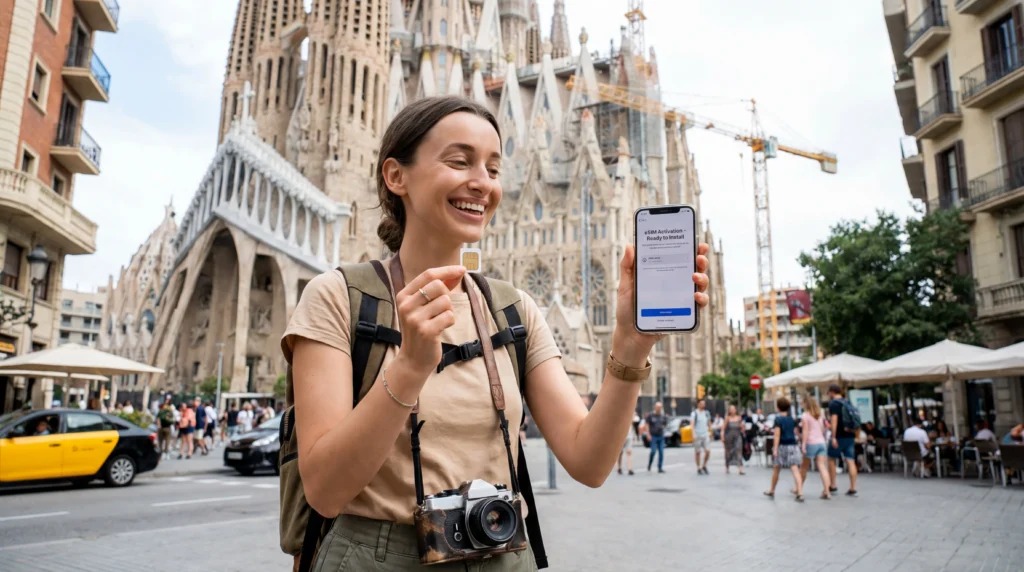

If you are traveling to Spain, you may be comparing a local SIM card and a Spain eSIM for mobile internet during your trip.
Both options can help you stay connected, but they are different in setup, convenience, arrival experience, compatibility, and how easily you can keep your regular phone number active.
Quick answer: Many travelers now prefer using a Spain eSIM because it can be installed before travel and used after arrival without buying or replacing a physical local SIM card.
Top Spain eSIMs

Spain eSIM
Fixed
1 GB, 7 days€ 1.732 GB, 15 days€ 3.463 GB, 30 days€ 4.33Unlimited
Unlimited, 1 day€ 2.16Unlimited, 3 days€ 4.76Unlimited, 5 days€ 7.79
Europe Extra eSIM
Fixed
1 GB, 7 days€ 2.162 GB, 15 days€ 3.463 GB, 30 days€ 4.33Unlimited
Unlimited, 1 day€ 2.60Unlimited, 3 days€ 5.19Unlimited, 5 days€ 8.65Europe+ eSIM
Fixed
1 GB, 7 days€ 2.602 GB, 15 days€ 3.893 GB, 30 days€ 5.19Unlimited
Unlimited, 1 day€ 2.60Unlimited, 3 days€ 6.06Unlimited, 5 days€ 9.95What Is a Local SIM Card in Spain?
A local SIM card is a physical prepaid SIM card that travelers buy after arriving in Spain.
It is inserted into your phone and can provide mobile data, and sometimes calls or SMS, depending on the plan.
Tourists may find local SIM cards at:
- Airport shops
- Mobile operator stores
- Electronics stores
- Shopping centers
- Convenience shops
- Tourist kiosks
What Is a Spain eSIM?
An eSIM is a digital SIM card built directly into compatible smartphones.
Instead of inserting a physical card, travelers install the eSIM digitally using a QR code, activation link, or manual installation details.
This allows travelers to prepare mobile internet before departure and connect shortly after arriving in Spain.
Local SIM vs eSIM Spain: Main Differences
| Feature | Local SIM Card | Spain eSIM |
|---|---|---|
| Physical card required | Yes | No |
| Can install before travel | No | Yes |
| Need to find a shop | Usually yes | No |
| Airport queue risk | Often yes | No |
| Keep regular SIM active | Depends on device | Yes, on many phones |
| Best for quick arrival internet | Less convenient | Yes |
Why Many Travelers Prefer eSIM in Spain
Many tourists prefer eSIM because it reduces the friction of getting connected after landing.
With a Spain eSIM, travelers usually avoid:
- Searching for SIM card shops after arrival
- Waiting in airport queues
- Replacing their regular physical SIM card
- Risking losing the home SIM card
- Comparing plans in a foreign language
- Depending on store opening hours
When a Local SIM Card May Still Be Useful
A local SIM card may still be a good option if:
- Your phone does not support eSIM
- Your device is locked and cannot use travel eSIMs
- You prefer buying from a physical store
- You need a specific local prepaid SIM service
- You are using an older smartphone
Which Option Is Better for Tourists?
For many short-term tourists, eSIM is often the easier option.
This is because tourists usually want mobile internet quickly for:
- Airport transfers
- Google Maps
- Hotel check-in communication
- Train and bus tickets
- Restaurant bookings
- Travel apps
A local SIM card can work well, but it usually requires more effort after arrival.
Which Option Is Better for Long Stays?
For longer stays, both options can work.
A local SIM card may be useful for travelers who want a traditional local mobile setup, while an eSIM may be better for travelers who want a faster digital setup and do not want to replace their regular SIM.
Digital nomads, business travelers, and remote workers may prefer larger eSIM plans or unlimited data options, especially when hotspot is needed.
Spain eSIM vs Local SIM for Airports
Airports are one of the most common places where travelers need internet immediately.
After landing, mobile internet is useful for:
- Messaging your hotel or host
- Opening ride apps
- Finding airport transport
- Checking train or bus routes
- Loading maps
- Accessing booking confirmations
An eSIM can be installed before departure, which means travelers do not need to depend on airport SIM card shops or public WiFi.
Spain eSIM vs Local SIM for City Travel
In cities such as Barcelona, Madrid, Valencia, Seville, Malaga, Bilbao, and Granada, mobile internet helps with metro navigation, walking routes, restaurant reservations, ticket apps, translation tools, and hotel communication.
Both local SIM and eSIM can work, but eSIM is usually simpler for travelers who want internet ready immediately.
Spain eSIM vs Local SIM for Beaches and Islands
Spain is a major beach and island destination.
Travelers visiting Mallorca, Ibiza, Tenerife, Gran Canaria, Lanzarote, Costa del Sol, and other coastal areas use mobile internet for:
- Beach navigation
- Ferry schedules
- Boat tours
- Hotel transfers
- Weather updates
- Restaurant reservations
- Car rental navigation
Coverage is usually good in popular tourist zones, although signal may vary in remote beaches, ferry routes, mountainous island areas, or rural roads.
Spain eSIM vs Local SIM for Road Trips
If you plan to drive in Spain, mobile internet is highly useful.
Travelers often use data for:
- Google Maps and GPS navigation
- Traffic updates
- Parking apps
- Fuel stations
- Hotel communication
- Remote beaches
- Scenic route planning
Downloading offline maps before remote drives is recommended, especially for mountain regions, rural roads, islands, and coastal routes.
How Much Data Do You Need in Spain?
The right amount of data depends on your travel style.
| Travel Style | Estimated Data Need |
|---|---|
| Maps, messaging, browsing | 3GB – 5GB |
| Regular tourist usage | 5GB – 15GB |
| Heavy social media and video calls | 15GB – 30GB |
| Remote work, hotspot, streaming | 30GB+ or unlimited recommended |
What Uses the Most Data?
The biggest data usage usually comes from video and background-heavy apps.
- Video streaming
- Instagram Reels and TikTok
- Video calls
- Cloud photo backups
- Mobile hotspot
- Large file uploads and downloads
Maps, WhatsApp text messages, browsing, and transport apps usually use much less data.
Unlimited Data: Local SIM or eSIM?
Unlimited data may be useful if you plan to work remotely, share hotspot, upload videos, stream content, or stay in Spain for longer.
However, both local SIM and eSIM plans may include conditions such as:
- Fair usage policies
- Daily high-speed data limits
- Reduced speeds after heavy usage
- Hotspot restrictions
- Network management during congestion
Always check the plan details before choosing an unlimited data option.
Can You Use Hotspot with a Spain eSIM?
Hotspot availability depends on the selected eSIM plan and device settings.
Some plans may allow hotspot sharing for laptops, tablets, or other devices.
If hotspot is important for your trip, check the plan details before purchase.
Coverage Across Spain
Mobile coverage is usually strongest in cities, airports, train stations, highways, beaches, tourist zones, and populated coastal regions.
Coverage is usually good in:
- Barcelona
- Madrid
- Valencia
- Seville
- Malaga
- Bilbao
- Major beach resorts
- Main airports
- Popular tourist destinations
Signal quality may vary in:
- Mountain regions
- Remote beaches
- Small villages
- Rural countryside roads
- Tunnels
- Ferry routes and offshore areas
Local SIM vs eSIM vs Roaming
| Option | Best For | Main Limitation |
|---|---|---|
| Spain eSIM | Fast digital setup | Requires eSIM-compatible phone |
| Local SIM card | Older phones without eSIM | Requires store visit and SIM swap |
| Roaming | Short trips with included roaming | Depends on your home carrier |
| Public WiFi | Hotels and cafes | Limited while moving around |
Do You Need Data Roaming Enabled?
Yes. Most travel eSIM plans require data roaming to be enabled on the eSIM line.
This is normal for many travel eSIM plans.
If you want to avoid using your primary SIM abroad, keep data roaming disabled on your regular SIM and enable it only on the Spain eSIM line.
APN Settings for NoveSIM eSIM
In most cases, APN settings configure automatically.
If manual setup is required for NoveSIM eSIM, use:
| Setting | Value |
|---|---|
| APN | data.esim |
Can You Keep Your Main SIM Active with eSIM?
Yes. Most modern smartphones support dual SIM functionality.
This allows travelers to use the Spain eSIM for mobile data while keeping their regular SIM active for:
- Calls
- SMS verification codes
- Banking apps
- Authentication messages
- WhatsApp on the same number
How to Activate a Spain eSIM
- Choose your Spain eSIM plan before travel.
- Install the eSIM using the QR code or activation link.
- Arrive in Spain.
- Select the eSIM for mobile data.
- Enable data roaming on the Spain eSIM line.
- Wait for the phone to connect to the local network.
Where to Find Your NoveSIM eSIM Details
Your NoveSIM eSIM QR code and installation instructions are available:
- In your confirmation email
- Under My Account → Orders → View → eSIM details
Before Choosing Local SIM or eSIM
Before deciding which option is better, check:
- Whether your phone supports eSIM
- Whether your phone is carrier unlocked
- How much data you need
- Whether hotspot is important
- Whether you need to keep your regular SIM active
- Whether you want internet immediately after landing
Get Mobile Internet Before Your Spain Trip
Many travelers prepare mobile internet before departure so they can stay connected immediately after arriving in Spain.
Browse NoveSIM eSIM destinations
More Spain eSIM and Internet Guides
- Spain eSIM
- Best eSIM for Spain
- Buy eSIM Spain
- Best SIM Card Spain
- Mobile Internet Spain
- Internet Spain Tourists
- Spain Roaming Charges
- eSIM vs SIM Card Spain
- Roaming vs eSIM Spain
- How Much Data Do You Need for Spain
FAQ: Local SIM vs eSIM Spain
Is eSIM better than a local SIM card in Spain?
For many travelers with compatible phones, eSIM is easier because it can be installed before travel and does not require a physical SIM swap.
Can tourists buy local SIM cards in Spain?
Yes. Tourists can usually buy prepaid local SIM cards at airports, mobile shops, electronics stores, shopping centers, and tourist areas.
Does Spain eSIM work immediately after arrival?
In many cases, yes. Once the eSIM is installed, selected for mobile data, and data roaming is enabled, it can connect after arriving in Spain.
Can I keep my regular SIM active with eSIM?
Yes. Most modern smartphones support using a regular SIM together with an eSIM.
Do I need data roaming enabled for Spain eSIM?
Yes. Most travel eSIM plans require data roaming to be enabled on the eSIM line.
What is the APN for NoveSIM eSIM?
The APN for NoveSIM eSIM is data.esim.
Which option is better for older phones?
If your phone does not support eSIM, a local physical SIM card may be the better option.
Final Recommendation
For most travelers visiting Spain, eSIM is usually more convenient than buying a local physical SIM card after arrival.
It allows travelers to prepare mobile internet before departure, avoid airport SIM card queues, keep their regular SIM active, and use mobile data for maps, trains, beaches, ferries, bookings, WhatsApp, and travel apps across Spain.
A local SIM card may still be useful for older phones without eSIM support, but if your device supports eSIM, a Spain eSIM is often the faster and easier travel internet option.