


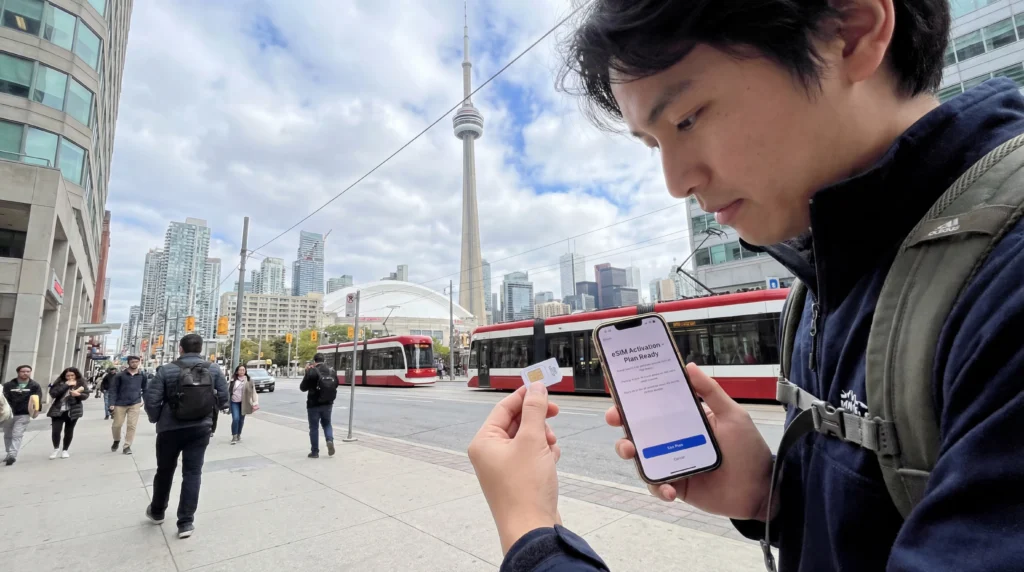

A local Canadian SIM and a travel eSIM can both provide mobile data, but they solve different travel needs. The main differences are purchase timing, phone requirements, local-number availability, plan commitment and what happens to the primary SIM.
A travel eSIM is designed for advance data setup on a compatible unlocked phone. A local SIM can be useful for a longer stay or when a Canadian number and domestic mobile services are essential.
NoveSIM Canada plans are data-only. They support online apps but do not include a Canadian telephone number, traditional voice minutes or SMS, so travellers who require those features should compare an authorised local offer.
Quick answer: Choose a travel eSIM for pre-arranged data and dual-SIM convenience; choose a local SIM when a Canadian number or longer domestic arrangement is necessary; use home roaming only after checking its complete charges.
Top Canada eSIMs

Canada eSIM
Fixed
1 GB, 7 days€ 3.992 GB, 15 days€ 6.663 GB, 30 days€ 9.76Unlimited
Unlimited, 1 day€ 5.32Unlimited, 3 days€ 15.09Unlimited, 5 days€ 23.52
Before choosing or changing a plan, compare the current Canada eSIM plans, confirm the exact handset on the compatible-device list and review how NoveSIM works. Product availability, supported partner networks, 5G, hotspot use and fair-use terms depend on the selected package, device, location and current product conditions.
Setup before Travel or after Arrival
A travel eSIM can be bought and installed before departure, leaving only line selection and roaming settings for arrival. A local SIM normally requires an in-country purchase, activation and any provider-specific account process.
Arrival convenience matters after a long flight or late landing. Compare not only the price but also shop hours, queue time, accepted identification and how quickly the service can be tested.
Phone Compatibility and SIM Slots
An eSIM requires the exact model to support embedded SIM provisioning and the phone to be carrier-unlocked. A physical local SIM requires an available slot and may displace the home SIM.
Regional variants can differ, so confirm the model number and look for an EID or Add eSIM menu. Store a removed physical SIM safely and consider how verification messages will be received.
Canadian Number, Calls and SMS
A local plan may include a Canadian number, but the traveller must verify its voice, SMS and account terms. NoveSIM travel plans provide data only.
WhatsApp, iMessage, Signal, email and other internet services can use travel data where available. They do not replace ordinary telephone access for every purpose, so list communication requirements before choosing.
Coverage and Network Access
SIM format does not itself determine coverage. The underlying network, plan entitlement, phone bands, terrain, building and congestion determine the result.
The current NoveSIM Canada page lists Videotron, Bell, Rogers and TELUS partner access. A local plan may use one provider or its arrangements; compare official coverage maps for the exact route.
Cost and Plan Commitment
A travel eSIM typically presents an allowance and validity for a trip. A local offer may include activation fees, taxes, recurring billing or cancellation requirements in addition to its advertised amount.
Compare total usable data, validity, hotspot terms, local-number value and time spent obtaining service. Avoid declaring one format always cheaper without the exact current offers.
Dual-SIM Convenience
A compatible phone can often keep the primary number available while the Canada eSIM supplies data. This helps with account verification and existing messaging identities.
Keep Data Roaming off on the primary SIM and automatic data switching off. The home carrier may still charge for calls, messages and voicemail, so dual SIM is a technical capability rather than a free-roaming guarantee.
Road Trips and Cross-Border Travel
Canada’s geography makes route coverage important. Save offline maps before remote or mountain travel, regardless of the SIM format.
If the itinerary crosses into the United States, confirm that the plan includes both countries. Neither a Canadian local SIM nor a Canada-only travel eSIM should be assumed to work across the border on the same terms.
Decision Checklist
Choose eSIM when advance setup, keeping the physical slot and short-term data matter most. Choose a local SIM when a Canadian number, domestic calling or a long stay makes the local process worthwhile.
Before payment, confirm compatibility, unlocked status, coverage, allowance, validity, hotspot policy, taxes and cancellation. Keep order or retail documentation until the trip and any support questions are complete.
Arrival and Airport Preparation
Install the eSIM before departure while dependable private Wi-Fi and the purchase details are available. Installation does not necessarily begin the plan validity: follow the activation rule supplied with the selected product. Label the line Canada or Travel, confirm that it appears in the SIM list and keep the QR code and manual activation details private. Do not scan the code again after the profile has installed.
Before the aircraft lands, save the accommodation address, transfer instructions, booking references and a basic offline map. Airport Wi-Fi can help with initial setup, but its availability, sign-in process and performance can change. Verify any public network name against official signs before connecting and avoid making an unverified open network the only route to essential documents.
Travelling between Canada and the United States
A plan sold for Canada should not automatically be treated as a North American regional plan. If the itinerary includes a drive, train, flight or cruise into the United States, open the exact product details and confirm that both countries are listed. Network signals can also cross a border, but seeing a carrier name does not prove that the plan is authorised there.
Download border-crossing directions and retain tickets before approaching the frontier. Keep automatic mobile-data switching off so the primary SIM cannot take over when the Canada plan loses service. For a multi-country journey, compare a genuinely regional product with separate country plans by total validity, data and supported destinations.
Security on Public Wi-Fi
Hotel, airport, café and station Wi-Fi is useful for large downloads, but travellers should confirm the official network name and sign-in page. Avoid sending sensitive information through an unknown open hotspot, keep the operating system and browser protections enabled and disconnect from networks that behave unexpectedly. A plausible name alone does not establish that a hotspot belongs to the venue.
Mobile data provides a useful alternative when a public network is unavailable or questionable, yet it does not remove ordinary account-security responsibilities. Use strong device authentication, protect email access and never share an eSIM QR code in a public message or screenshot. Activation credentials should be treated like a password.
Calls, Emergency Access and Offline Backups
A data-only travel eSIM is intended for internet access and should not be presented as a substitute for a Canadian telephone plan or guaranteed emergency-calling service. Internet calling and messaging apps depend on data, the app and local availability. Travellers who need conventional calls or SMS must arrange those services separately and understand the home or local carrier charges.
Keep emergency contacts, insurance details, medical information and key addresses available offline. In remote terrain, coverage can be absent even when the wider region appears served. For backcountry or safety-critical travel, follow the communications recommendations of the responsible park, tour operator or local authority rather than relying solely on a consumer mobile plan.
Canada Travel Connectivity Checklist
- Confirm that the exact phone model supports eSIM and is carrier-unlocked.
- Match the allowance and validity to the entire trip.
- Check current partner-network information and route coverage.
- Install on stable Wi-Fi before departure unless instructed otherwise.
- Select the Canada eSIM for mobile data after arrival.
- Enable Data Roaming on the travel line and keep it off on the primary line.
- Disable automatic data switching and retain offline maps.
- Keep the QR code, activation details and order number private.
Recommended Dual-SIM Settings
| Setting | Recommended value |
|---|---|
| Mobile Data | Canada travel eSIM |
| Travel eSIM Data Roaming | On |
| Primary SIM Data Roaming | Off |
| Automatic Data Switching | Off |
| Network Selection | Automatic |
| Manual APN | data.esim only if required |
Related Articles
- Canada eSIM plans
- Best eSIM for Canada
- How to get internet in Canada
- Canada travel data plans
- Canada roaming charges
- Local SIM versus eSIM in Canada
- How much data Canada travellers need
- Best network in Canada for tourists
- Canada eSIM troubleshooting
- eSIM-compatible devices
- How NoveSIM works
- Check whether your phone supports eSIM
- Install eSIM on iPhone
- Install eSIM on Android
- Data Roaming for eSIM
- NoveSIM APN settings
- Keep your number with a data eSIM
- Fix an eSIM showing No Service
- Fix an eSIM connected without internet
- NoveSIM FAQ
- NoveSIM Support
FAQ
Is an eSIM better than a local SIM in Canada?
It is often more convenient for short data-focused trips, while a local SIM may be better when a Canadian number or longer-term domestic service is required.
Is a Canadian phone number included with NoveSIM?
No. NoveSIM Canada plans are data-only and do not include a local number, calls or SMS.
Which option has better coverage?
Coverage depends on the network, plan, phone and route rather than whether the SIM is physical or embedded.
Can I keep my physical SIM while using eSIM?
Yes on many compatible dual-SIM phones. Select the eSIM for data and keep primary-line Data Roaming off.
Final Recommendation
For a short Canada trip focused on maps, messages and bookings, a travel eSIM is usually the more direct option.
For a long stay or a genuine Canadian-number requirement, compare authorised local plans including taxes, activation and cancellation.
Whichever format you choose, verify route coverage, control primary-line roaming and prepare offline information for remote travel.