


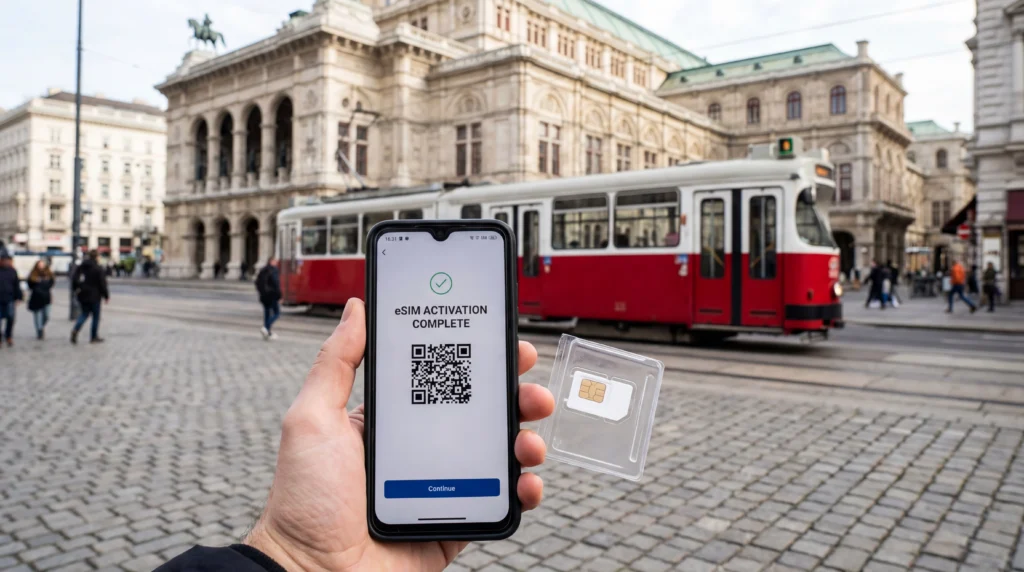

Traveling to Austria in 2026? One of the smartest things to plan before departure is how you will stay connected.
Tourists visiting Vienna, Salzburg, Innsbruck, Hallstatt, and the Austrian Alps often need reliable mobile internet for:
- Google Maps and navigation
- train and public transport apps
- hotel check-ins and bookings
- WhatsApp and messaging
- restaurant reservations
- social media and travel photos
Most travelers choose between two main options:
- buying a local SIM card in Austria
- installing a travel eSIM before arrival
This guide compares Local SIM vs eSIM in Austria so you can choose the best option for your trip.
Quick Answer
- Best convenience: eSIM
- Best for instant internet: eSIM
- Best for local number: Local SIM
- Best for longer stays: Local SIM or larger eSIM plan
- Best overall for tourists: eSIM
Mobile Networks in Austria
Austria has modern mobile infrastructure with strong nationwide coverage.
Main operators include:
- A1 Telekom Austria
- Magenta Telekom
- Three Austria
Travelers can expect strong 4G coverage and growing 5G availability in cities and tourist areas.
What Is a Local SIM Card?
A local SIM card is a physical prepaid SIM purchased after arriving in Austria.
You usually insert the SIM card into your phone and activate a plan.
Common places to buy:
- Vienna Airport
- mobile operator stores
- electronics retailers
- supermarkets
- city kiosks
Helpful guides:
What Is an eSIM?
An eSIM is a digital SIM card built into compatible smartphones.
Instead of inserting plastic SIM cards, you install the plan digitally by QR code.
Main advantages:
- buy before travel
- activate in minutes
- internet immediately after landing
- keep your physical SIM active
- no store visit required
Top Austria eSIMs

Austria eSIM
Fixed
1 GB, 7 days€ 1.732 GB, 15 days€ 3.033 GB, 30 days€ 3.89Unlimited
Unlimited, 1 day€ 2.16Unlimited, 3 days€ 5.19Unlimited, 5 days€ 8.22
Europe Extra eSIM
Fixed
1 GB, 7 days€ 2.162 GB, 15 days€ 3.463 GB, 30 days€ 4.33Unlimited
Unlimited, 1 day€ 2.60Unlimited, 3 days€ 5.19Unlimited, 5 days€ 8.65Europe+ eSIM
Fixed
1 GB, 7 days€ 2.602 GB, 15 days€ 3.893 GB, 30 days€ 5.19Unlimited
Unlimited, 1 day€ 2.60Unlimited, 3 days€ 6.06Unlimited, 5 days€ 9.95Helpful guides:
Local SIM vs eSIM in Austria
| Feature | Local SIM | eSIM |
| When to set up | After arrival | Before travel |
| Format | Physical SIM | Digital |
| Store visit | Usually yes | No |
| Activation speed | Manual | Fast |
| Keep home SIM active | Less convenient | Yes |
| Convenience | Medium | Very high |
Typical Tourist Data Prices in Austria
| Data | Validity | Typical Price |
| 10–15 GB | 7 days | €10 – €15 |
| 20–30 GB | 15 days | €15 – €25 |
| 40+ GB | 30 days | €25 – €35 |
Prices vary by provider, promotions, and included benefits.
When Local SIM Is Better
- you want an Austrian phone number
- you stay for several weeks or months
- you prefer buying in-store
- your phone does not support eSIM
When eSIM Is Better
- you want internet immediately after landing
- you do not want to visit shops
- you want to keep your main SIM active
- you want fast digital setup
- you travel for a short trip or holiday
Best Choice for Most Tourists
For most short-term travelers visiting Austria, eSIM is usually the better option.
You land in Vienna, open maps, book transport, message family, and start your trip immediately.
Austria Travel Examples
Weekend in Vienna
Best option: eSIM
2-Week Austria + Europe Trip
Best option: Europe eSIM or Austria eSIM
Long Stay Student / Worker
Best option: Local SIM may be worth considering
Final Thoughts
Austria offers reliable mobile internet through modern networks across cities, ski resorts, and tourist destinations.
Local SIM cards are affordable and easy to find, but they require time after arrival.
For many tourists, installing an eSIM before departure is the fastest and easiest solution.
Frequently Asked Questions
Is eSIM better than a local SIM card in Austria?
For many tourists, yes. eSIM is more convenient because it can be installed before travel and activated instantly.
Can tourists buy SIM cards in Austria?
Yes. SIM cards are available at airports, supermarkets, electronics stores, and operator shops.
Do eSIM and local SIM use the same networks in Austria?
Often yes. Many eSIM providers use partner networks such as A1, Magenta Telekom, and Three Austria.
Can I keep my home SIM while using eSIM?
Yes. Most modern phones support dual SIM functionality.
Does Austria have good mobile coverage?
Yes. Austria generally has strong coverage in cities and tourist regions.