


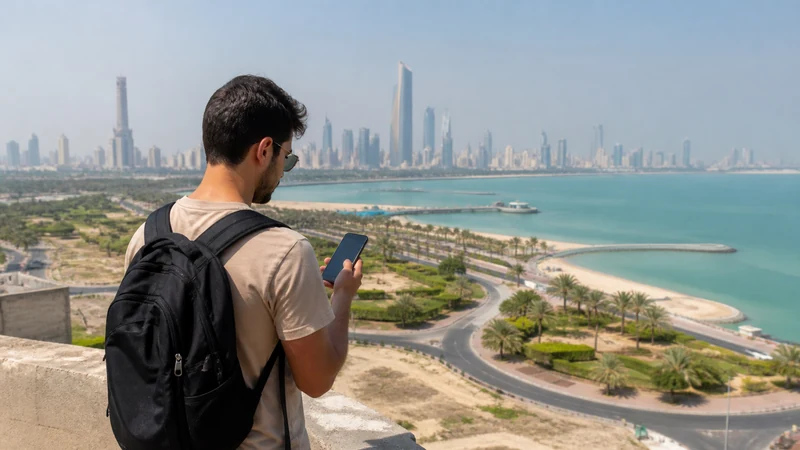

Kuwait eSIM coverage follows the local partner allowed by the travel plan; it is not a separate NoveSIM radio network. Kuwait’s national infrastructure is extensive, but product access and address-level reception remain separate questions.
Urban streets and main roads are a different risk from a basement, ferry crossing, offshore trip or border approach. A country statistic cannot predict the signal at one of those places.
NoveSIM Kuwait plans are data-only unless the current product states otherwise. Coverage enables internet access, not a Kuwaiti number, ordinary voice minutes or SMS.
Quick answer: confirm the live plan’s partner information, expect LTE or 5G where the plan, phone and location support it, and keep offline maps and essential details for Failaka Island, boat journeys, desert roads and border areas.
Top Kuwait eSIMs


Read national Kuwait eSIM coverage carefully
Kuwait’s Communications and Information Technology Regulatory Authority lists Zain, Ooredoo and stc among the country’s mobile service providers. Its 2025 mobile-network benchmark used measurements collected from 3 July to 2 October 2025. Across the three anonymised operators, the report classified roughly 96.5%–99.2% of measured LTE coverage and 93.9%–95.7% of measured 5G coverage as “Good” or better. These are dated test results, not a live coverage map or a ranking of named operators.
Those figures describe operator networks, not guaranteed access for every travel eSIM. A travel plan connects only through partners authorised for that product. The selected partner can change, and the phone still needs compatible radio bands and current software.
City and suburban expectations
Kuwait City, Salmiya, Hawalli, Jabriya, Farwaniya, Mahboula and Fahaheel lie within the country’s heavily developed urban corridor. Outdoor service is generally the least difficult part of a trip, but dense construction introduces indoor variation.
Basements, lifts, underground parking, deep hotel rooms and buildings with coated glass can reduce signal. Move near a window or outside when safe before changing the plan or APN. Congestion at malls, events and busy waterfront locations can lower speed even when bars remain strong.
Different districts still create different practical tasks. In Farwaniya, save the airport pickup area and exact building entrance. In Hawalli and Jabriya, dense blocks make entrance-level meeting pins more useful than a venue name. In Mahboula, longer stays may justify fixed accommodation Wi-Fi with mobile backup. In Salmiya and Fahaheel, waterfront reception can differ from service inside malls, cafés or commercial buildings.
For a general choice between eSIM, local SIM, roaming and Wi-Fi, read mobile internet in Kuwait.
Choose a network by itinerary, not by one speed-test winner
| Criterion | Why it matters |
|---|---|
| Coverage at exact locations | A national result does not describe one basement, island or road segment |
| Travel-eSIM partner access | The product may not authorise every visible network |
| Phone radio bands | Regional handset variants can differ |
| Hotspot and fair-use terms | These affect work and heavy data use |
| Need for a local number | A data-only eSIM does not replace domestic voice service |
A speed test records one handset, cell, time and load; it does not establish a permanent national winner. Local-SIM buyers should compare current offers at their actual destinations. Travel-eSIM users must first confirm which partners the live product allows.
Road travel south toward Al Khiran
The route from Kuwait City through Fahaheel and toward Al Khiran follows developed areas for much of the journey, but service can vary as density falls and the phone changes cells. Download the route before departure, save the destination pin and avoid making a live connection the only navigation method.
Do not handle the phone while driving. Let a passenger monitor directions or stop safely before troubleshooting. A weak section often resolves after moving, so deleting the profile is particularly unhelpful on the road.
Save the return route, fuel stops and safe roadside meeting points as well as the outward journey. Carry a car charger and keep the handset shaded; heat and continuous network searching can drain or throttle a phone before the connection itself becomes the main problem.
Failaka Island and ferry travel
Coastal mobile coverage may reach parts of Failaka Island and the ferry route, but water, vessel position, shore distance and local infrastructure make performance less predictable than central Kuwait City. A signal visible on shore does not ensure continuous data throughout the crossing.
Save ferry details, tickets, return times and essential contacts offline. If data is important on the island, test it after arrival and keep a second offline method for navigation. Hotspot and video use should not be assumed during the crossing.
Before leaving Kuwait City, save the exact ferry-terminal entrance rather than only the destination name. At the terminal, retain the booking reference offline and identify the correct boarding point before relying on live messages.
Boat trips and offshore limits
Terrestrial networks are designed primarily for land. Coverage can fade rapidly offshore, and a phone may use more battery while searching. Put critical documents on the device and tell someone your itinerary before relying on a recreational boat connection.
An eSIM does not create satellite coverage. Maritime or satellite communications are separate services and equipment.
Protect the phone from spray and direct sun, carry protected backup power and avoid repeated manual network scans. Share the route and expected return time with someone ashore. Delay large photo uploads until a stable connection is available.
Saudi and Iraqi border approaches
Near an international border, a handset may detect networks from the neighbouring country. The Kuwait plan may not cover those networks, and unintended registration could affect service or create charges on the home line.
- Keep automatic data switching off.
- Keep roaming disabled on the home SIM.
- Confirm the displayed operator before using data.
- Download the route and documents before entering a remote stretch.
- Follow border-area photography and security rules.
For the Saudi crossing, store passport, visa and vehicle information securely offline and download the onward route on both sides. For northern travel towards Iraq, carry appropriate supplies, record the return route and avoid photographing military, government, border or energy infrastructure. Follow all instructions from officials.
Manual selection should be used only with an allowed partner. The manual network selection guide explains why every visible network is not necessarily valid for the plan.
4G and 5G expectations
A 5G icon requires support from the plan, partner network, handset, radio bands and local cell. Moving indoors or between cells may return the phone to 4G. That is normal, and stable 4G can be more useful than forcing a weak 5G signal.
Speed also reflects congestion and any plan-level fair-use policy. Coverage and speed are related but not identical: a phone can have strong signal while available capacity is busy.
Prepare for weak or absent coverage
- Download offline maps for the complete route.
- Save accommodation, ferry and transport information locally.
- Carry a charged power bank for longer road or island days.
- Share the itinerary when visiting remote or offshore locations.
- Check that the Kuwait eSIM is selected for data before leaving the city.
If the profile stops registering, leave Network Selection on Automatic, toggle Airplane Mode and restart. If signal returns without data, check the allowance and use data.esim only when manual APN entry is required. Keep the installed eSIM; removal can make a temporary coverage issue harder to resolve.
Related Articles
- Mobile internet in Kuwait
- Best SIM card for Kuwait
- Manual network selection
- Slow Kuwait eSIM fixes
- Internet at Kuwait Airport
- Kuwait eSIM plans
FAQ
Is eSIM coverage good in Kuwait City?
Urban coverage is generally broad, but indoor materials, congestion, the phone and the exact partner network can affect a particular address.
Will a Kuwait eSIM work on Failaka Island?
Coverage may be available in parts of the island, but ferry and local conditions are less predictable than central urban areas. Save essential information offline.
Does Kuwait have 5G coverage?
Yes. CITRA’s 2025 benchmark reported widespread 5G across all three operators. Access on a travel eSIM still depends on the exact plan and device.
What happens near Kuwait’s borders?
The phone may see Saudi or Iraqi networks. Keep home-line roaming and data switching off, confirm the operator and use only partners allowed by the Kuwait plan.
Final Recommendation
Use Kuwait eSIM coverage evidence to understand national infrastructure, not to promise reception at a specific building, ferry or road segment.
Check the current plan partner and device bands, allow the phone to select automatically and test outdoors before diagnosing an indoor gap.
Prepare offline navigation for islands, boats, desert routes and borders. A temporary loss of service is not a reason to delete the installed eSIM.