


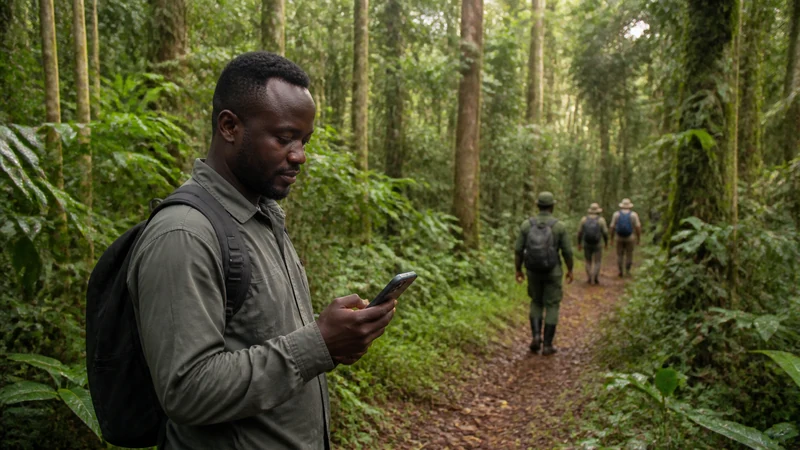

Kibale is best known for chimpanzee trekking, and the connectivity pattern follows the same shape as the activity itself: reasonable signal on the approach from Fort Portal, and effectively none once you’re inside the forest. It’s a shorter, more predictable gap than somewhere like Kidepo, but worth planning around all the same.
Top Uganda eSIMs

Uganda eSIM
Fixed
1 GB, 7 days€ 11.112 GB, 15 days€ 21.333 GB, 30 days€ 29.33Unlimited
Unlimited, 1 day€ 10.22Unlimited, 3 days€ 29.33Unlimited, 5 days€ 47.99
Coverage on the way in
Fort Portal itself has solid 4G on both MTN and Airtel, and that generally holds for a good part of the drive toward Kibale. Signal starts to weaken as you get closer to the park boundary and drops off entirely once you’re inside forested areas — this is a gradual fade rather than a hard cutoff, so don’t assume you’ve lost coverage the moment you leave town. Test as you go rather than guessing.
Inside the forest
Expect no signal during chimpanzee trekking itself. This is normal for the terrain and not something worth troubleshooting — guides navigate by local knowledge rather than GPS once you’re off the main trails, and that’s standard practice here, not a backup plan. If you’re checking the general pattern for Uganda’s forests and parks, the rural Uganda coverage guide covers this more broadly.
What to settle before you head into the forest
- Confirm your exact meeting point and start time for the trek with your lodge or guide the evening before, not the morning of.
- Save the lodge’s address and entrance details offline — a dropped map pin doesn’t always show which gate to use.
- Download the surrounding area’s map while you still have signal in Fort Portal, using the approach covered in the Google Maps in Uganda guide.
- Let your lodge know if you have any specific concerns for the day, since they’re your practical point of contact once you’re out of range.
Lodge WiFi around Kibale
Properties near the park vary — some have reasonable WiFi for evenings, others run on a slower shared connection that struggles once everyone’s back from the day’s activity. Check with your specific lodge rather than assuming either way; the general pattern is covered in the Uganda lodge internet guide, including why evenings tend to be the least reliable time to count on a connection.
If you’re combining Kibale with other stops
Many itineraries pair Kibale with a night or two near the crater lakes, or continue on toward Queen Elizabeth National Park. If you’re driving between them, treat each leg separately rather than assuming Fort Portal’s coverage extends the whole way — the Uganda road-trip connectivity guide covers planning leg by leg, which applies here even for a relatively short multi-stop itinerary.
Data and eSIM setup before you arrive
If you haven’t set up an eSIM yet, do it before arriving in Fort Portal rather than trying to sort it out locally — the Uganda eSIM installation guide and activation guide cover the steps in order. If a connection isn’t working once you’ve arrived, the troubleshooting guide is the better next step than assuming it’s a coverage issue — coverage in Fort Portal itself is generally reliable.
Frequently asked questions
Will I have signal during chimpanzee trekking?
No, or very weak signal at most, once you’re inside the forest. Treat this as expected rather than a problem to fix, and let your guide handle navigation.
Is Fort Portal a reliable place to sort out connectivity issues?
Yes — coverage there is generally solid, so it’s a better place to troubleshoot an eSIM or SIM issue than assuming it’ll resolve itself once you’re near the park.
Can I rely on my lodge’s WiFi near Kibale?
It varies by property and tends to be weaker in the evenings. Check directly with your lodge rather than assuming.
Should I download maps before leaving Fort Portal?
Yes — signal fades gradually on the approach to the park and disappears inside the forest, so it’s worth having the route saved before you need it.
Final Recommendation
Kibale’s connectivity gap is shorter and more predictable than some of Uganda’s more remote parks — solid signal in Fort Portal, a gradual fade on approach, and none during the trek itself. Settle your meeting point and any time-sensitive details the evening before, download what you need while you’re still in town, and treat the hours inside the forest as offline by default.