


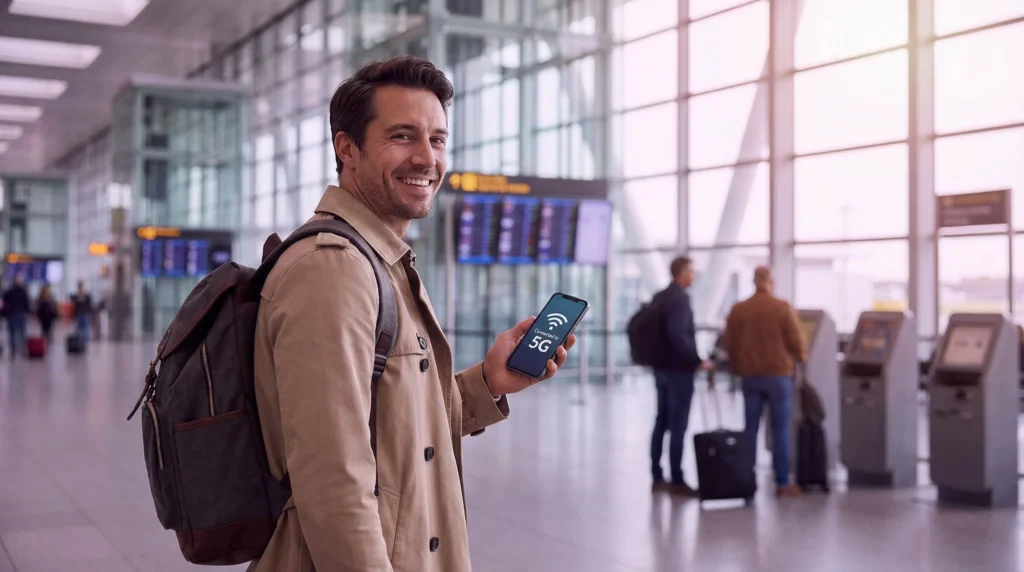
If you’re planning a trip abroad, you might be wondering:
Is eSIM actually worth it for travel?
With so many connectivity options available — roaming, local SIM cards, public Wi-Fi — choosing the best one can feel confusing.
👉 The short answer:
Yes, for most travelers, eSIM is one of the best and easiest ways to stay connected internationally.
In this guide, you’ll learn:
- When eSIM is worth it
- When it might not be
- Cost comparison vs alternatives
- Real advantages for travelers
- Who benefits most
What does “worth it” mean for travel connectivity?
When travelers evaluate connectivity options, they usually care about:
- Price
- Convenience
- Speed
- Reliability
- Safety
Let’s see how eSIM performs.
1. Cost — Is eSIM cheaper?
In most destinations, travel eSIM plans cost less than roaming and often less than airport SIM cards.
Why?
- Because travel eSIM providers negotiate local data rates and offer prepaid packages.
Compared to roaming:
- Roaming → charged per MB or day
- eSIM → fixed data plan price
Comparison guide: 👉 https://novesim.com/esim-vs-roaming/
2. Convenience — No physical SIM cards
With eSIM:
- No store visits
- No SIM swapping
- No waiting in line
- No passport registration
You install it digitally and you’re ready. Installation guide: 👉 https://novesim.com/how-to-activate-esim-manually/
3. Speed — Local network access
Travel eSIMs connect directly to local partner networks.
That usually means:
- Better speed
- Stable connection
- Lower latency
Especially compared to public Wi-Fi.
4. Reliability — Internet when you need it
Travelers rely on data for:
- navigation
- ride apps
- hotel bookings
- payments
- messaging
eSIM gives immediate connectivity after arrival.
Activation timing: 👉 https://novesim.com/does-esim-work-immediately-after-landing/
5. Safety — More secure than public Wi-Fi
- Public Wi-Fi networks can be risky.
- Mobile data connections are generally safer because they use encrypted carrier networks.
Security guide: 👉 https://novesim.com/is-esim-safe-to-use-when-traveling/
When eSIM may NOT be worth it
eSIM might not be ideal if:
- Your carrier offers free roaming
- You travel extremely rarely
- You only need Wi-Fi access
- Your phone doesn’t support eSIM
Compatibility checker: 👉 https://novesim.com/which-phones-support-esim-in-2026/
Who benefits most from eSIM?
eSIM is especially worth it for:
- Frequent travelers
- Digital nomads
- Business travelers
- Backpackers
- Short-trip travelers
- People visiting multiple countries
Multi-country guide: 👉 https://novesim.com/can-i-use-one-esim-in-multiple-countries/
Real travel scenario example
Imagine landing in a new country:
Without eSIM:
- You search for Wi-Fi
- Look for SIM shop
- Wait in line
With eSIM:
- You turn off airplane mode
- Internet works instantly
Hidden advantage most people don’t realize
One of the biggest benefits is control.
With eSIM:
- You know exactly how much data you have
- You get usage alerts
- You avoid surprise bills
Usage guide: 👉 https://novesim.com/what-happens-when-your-esim-data-runs-out/
Final verdict
For most travelers:
Yes — eSIM is absolutely worth it. It’s usually:
- Cheaper than roaming
- Easier than local SIM cards
- Safer than public Wi-Fi
- Faster than hotel internet
See available travel plans here: 👉 https://novesim.com/destinations/
Frequently asked questions
Is eSIM worth it for international travel?
Yes. It’s usually cheaper, easier, and more reliable than roaming or buying local SIM cards.
Is eSIM better than buying a SIM card abroad?
For most travelers yes, because it saves time and can be installed before travel.
Is eSIM good for short trips?
Yes. eSIM is ideal for short trips because activation is instant and plans are flexible.
Does eSIM work everywhere?
Coverage depends on the provider and destination.